On this day in military history…
The Winter War began before dawn on 30 November 1939, when Soviet aircraft crossed the Finnish border and bombed Helsinki. For Finland, it was the shock that confirmed what many had feared but hoped would never happen. The Soviet Union, led by Joseph Stalin, had decided that its security concerns outweighed Finland’s independence, and the pressure that had been building for months finally exploded into open war.
The political background of the conflict stretched back to the late 1930s, when tensions in Europe made the Soviet leadership obsessed with its western borders. Leningrad (modern-day St Petersburg) lay only about 30 kilometres from the Finnish frontier, which Stalin considered intolerably dangerous. He demanded a land swap that would push the border further west and give the USSR access to bases on Finnish islands in the Gulf of Finland. For the Finns, who had painful memories of Russian rule before 1917, these demands felt like the first steps toward losing their independence. Negotiations dragged on, but Finland refused to grant what the Soviets wanted.
The excuse used to justify the invasion arrived on 26 November 1939 at a place called Mainila. Soviet artillery shelled their own territory, blamed Finland for the attack, and declared that the Finnish government had become a threat to Soviet security. Although the event was clumsy and unconvincing even at the time, Moscow treated it as sufficient justification to tear up the non-aggression pact and launch the attack four days later. It was clear to most outsiders, and certainly to the Finns, that the incident had been staged.
When the Red Army crossed the border, it did so under the command of Marshal Kliment Voroshilov, although Stalin personally involved himself in strategy. The Soviets expected a quick victory. They had overwhelming numbers, thousands of tanks and aircraft, and every confidence that tiny Finland would collapse within weeks. What they encountered instead was one of the most stubborn and skilfully organised defences of the entire Second World War.
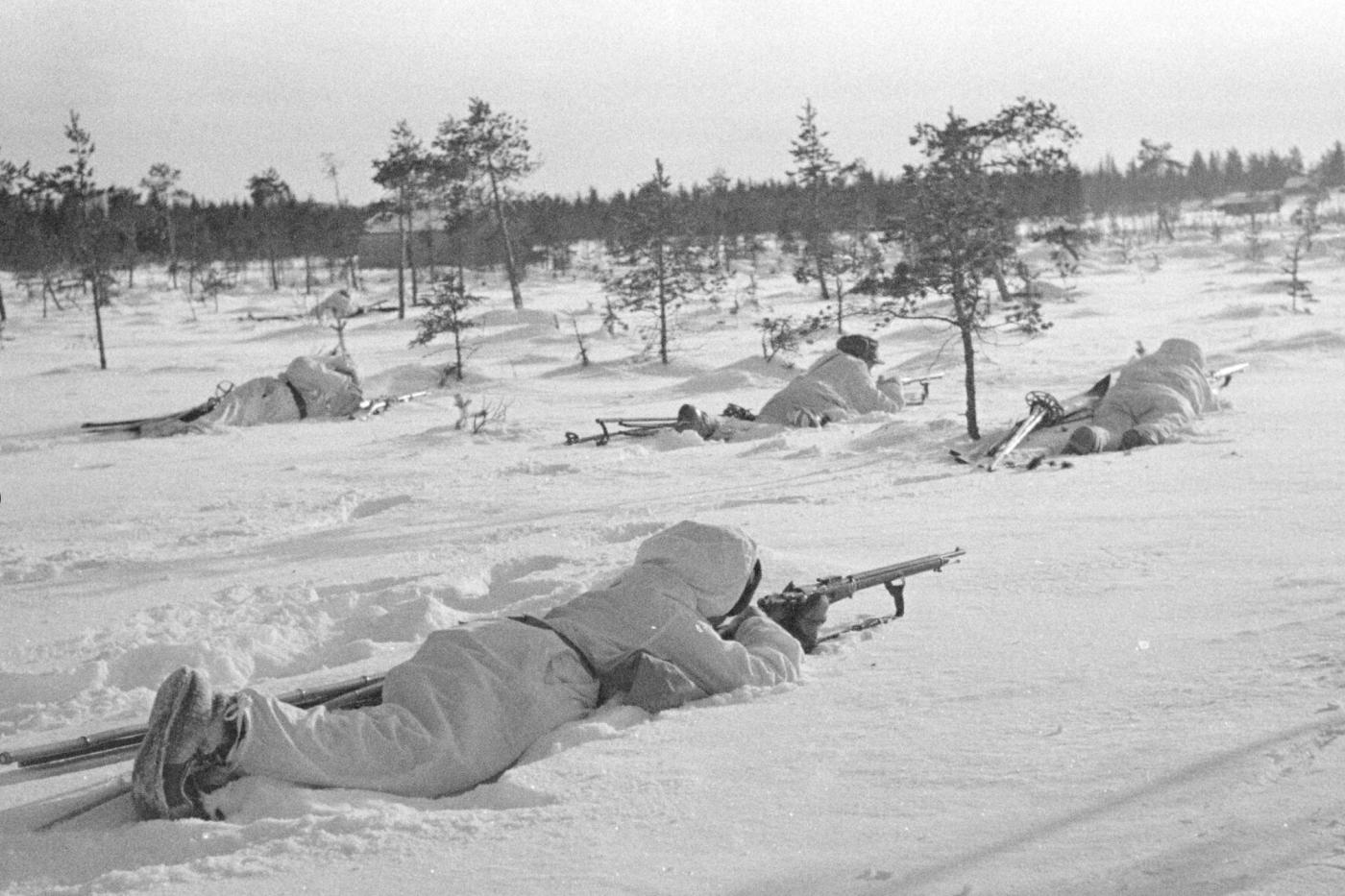
Finland’s response was built on national unity and a clear sense of what was at stake. Marshal Carl Gustaf Emil Mannerheim, the commander-in-chief of Finnish forces, had warned that war was likely, and he now mobilised nearly every able-bodied man. The Finnish Army was small, poorly equipped, and lacked tanks and heavy artillery, but it had two strengths that would prove decisive: a deep familiarity with the forested terrain and the ability to fight in extreme winter conditions.
Outnumbered soldiers on skis used speed and stealth to harass Soviet columns, ambushing them in the dense forests of Karelia. They perfected tactics known as motti, encircling Soviet units, cutting them into smaller pockets, and destroying them bit by bit. Finnish snipers, most famously Simo Häyhä, caused disproportionate casualties. The Soviets struggled terribly with the cold, with temperatures dropping as low as –40°C. Their uniforms were dark and easily spotted against the snow, their officers rigid and inflexible, and their supply lines chaotic.
Despite this, Finland was under enormous pressure. The bombing of Helsinki killed dozens, destroyed homes and public buildings, and aimed to break Finnish morale. But rather than collapse, the civilian population dug in and adapted, reinforcing air-raid shelters and organising volunteer defence units. International sympathy flowed toward Finland, especially from Britain and France, but material help arrived slowly and in small amounts.
Perhaps the most interesting detail about the Winter War is how badly the Soviets underestimated their opponent. They had assumed that Finnish society was divided and that Finnish workers would welcome Soviet troops as liberators. Instead, Finland united as never before. Another unexpected outcome was that the conflict exposed critical weaknesses in the Red Army, which had recently suffered Stalin’s purges. Poor leadership, crippled organisation, and weak morale all became painfully visible.
The war ultimately ended in March 1940 with the Moscow Peace Treaty, in which Finland ceded territory but preserved its independence. Although heavily outmatched, the Finns had made the Soviet Union pay a terrible price for every kilometre gained, and the courage and ingenuity of their defence became legendary.