On this day in historic military history…
The Battle of Rorke’s Drift was one of the most dramatic and unlikely defensive victories in British military history. It took place in South Africa during the Anglo-Zulu War and is remembered for how a very small British garrison held off a massive Zulu assault against overwhelming odds.
The battle was fought on 22 and 23 January 1879, immediately after the British army had suffered a devastating defeat at the Battle of Isandlwana earlier the same day. At Isandlwana, a Zulu army of around 20,000 warriors destroyed a British force of more than 1,300 men. News of this disaster spread rapidly, and one Zulu division was then sent to attack Rorke’s Drift, a small mission station and supply depot located near the Buffalo River, which formed the border between British-controlled Natal and the Zulu Kingdom.
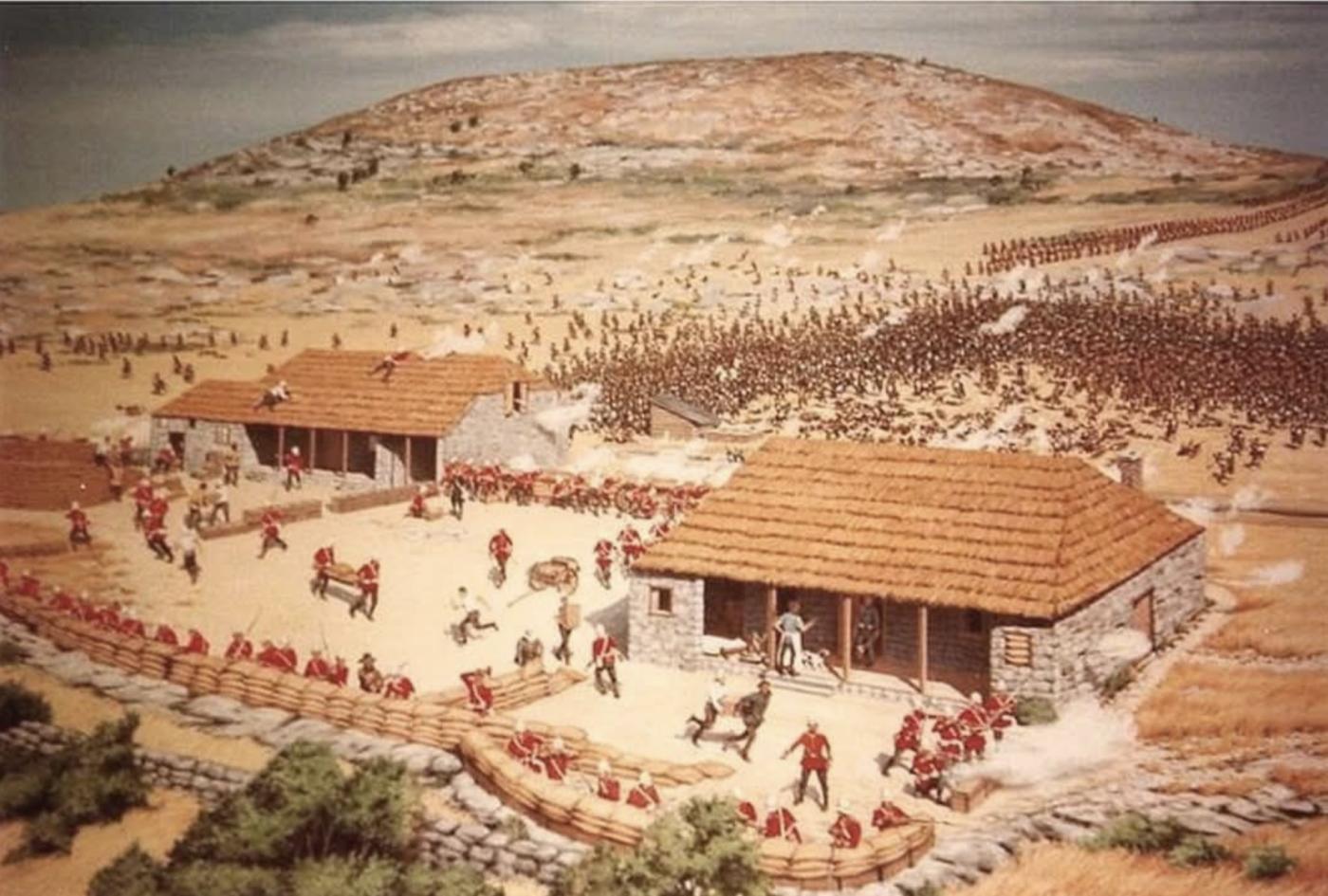
Rorke’s Drift was not a fort in the usual sense. It consisted of a small hospital, a storehouse, and a few outbuildings used as a mission station. At the time of the attack it was held by only about 150 British and colonial troops, most of them soldiers of B Company, 2nd Battalion, 24th Regiment of Foot. Many of these men were sick or wounded, and some were in the hospital beds when the fighting began. The position was commanded by Lieutenant John Chard of the Royal Engineers and Lieutenant Gonville Bromhead of the 24th Regiment.
When news arrived that a large Zulu force was approaching, Chard and Bromhead quickly realized how serious the danger was. They ordered their men to build defensive barricades using whatever materials were available. They stacked hundreds of heavy mealie bags filled with corn and used wooden biscuit boxes to form walls between the hospital and the storehouse. These makeshift defenses created a rough perimeter that could be defended from several angles.
The Zulu force that attacked Rorke’s Drift numbered around 3,000 to 4,000 warriors, mainly from the reserve of the army that had just defeated the British at Isandlwana. Although they were not the main Zulu army, they were still a large and determined fighting force. Armed mostly with spears and shields, but also with some captured rifles, they launched their attack in the late afternoon of 22 January.
The Zulus charged the British position repeatedly, attempting to break through the barricades and overwhelm the defenders. The British soldiers fired volley after volley from their Martini-Henry rifles, which were powerful and accurate, but the attackers kept coming. The hospital soon became a focal point of the fighting. Zulu warriors broke into the building, forcing the defenders to fight room by room. Several soldiers, including Privates John Williams and Henry Hook, helped rescue patients by knocking holes through the interior walls and pulling wounded men out while the Zulus were only feet away.
As the fighting continued into the night, parts of the hospital caught fire, lighting up the battlefield and making the British positions easier to see. The defenders were forced to retreat to a smaller inner line around the storehouse. Ammunition was passed forward constantly, and men fought on despite exhaustion, smoke, and the growing number of dead and wounded around them.
The Zulu attacks continued for more than ten hours. Waves of warriors charged, withdrew, and then attacked again. The British soldiers, though badly outnumbered, held their ground through disciplined rifle fire and the protection of their barricades. By the early morning of 23 January, the Zulus finally withdrew, leaving the field covered with their fallen.
When daylight came, the scale of the battle became clear. Around 17 British defenders had been killed and about 15 wounded. The Zulu losses were far higher, with estimates ranging from 350 to over 500 killed, and many more wounded. Considering the huge difference in numbers, the survival of the British garrison was seen as extraordinary.
The defense of Rorke’s Drift became famous almost immediately. It was seen in Britain as a heroic stand that helped restore national pride after the disaster at Isandlwana. Eleven Victoria Crosses, the highest award for bravery in the British Empire, were given for actions during the battle, which is more than were awarded in any other single engagement in British history. These included awards to John Chard, Gonville Bromhead, and several of the soldiers who had fought in the hospital.
Today, Rorke’s Drift is remembered as a symbol of courage, discipline, and determination in the face of overwhelming odds. The small mission station in what is now KwaZulu-Natal, South Africa, stands as a historic site, marking one of the most remarkable defensive battles ever fought by the British Army.