Daimler Dingo
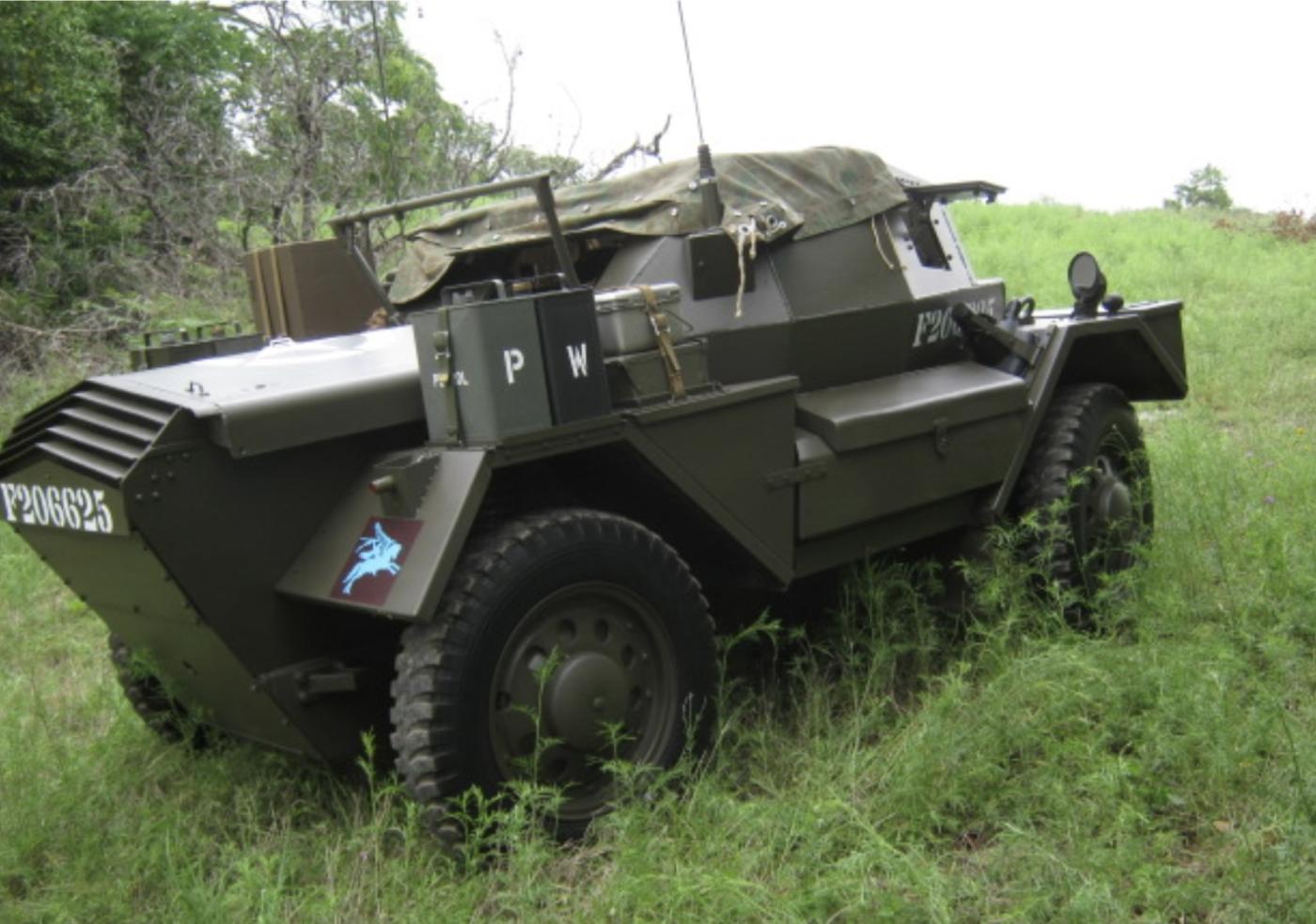
The Daimler Dingo was one of the most successful and distinctive British scout cars of the Second World War, prized for its speed, agility and quiet efficiency in gathering frontline intelligence. Its origins lay in a late-1930s War Office requirement for a compact, fast, lightly armoured reconnaissance vehicle. Birmingham Small Arms Company (BSA) produced the winning design, while Daimler undertook full-scale manufacture thanks to its proven automotive engineering expertise. Production began in 1939 and continued throughout the war, with roughly 6,600 vehicles completed.
Although small, the Dingo represented advanced engineering for its time. It used full four-wheel drive and fully independent suspension, giving it remarkable cross-country performance and a smoother ride than most Allied or Axis contemporaries. One of its defining mechanical features was the Wilson pre-selector gearbox paired with fluid flywheel transmission, allowing the driver to change gears exceptionally quickly and even execute abrupt changes of direction—ideal for a vehicle that might need to evade enemy fire in an instant. Early versions also carried a second set of controls for reverse driving, letting crews retreat at speed without turning around, though this feature was later omitted to ease production.
Its engine was central to the Dingo’s reputation for reliability and quiet operation. The vehicle was powered by the Daimler 2.5-litre (2,516 cc) straight-six petrol engine, producing around 55 horsepower. While modest in raw output, the engine’s smoothness, durability and compatibility with the car’s lightweight design gave the Dingo surprisingly lively performance. It could reach speeds of about 55 mph on roads and maintained good pace across rough ground. The engine was positioned in the rear of the vehicle, contributing to the Dingo’s low profile and aiding weight distribution for better handling. Its dependable running was noted repeatedly by crews, who often praised the engine’s ability to withstand long patrols, intense heat in North Africa, and muddy European conditions with minimal maintenance problems.
The Dingo carried a crew of two—a driver and a commander-observer—seated within a compact, low-silhouette armoured hull. Armour thickness was light, intended only to stop small-arms fire and shrapnel, as protection was considered secondary to speed and stealth. The interior was cramped but designed for efficiency, with communication equipment, observation instruments and stowage all arranged to allow quick reactions and minimal distraction.
Armament was limited, reflecting its reconnaissance role. The standard weapon was the .303 Bren light machine gun, which could be mounted on the roof or used dismounted. Early-war vehicles sometimes carried the Boys anti-tank rifle, but this was soon abandoned as armour improved across the battlefield. Crews typically carried personal weapons and occasionally smoke dischargers for concealment. The Dingo was not built for direct combat; its best defence was avoidance, and its design encouraged precisely that.
On the battlefield, the Dingo proved invaluable. Operating ahead of armoured divisions or screening their flanks, it scouted enemy movements, directed artillery fire and relayed information back to commanders with unusual clarity and speed. Its combination of quiet running, reliable engine performance and nimble handling allowed it to slip close to enemy lines without attracting undue attention. The vehicle was used in every major theatre where British and Commonwealth forces fought, from the Western Desert to the Normandy bocage and the forests of northwest Europe.
An interesting characteristic of the Dingo was the way its engineering shaped tactics. Units often deployed them in pairs, with one vehicle pushing forward to observe while the other remained slightly behind as support and relay. The Dingo’s speed also made it a popular liaison vehicle, carrying officers between units and delivering critical messages when radios were unreliable or compromised.
By the time production ended, the Daimler Dingo had earned a reputation as one of the finest scout cars of the war. Its blend of advanced mechanical design, dependable engine performance and battlefield practicality ensured it remained in service well after 1945.