Daimler Armoured Car
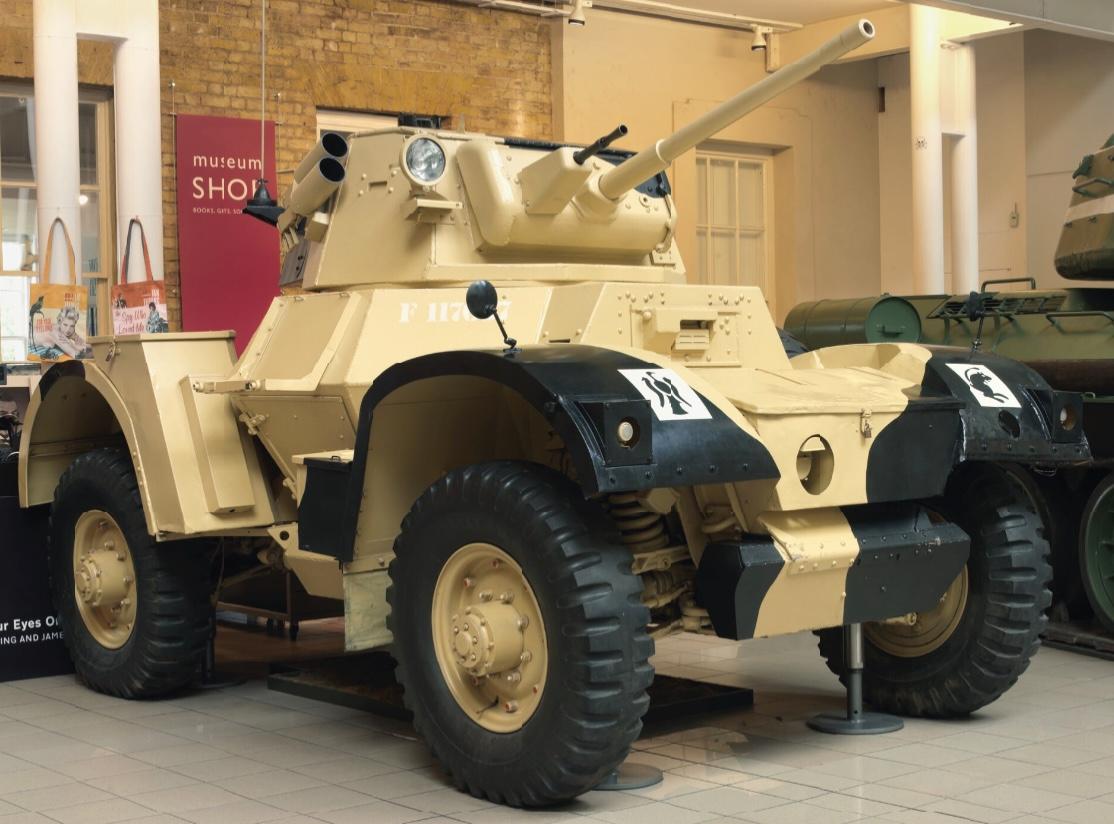
The 4x4 Daimler armoured car that fought in North Africa with the British Eighth Army was one of those rare wartime designs that seemed to get almost everything right at once: compact, mechanically sophisticated, fast enough on roads, steady enough off them, and armed well beyond what most people expect from a wheeled reconnaissance vehicle. Officially it was built for armed reconnaissance and liaison, but in the desert it often became the sharp end of finding the enemy, fixing his position, and when the opportunity appeared, punching well above its weight.
Its origins lay in the War Office’s late-1930s push for modern scouting vehicles. Birmingham Small Arms had produced a very successful scout car design to the 1938 requirement, which became the famous Dingo, and the same basic layout and engineering philosophy was then scaled up into a heavier wheeled fighting vehicle. This became the Daimler armoured car. Development began in 1939, with prototypes running by the end of that year, but the combination of heavy armour and a complex four-wheel-drive transmission created mechanical problems that had to be solved before it could be produced in quantity. These delays meant that full-scale production only really got underway in 1941, just in time for the North African campaign to reach its most intense phase.
Although it carries the Daimler name, the vehicle was very much a product of the Birmingham Small Arms group. BSA designed the vehicle, and Daimler, which was part of the same industrial group, was responsible for manufacturing it. The result was a vehicle that combined BSA’s experience in military vehicle design with Daimler’s long background in building refined and robust automotive engineering.
In total about 2,700 Daimler armoured cars were produced during the war, making it one of the most widely used British armoured cars of the conflict. Production ran from 1941 through to the end of the war, and the vehicles served not only in North Africa but also in Italy, North-West Europe and the Far East, which says a great deal about how well the design stood up to different climates and types of terrain.
Mechanically, the Daimler was extremely advanced for its time. It was a true four-wheel-drive vehicle with independent coil-spring suspension on all four wheels, which gave it excellent stability and traction over rough ground. The engine was mounted at the rear, helping balance the weight of the turret at the front, and power was fed through a fluid flywheel and a Wilson pre-selector gearbox. This allowed the driver to change gear very quickly and smoothly, which was invaluable when manoeuvring under fire. One of its most unusual and useful features was that it had five forward gears and five reverse gears, meaning it could retreat almost as fast as it could advance, a priceless quality in reconnaissance fighting.
The powerplant was the Daimler 27 petrol engine, a 4.1-litre six-cylinder unit producing around 95 horsepower. While that may not sound impressive today, it gave the armoured car a top speed of roughly 50 miles per hour on roads and good acceleration off-road. Its range of about 200 miles allowed it to operate far ahead of friendly forces, which was exactly what desert reconnaissance units needed in North Africa.
The crew consisted of three men: a driver in the hull, and a commander and gunner in the turret. This was a well-balanced arrangement that allowed the commander to concentrate on observing the battlefield and giving orders while the gunner focused on fighting the vehicle. Visibility was excellent for an armoured vehicle of the period, with multiple vision ports and a rotating turret that allowed all-round observation.
In terms of protection, the Daimler was heavily armoured for a wheeled vehicle. The front armour was up to about 16 millimetres thick, with slightly thinner plates on the sides and rear. This was enough to stop rifle and machine-gun fire and to provide some protection against shell splinters and light anti-tank weapons, which were the most common threats faced by armoured cars in the desert. The low silhouette of the vehicle also made it harder to hit, especially at long ranges in the shimmering heat of the North African plains.
What really made the Daimler formidable was its armament. Unlike most armoured cars of the period, which were armed only with machine guns or small automatic cannons, the Daimler carried the same 2-pounder 40 mm gun used by early British tanks. This meant it could destroy enemy armoured cars and even threaten light and medium tanks if it could get a good angle. Alongside the main gun was a coaxial 7.92 mm Besa machine gun, ideal for dealing with infantry and soft-skinned vehicles. Many vehicles were also fitted with a smoke discharger, allowing the crew to lay down a smoke screen to escape or to cover a manoeuvre.
In the North African campaign, these qualities made the Daimler a perfect tool for the Eighth Army. The wide open desert placed a premium on speed, long range and the ability to fight unexpected encounters. Daimler armoured cars ranged far ahead of the main forces, locating Axis units, screening British movements and launching sudden attacks on supply columns, artillery positions and isolated enemy units. Their ability to engage German and Italian armoured cars on equal terms, and sometimes even drive off tanks, gave British reconnaissance units a level of confidence they had not always enjoyed earlier in the war.
Equally important was reliability. Desert warfare was brutal on machinery, but the Daimler’s well-engineered drivetrain and suspension meant it coped better than many vehicles with sand, heat and long distances. Crews grew to trust it, which in war is just as important as any technical specification.
By the time the Eighth Army was pushing westwards after El Alamein, the Daimler armoured car had become one of the quiet workhorses of British victory in North Africa. It did not have the fame of the Sherman or the Crusader, but it was the eyes, ears and often the sharp claws of the army, helping to find the enemy, strike him where he was weak, and keep the pressure on until the Axis forces were finally driven out of Africa.