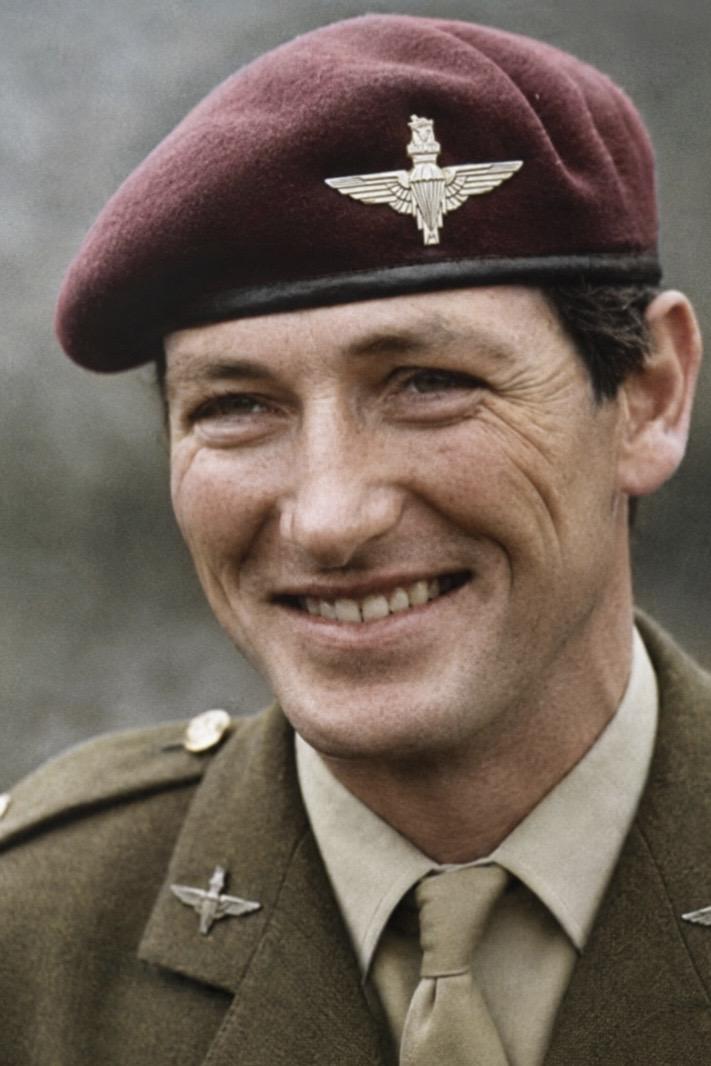
Colonel H Jones
Lieutenant Colonel Herbert “H” Jones VC OBE was one of the best-known British Army officers of the Falklands War. He is remembered above all as the commanding officer of 2 PARA who was killed during the Battle of Goose Green in May 1982, but his life was far more than the final few minutes for which he became famous. He was a determined, energetic and forceful man who rose steadily through the Army, shaped by boarding school, Sandhurst, infantry soldiering, service in Northern Ireland and finally command in war.
Herbert Jones was born on 14 May 1940 in Putney, south-west London. His father, also called Herbert Jones, was an American artist, and his mother, Olwen, was Welsh and had trained as a nurse. He was the eldest of three sons. His background was not that of a purely military family, but he grew up with discipline, ambition and a strong sense that he had to make something of himself. From an early age he seems to have been drawn towards the Army and towards the kind of life where courage, leadership and physical toughness mattered.
He was educated first at St Peter’s Preparatory School at Seaford in Sussex and then at Eton College. Later he attended DLD College in London. He was not remembered as a brilliant academic, and his school career was not one of effortless success, but that is part of what makes his story interesting. Jones was not simply carried forward by privilege or natural ease. He had to work for his place. He wanted a career in the Army, and he pushed himself towards it with the same determination that later became one of his strongest traits as an officer.
In 1958 he entered the Royal Military Academy Sandhurst. Sandhurst suited the kind of life he wanted. It was competitive, demanding and built around leadership. Jones passed through the academy and was commissioned on 23 July 1960 as a second lieutenant in the Devonshire and Dorset Regiment. This was his first regimental home and remained important to him throughout his life. The Devon and Dorsets were a traditional county infantry regiment, and it was there that Jones learned the basic trade of soldiering and command.
His early Army career took him to a wide range of postings. He served in places such as Cyprus, Plymouth, British Guiana, Aldershot, Northern Ireland and Germany. These were not all glamorous appointments, but they gave him a broad education as an infantry officer. He experienced overseas service, garrison soldiering, conventional Cold War duties and internal security work. He learned how soldiers lived, how battalions worked and how officers were judged by the men under their command.
Jones rose steadily. He was promoted lieutenant in January 1962, captain in July 1966 and major in December 1972. His progress was not a sudden leap but a steady climb. He became known as a driven and demanding officer, someone with great energy and strong opinions. He expected high standards from those around him, but he also expected them from himself. That was one of the keys to his leadership. He could be hard, sometimes impatient, but he did not ask others to face difficulties that he would avoid himself.
One of the most important periods in his career came during the Troubles in Northern Ireland. By the early 1970s and into the later part of that decade, Northern Ireland was one of the most difficult places in which a British officer could serve. It demanded discipline, patience and courage, but also judgement. Mistakes could have political as well as military consequences. Jones served as brigade major at Headquarters 3rd Infantry Brigade, a significant appointment for an officer of his rank. In that role he had to help organise and coordinate operations in a tense and dangerous environment.
During this time he became connected with one of the most haunting stories of the Troubles, the disappearance and murder of Captain Robert Nairac. Nairac, an officer in the Grenadier Guards, was working in intelligence when he was abducted by the Provisional IRA in 1977. Jones knew him personally, and Nairac had visited the Jones family home. After Nairac disappeared, Jones was involved in the efforts to find him. Nairac was later confirmed to have been killed. The episode showed the grim reality of the conflict in which Jones was serving and the kind of pressure faced by officers in Northern Ireland.
Jones’s service in Northern Ireland was formally recognised. In 1977 he was appointed MBE for his work there. This was an important mark of professional respect. It showed that he was not only a brave front-line officer but also someone trusted with serious responsibility in a difficult theatre.
In his private life, Jones married Sara in 1964. They had two sons, David and Rupert. Those who only know Jones through the story of Goose Green may imagine him simply as a hard soldier, but his family life shows another side of him. He was a husband and father who wrote affectionate letters when he was away and who had deep loyalties. Sara later spoke of the warmth and love that existed behind the public image of the tough officer. This private side is important because it reminds us that the man later remembered as “H Jones VC” was also a family man, not just a figure from a battle map.
Jones was promoted lieutenant colonel in June 1979, and later that year he transferred to the Parachute Regiment. This was a major step in his career. The Parachute Regiment had, and still has, a reputation for toughness, aggression and high standards. It was a regiment with a strong identity and a fierce pride in its airborne role. Jones’s personality fitted much of that culture. He was energetic, forceful and physically courageous. He believed in leading from the front, and that belief was central to the way he commanded.
By 1982 he was commanding officer of 2nd Battalion, The Parachute Regiment, usually known as 2 PARA. When Argentina invaded the Falkland Islands in April 1982, Jones was on leave in France. His battalion had been preparing for other duties, but the invasion changed everything. Britain assembled a task force to sail south and retake the islands, and 2 PARA became part of the land force attached to 3 Commando Brigade Royal Marines.
The journey south was long and uncertain. The men knew they were going to war, but much remained unclear. The Falklands were thousands of miles from Britain, in harsh weather, with difficult terrain and an enemy already dug in. For Jones, this was the ultimate test of command. He had spent more than twenty years rising through the Army, and now he was leading a battalion into battle.
The first major land battle of the campaign for 2 PARA came at Goose Green. The settlement of Goose Green and the nearby Darwin area were held by Argentine forces. The battle began on 28 May 1982. 2 PARA was ordered to attack across open and difficult ground against enemy positions that were well defended with trenches, machine guns, rifles, mortars and artillery support. It was a hard fight from the start.
As the battle developed, the battalion became held up near Darwin Hill by strong Argentine positions. The enemy was dug in, and the British advance slowed under heavy fire. Jones moved forward to see the situation for himself. This was typical of him. He did not want to command from far behind if his men were in trouble. He wanted to understand the problem with his own eyes and push the battle forward.
What happened next became the defining moment of his life. Seeing that the attack had stalled, Jones decided that direct action was needed. He took a weapon and charged towards the enemy trenches, calling on others to follow. He exposed himself to heavy fire as he tried to get around or break into the Argentine position. He was hit, fell, rose again and continued forward before being hit again. He died close to the enemy position he had been attacking.
His death was a terrible blow to 2 PARA, but the battle continued. Command passed to Major Chris Keeble, who handled the later stages of the action with skill. The Argentine forces at Goose Green eventually surrendered. The victory was important for British morale and for the progress of the campaign, but it came at a heavy cost. Jones was one of those killed, and his death became one of the most famous of the war.
For his actions at Goose Green, H Jones was posthumously awarded the Victoria Cross, the highest award for gallantry. The award recognised his personal courage and the example he gave under fire. To many people, his actions represented the finest traditions of British military leadership: a commanding officer willing to risk everything in front of his men.
At the same time, his final charge has been debated ever since. Some have argued that it was an act of extraordinary bravery that helped restore momentum at a critical moment. Others have questioned whether a battalion commander should have taken such a personal risk, because his job was to command the whole battle rather than lead a small assault himself. This debate does not lessen his courage. Instead, it shows the complexity of command in war. Jones believed in leading from the front, and at Goose Green he followed that belief to the very end.
He was first buried near where he fell and was later laid to rest at Blue Beach Military Cemetery at San Carlos in the Falkland Islands. He was only 42 years old. His wife Sara and their two sons were left to carry the personal loss behind the public honour. Both sons later began their military careers in the Devon and Dorset Regiment, their father’s original regiment. His son Rupert Jones went on to become a senior Army officer.
H Jones is remembered in several places connected with the Falklands and the Army. His name is on memorials, and roads in the Falklands have been named in his honour. His medals, including the Victoria Cross, are held by the National Army Museum. But perhaps his strongest memorial is the story still told about him in connection with 2 PARA and Goose Green.
His life was not simply the story of one brave death. It was the story of a boy from Putney who worked his way into the Army, passed through Sandhurst, learned his trade in the infantry, served in difficult places and rose by determination and force of character. He was ambitious, demanding and sometimes controversial, but he was also loyal, brave and deeply committed to the men he commanded.
Lieutenant Colonel H Jones VC OBE remains a powerful figure because his life brings together so many themes of soldiering: ambition, duty, family, courage, leadership and sacrifice. At Goose Green he made a decision that has been admired, questioned and studied ever since. Whatever view is taken of that decision, there is no doubt about the courage behind it. He led from the front because that was the kind of officer he believed he had to be, and it was the kind of officer he remained until the last moments of his life.