The Last Battle on Dutch Soil: The Georgian Uprising on Texel
By the spring of 1945, German rule in the Netherlands was close to collapse. Allied armies were advancing through the eastern provinces. Much of the south had already been liberated, while the west still suffered occupation, hunger and shortages. Texel also remained under German control. The Dutch island formed part of the Atlantic Wall and contained bunkers, coastal guns and military positions. Yet the occupation had been relatively quiet compared with the fighting elsewhere. That changed during the final weeks of the war, when Texel became the scene of a battle that continued for weeks after Germany had surrendered in the Netherlands.
The men who began the fighting had come from far beyond the Wadden Sea. They were Georgians from the Soviet Union, many of whom had served in the Red Army. Germany captured millions of Soviet soldiers after invading the Soviet Union in June 1941. Prisoners were held in camps where food, shelter and medical care were often almost absent. Disease and starvation killed enormous numbers. German commanders later recruited prisoners into auxiliary formations and Eastern battalions. Some men joined because it offered their best chance of survival. Others opposed Stalin or hoped that a German victory might lead to an independent Georgia.
Joining the Wehrmacht created new dangers. Remaining in a prisoner-of-war camp could mean death, but service in German uniform could be treated as treason by the Soviet authorities. The Georgians therefore faced suspicion from both sides. German officers did not fully trust them, while they feared punishment if they returned home after the war.
One of these formations was the 822nd Georgian Infantry Battalion, named after Queen Tamar, a medieval ruler of Georgia. It contained about 800 Georgians and 400 Germans. German officers held the senior positions, while Georgian officers commanded many of their own men. The best-known of these officers was Lieutenant Shalva Loladze, the senior Georgian officer in the battalion. The battalion spent a long period at Zandvoort, where it guarded part of the Dutch coast. Eastern battalions were often sent west because German commanders feared that they might desert if used against the Red Army. Their presence also released German troops for service elsewhere.
On 6 February 1945, the battalion arrived on Texel. The island already contained a large German garrison and several fortified positions. The Georgians came into contact with local people and members of the resistance. Through these contacts they learned that Germany was losing the war. If they waited for the German collapse, they might be captured as collaborators. If they fought against the Germans before the end, they could present themselves as men who had turned their weapons against Hitler.
Loladze and several other officers prepared an uprising. The plan depended on surprise and support from the Dutch resistance. The Georgians also hoped that Allied forces would soon reach the island. On 5 April, the German commander ordered part of the battalion to prepare for movement to the eastern Netherlands. The unit was expected to fight the advancing Allies. The order removed any possibility of waiting. The uprising was given the code name Day of Birth and was scheduled to begin during the following night.
At one o’clock in the morning on 6 April, the Georgians struck. Many Germans were asleep in shared quarters. The attackers used knives and bayonets to avoid raising the alarm. Hundreds of German soldiers were killed during the first hours, although estimates about the exact numbers differ. Other German troops were attacked at barracks, roadblocks and command posts. The rebels took control of much of Texel and captured weapons, vehicles and supplies. For several hours, the operation appeared to have succeeded. Major Klaus Breitner, the German battalion commander, escaped and reached troops who had not been surprised.
The Georgians had failed to capture every important position. German coastal batteries remained in action, while radio contact with Den Helder was restored. Reinforcements crossed the Marsdiep from the mainland. German guns opened fire on Den Burg and other suspected rebel positions. The fighting quickly changed from a mutiny into a battle. The Georgians controlled large parts of the island but lacked heavy weapons and a secure supply line.
German troops pushed north through Texel. Fighting took place around Den Burg, De Waal, De Cocksdorp and the farms of the Eierland polder. Georgians used farmhouses, ditches and bunkers as defensive positions. German forces replied with artillery, tanks, flamethrowers and rocket launchers. Civilians were caught between the two sides. Some Texelaars helped the rebels with food, information, shelter or medical care. This was dangerous because German troops executed inhabitants who were suspected of supporting the uprising.
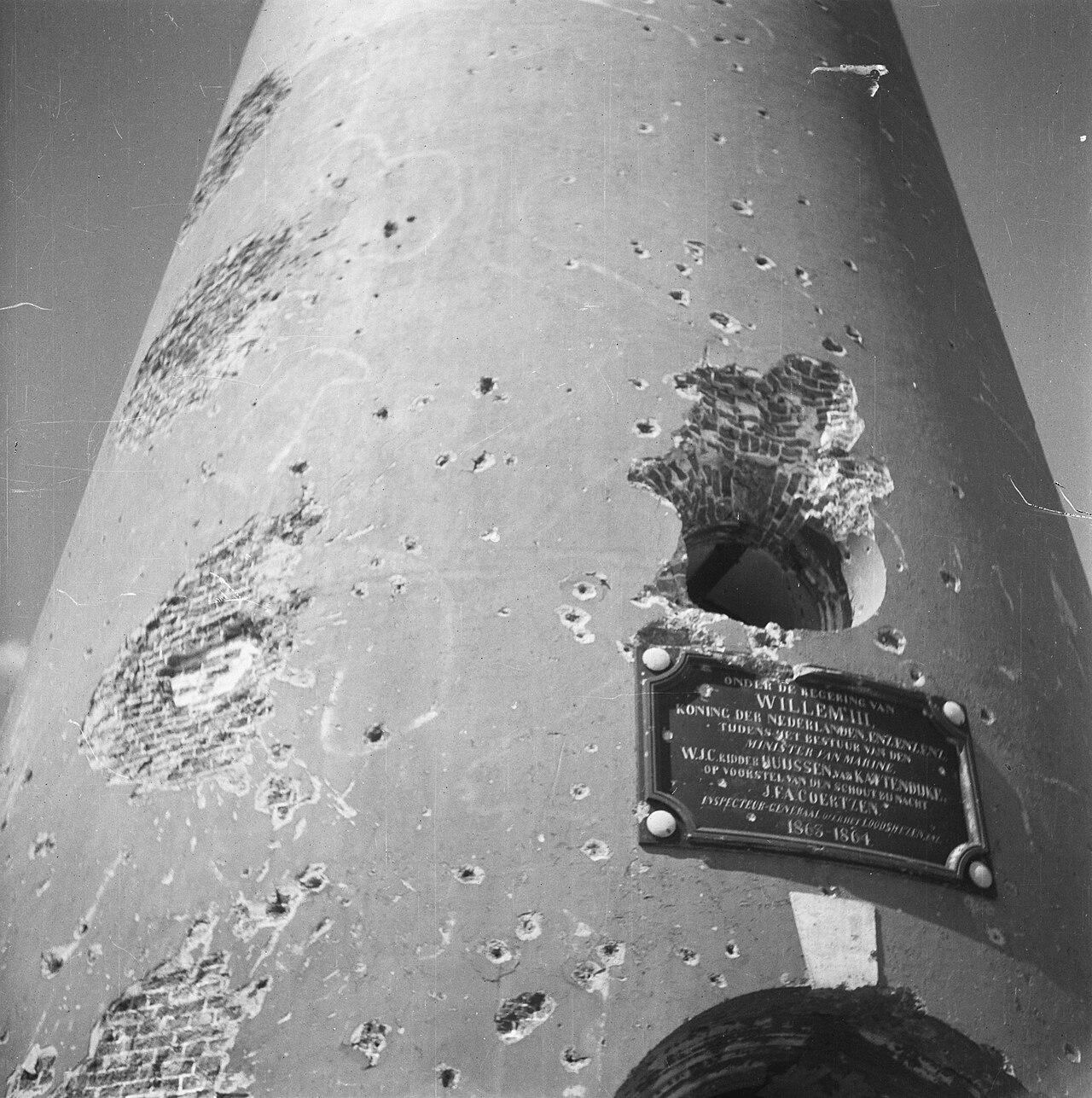
The lighthouse at the northern tip became the best-known battlefield. The Georgians had captured the fortified area during the first night. As the Germans regained the rest of the island, it became one of the last organised positions. German artillery bombarded the complex on 20 and 21 April. Infantry then attacked along the narrow road through the dunes, supported by tanks and flamethrowers. The defenders had little food, ammunition or medical care. Some were killed, while others took their own lives rather than surrender. The lighthouse returned to German control on 21 April.
Its fall did not end the uprising. More than 300 Georgians escaped capture and divided into small groups. They hid in barns, haystacks, dunes and areas surrounded by minefields. German soldiers searched farms and destroyed buildings where rebels might be concealed. Captured Georgians were often stripped of their uniforms and executed, sometimes after being forced to dig their own graves. The remaining fighters carried out ambushes and small attacks.
Germany surrendered in the Netherlands on 5 May 1945. Germany’s unconditional surrender came into effect on 8 May. On Texel, the German garrison remained armed and the Georgians remained in hiding. There was no Allied force on the island to impose the surrender. Shooting continued and more men died. Canadian troops finally arrived on 20 May. They separated the two sides, disarmed the Germans and ended the fighting. The German soldiers left the island the following day.
The exact number of dead remains disputed. The Netherlands Institute of Military History records at least 422 German soldiers, 532 Georgians and more than 100 inhabitants of Texel. Other widely used estimates are higher, placing the losses at about 800 Germans, 565 Georgians and 120 islanders. Dozens of farms were destroyed and parts of Den Burg lay in ruins. The church at De Waal was destroyed and the lighthouse was badly damaged. The island had passed through most of the occupation without a major battle, only to suffer its worst violence when the war was almost over.
More than 220 Georgians survived and were returned to the Soviet Union in June 1945. Their uprising allowed them to argue that they had fought against Germany, although their treatment after repatriation was not uniform. Many of the dead were buried at the Georgian cemetery on the Hoge Berg near Oudeschild. Loladze received a separate grave at the head of the cemetery. The site became the centre of annual commemorations, but memories on Texel remained divided. Some inhabitants regarded the Georgians as resistance fighters. Others remembered that the uprising had brought destruction to an island already close to liberation.
Courtesy of Tom Dankers, Historian, Arnhems Oorlogsmuseum 40-45