Worlds biggest Hospital Ships
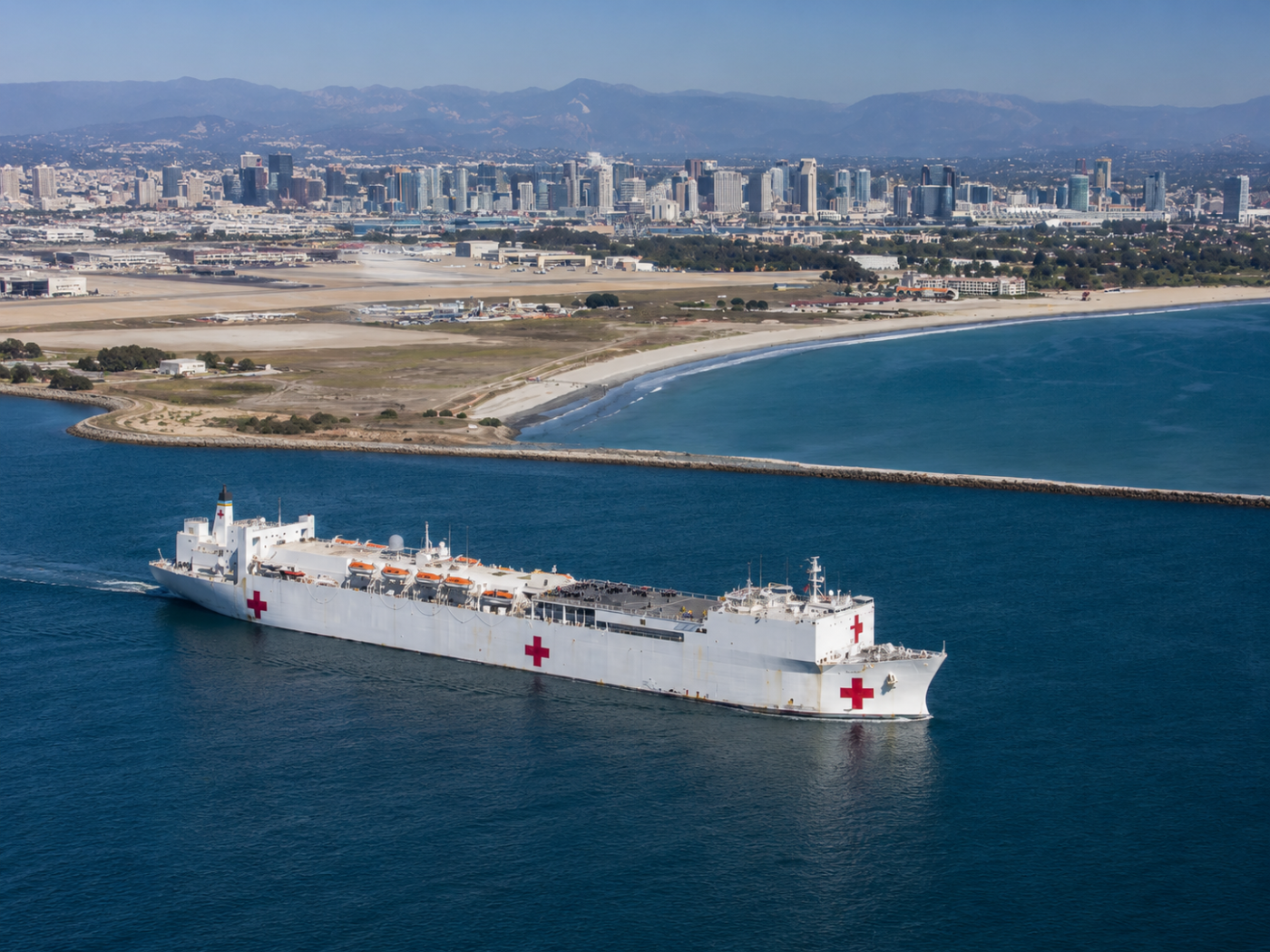
The United States Navy’s two Mercy-class hospital ships, USNS Mercy and USNS Comfort, are among the largest and most capable floating hospitals ever operated by a military force. Easily recognised by their brilliant white hulls, enormous red crosses and distinctive superstructures, the two ships were created to bring modern hospital facilities close to areas of conflict, humanitarian disaster and medical emergency. Although operated in support of the United States armed forces, their role has extended far beyond treating battlefield casualties, with both vessels becoming internationally recognised symbols of humanitarian assistance and disaster relief.
USNS Mercy, designated T-AH-19, and her sister ship USNS Comfort, T-AH-20, began life not as purpose-built hospital ships but as large San Clemente-class oil tankers. Mercy was originally constructed as the tanker SS Worth, while Comfort entered service as SS Rose City. Their huge hulls offered the internal volume needed for conversion into exceptionally large medical facilities, and during the 1980s both vessels underwent extensive reconstruction before entering service with the United States Navy's Military Sealift Command.
The decision to convert the tankers reflected Cold War concerns about the need to treat potentially large numbers of casualties during major military operations. Instead of constructing entirely new hospital ships, the existing tankers could be transformed into mobile medical centres capable of supporting forces operating thousands of miles from established military hospitals.
Each vessel is approximately 894 feet, or 272 metres, long and has a displacement exceeding 65,000 tons when fully loaded. Their size places them among the largest vessels associated with the United States Navy, although technically they are operated by Military Sealift Command rather than being conventional commissioned warships. Their enormous size is necessary because each ship effectively contains the facilities of a major modern hospital.
At full medical capability, Mercy and Comfort are designed to provide up to 1,000 hospital beds. Their medical facilities include intensive-care beds, recovery wards, general patient wards and facilities for dealing with serious trauma casualties. They also have 12 fully equipped operating rooms, allowing several complex surgical procedures to take place simultaneously. Diagnostic equipment includes radiological services, laboratory facilities and *blocked text* scanning equipment, while onboard pharmacies allow essential medicines to be stored and distributed without relying entirely on facilities ashore.
The ships also possess their own oxygen-producing plants, an important capability when dealing with large numbers of seriously injured patients who may require respiratory support. Dental services, optometry facilities and specialist medical departments allow the vessels to undertake a much wider range of treatments than would normally be expected aboard a ship.
Patients can arrive aboard the vessels in several ways. A large helicopter landing deck allows military helicopters to bring casualties directly to the ship, a particularly important feature during combat operations or natural disasters when roads and airports may have been damaged. Side ports built into the hull also allow patients to be transferred from smaller vessels while the hospital ship is operating offshore.
Despite their naval appearance, Mercy and Comfort have an unusual crew structure. The ships themselves are operated primarily by civilian mariners working for Military Sealift Command, while medical personnel are largely drawn from the United States Navy when the vessels are activated for major deployments. During periods of reduced operating status, relatively small crews maintain the ships and their systems until a larger medical and support complement is required.
The primary military mission of both vessels is to provide emergency medical and surgical treatment for American forces during major operations. In wartime they can act as floating casualty receiving centres positioned offshore, allowing wounded personnel to be stabilised, operated on and cared for before being evacuated to larger hospitals farther from the fighting.
Their status as hospital ships also gives them special protection under international humanitarian law. The large red crosses painted on their hulls and superstructures clearly identify their medical role. Hospital ships must not be used for offensive military purposes and are protected from deliberate attack when properly operating in their humanitarian capacity.
USNS Mercy has traditionally been based on the west coast of the United States, with San Diego serving as her home port, while USNS Comfort has generally operated from the east coast, including Norfolk, Virginia. This arrangement allows the United States to maintain large hospital ship capability on both sides of the country and provides access to operations across the Pacific, Atlantic and Caribbean regions.
Both vessels have participated in significant military operations. During the 1990–1991 Gulf War, Mercy deployed to the Persian Gulf region to support coalition forces during Operations Desert Shield and Desert Storm. The possibility of heavy casualties during the campaign made large-scale medical support essential, although the rapid progress of the ground offensive meant that the number of casualties was considerably lower than many planners had feared.
Comfort has also supported American military operations, including deployments connected with conflicts in the Middle East. The ships provide commanders with an extraordinary capability: essentially a major trauma hospital that can be moved across oceans and positioned relatively close to a theatre of operations without requiring permanent hospital infrastructure ashore.
However, some of the most famous missions carried out by the Mercy-class vessels have had nothing to do with conventional warfare.
Following the terrorist attacks of 11 September 2001, USNS Comfort was sent to New York City. Initially prepared to receive casualties, the ship increasingly became a source of medical and psychological support for emergency personnel and others involved in the enormous rescue and recovery operation.
In 2005 Comfort deployed following Hurricane Katrina, one of the most destructive natural disasters in modern American history. The ship provided medical assistance after hospitals and infrastructure along the Gulf Coast had been overwhelmed or damaged.
Perhaps one of Comfort's most significant humanitarian missions followed the devastating Haiti earthquake of January 2010. The destruction around the capital, Port-au-Prince, left the country's already limited medical infrastructure struggling to cope with enormous numbers of injured people. Comfort became an important surgical and medical centre, treating casualties who might otherwise have had little access to advanced medical care.
Mercy has developed a particularly strong association with humanitarian missions across the Pacific and Southeast Asia. Through deployments such as Pacific Partnership, medical personnel aboard the ship have worked alongside doctors, nurses and humanitarian organisations from numerous countries. These missions often involve treating patients ashore as well as aboard the ship, while also providing medical training and strengthening cooperation between nations.
The ships' medical role can therefore involve everything from major battlefield surgery to relatively routine dental procedures, eye examinations and preventive medicine. Humanitarian deployments also give American medical personnel experience working in different environments while strengthening relationships with local healthcare systems.
In 2020 the two ships once again attracted worldwide attention during the COVID-19 pandemic. Mercy was deployed to Los Angeles while Comfort sailed into New York Harbor. Their intended mission was initially to treat non-COVID patients, helping to relieve pressure on civilian hospitals dealing with the rapidly growing number of coronavirus cases.
The deployment demonstrated both the enormous potential and some limitations of traditional hospital ships. The vessels had large numbers of beds and sophisticated medical facilities, but they had originally been designed primarily to treat battlefield trauma rather than highly contagious respiratory diseases. Their internal layouts, involving enclosed compartments and shared spaces, presented challenges when dealing with infectious patients.
Despite their impressive capabilities, Mercy and Comfort also face practical difficulties created by their age and size. Because both vessels began life as commercial tankers constructed during the 1970s, maintaining increasingly old machinery requires considerable resources. Their great size also prevents them from entering many smaller ports, meaning patients sometimes have to be transported to the ships by helicopter or boat.
The ships are also relatively slow compared with modern naval warships. Although this is not normally a major problem during humanitarian operations, it means they cannot immediately appear at a disaster zone. They must first be activated, supplied and staffed before travelling to the area where they are required.
Nevertheless, few nations possess anything approaching the medical capacity represented by the two Mercy-class vessels. A single ship carrying hundreds of medical professionals, 1,000 hospital beds and multiple operating theatres can transform the availability of medical care in a region where hospitals have been destroyed or overwhelmed.
Their enormous red crosses have become a familiar sight during some of the world's most serious humanitarian emergencies. When Mercy or Comfort appears offshore, the ship represents far more than a naval vessel. Behind the white hull is a complex network of operating theatres, intensive-care facilities, laboratories, pharmacies and hospital wards capable of providing sophisticated medical treatment thousands of miles from the United States.
More than forty years after the decision was taken to convert two commercial oil tankers into floating hospitals, USNS Mercy and USNS Comfort remain extraordinary examples of how maritime power can be used not only to wage war but also to save lives. From treating military casualties to helping earthquake survivors, hurricane victims and communities with limited access to healthcare, the two giant hospital ships have become some of the most distinctive vessels operated by the United States military and among the most powerful mobile medical facilities ever put to sea.