
C-5 Super Galaxy Transport Plane
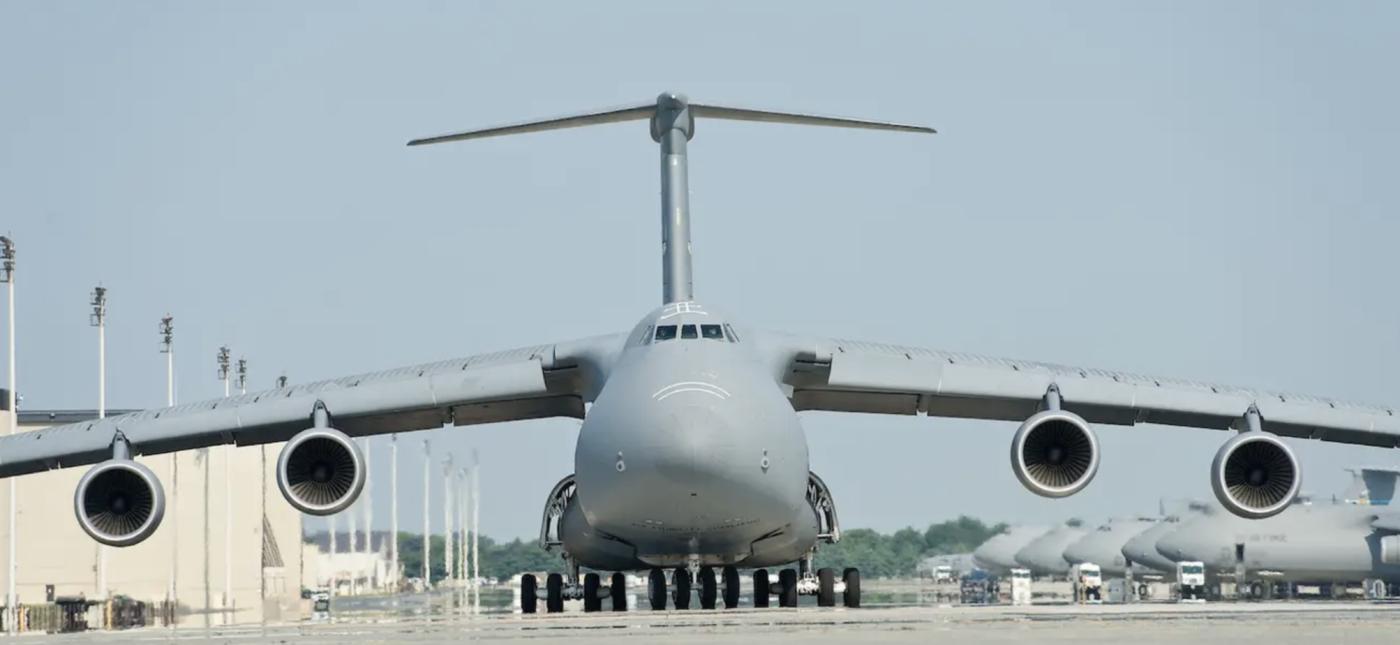
The U.S. Air Force’s C-5M Super Galaxy is one of the most important long-range military transport aircraft ever built, designed specifically to move extremely large, heavy, and complex cargo across intercontinental distances. It exists to solve a problem few other aircraft can: how to rapidly move oversized military equipment, vehicles, and supplies anywhere in the world without relying on sea transport. In that role, it has become a cornerstone of American and allied military logistics.
The aircraft traces its origins to the early 1960s, when the U.S. military recognized that its existing transport fleet could not efficiently move modern armored vehicles, large engineering equipment, or entire support packages in a single lift. Lockheed won the design competition, and the aircraft that emerged—the C-5 Galaxy—was revolutionary for its time. It first flew in 1968 and introduced a scale of airlift capability that had never existed before. Today’s C-5M Super Galaxy is the modernized version of that original design, upgraded to meet current operational demands.
Manufactured by Lockheed (now Lockheed Martin), the C-5M is one of the largest aircraft ever to enter regular service. It measures over 247 feet in length with a wingspan of nearly 223 feet and stands more than six stories tall. Its immense size allows it to carry cargo that no other Western military aircraft can transport in a single load. The cargo bay alone is long enough to hold multiple armored vehicles, helicopters, or large engineering systems, and it is tall and wide enough to accommodate unusually shaped or heavy equipment without disassembly.
The aircraft’s cargo handling system is a key part of its effectiveness. Both the nose and tail of the aircraft can open, allowing vehicles to drive straight through the fuselage. The landing gear can also “kneel,” lowering the aircraft to make loading easier. This design dramatically reduces ground time and allows simultaneous loading from both ends, which is especially valuable during high-tempo operations or emergency deployments.
In terms of capacity, the C-5M can carry over 280,000 pounds of cargo. That includes items such as main battle tanks, multiple armored vehicles, large helicopters, missile components, or large quantities of humanitarian aid. With a full load, the aircraft can fly more than 2,000 nautical miles, and with lighter loads it can cover intercontinental distances. When aerial refueling is used, its range is effectively global, limited more by crew endurance than fuel.
The C-5M typically operates with a crew of seven: pilot, co-pilot, two flight engineers, and three loadmasters. This relatively large crew reflects the complexity of operating and managing such a massive aircraft. Loadmasters play a critical role, calculating weight distribution, securing cargo, and ensuring the aircraft remains within safe limits throughout the flight. Their expertise directly affects safety and mission success.
A major factor in the aircraft’s modern performance is its engine upgrade. The original engines were replaced with General Electric F138 turbofans, derived from the commercial CF6 family. These engines produce significantly more thrust, improve fuel efficiency, and dramatically increase reliability. Compared to earlier versions, the upgraded aircraft climbs faster, takes off in shorter distances, carries heavier loads, and requires less maintenance. The engine upgrade transformed the aircraft from a capable but maintenance-intensive platform into a far more dependable strategic airlifter.
The C-5M’s importance lies not just in what it can carry, but in what it enables. In military operations, it allows rapid reinforcement of forces across continents, delivery of critical equipment before sealift assets arrive, and sustainment of operations in remote or austere locations. In humanitarian missions, it can deliver massive quantities of relief supplies, heavy equipment, and emergency infrastructure to disaster zones where ports or roads are damaged or nonexistent.
Despite its age as a design, the C-5M remains a cornerstone of U.S. global mobility. With just over fifty aircraft in service, each one represents an enormous concentration of strategic lift capability. Few other aircraft in the world can match its combination of payload, range, and flexibility. The Super Galaxy is not simply a transport aircraft; it is a logistical enabler that allows military power, humanitarian aid, and global response to move at the speed required by modern crises.