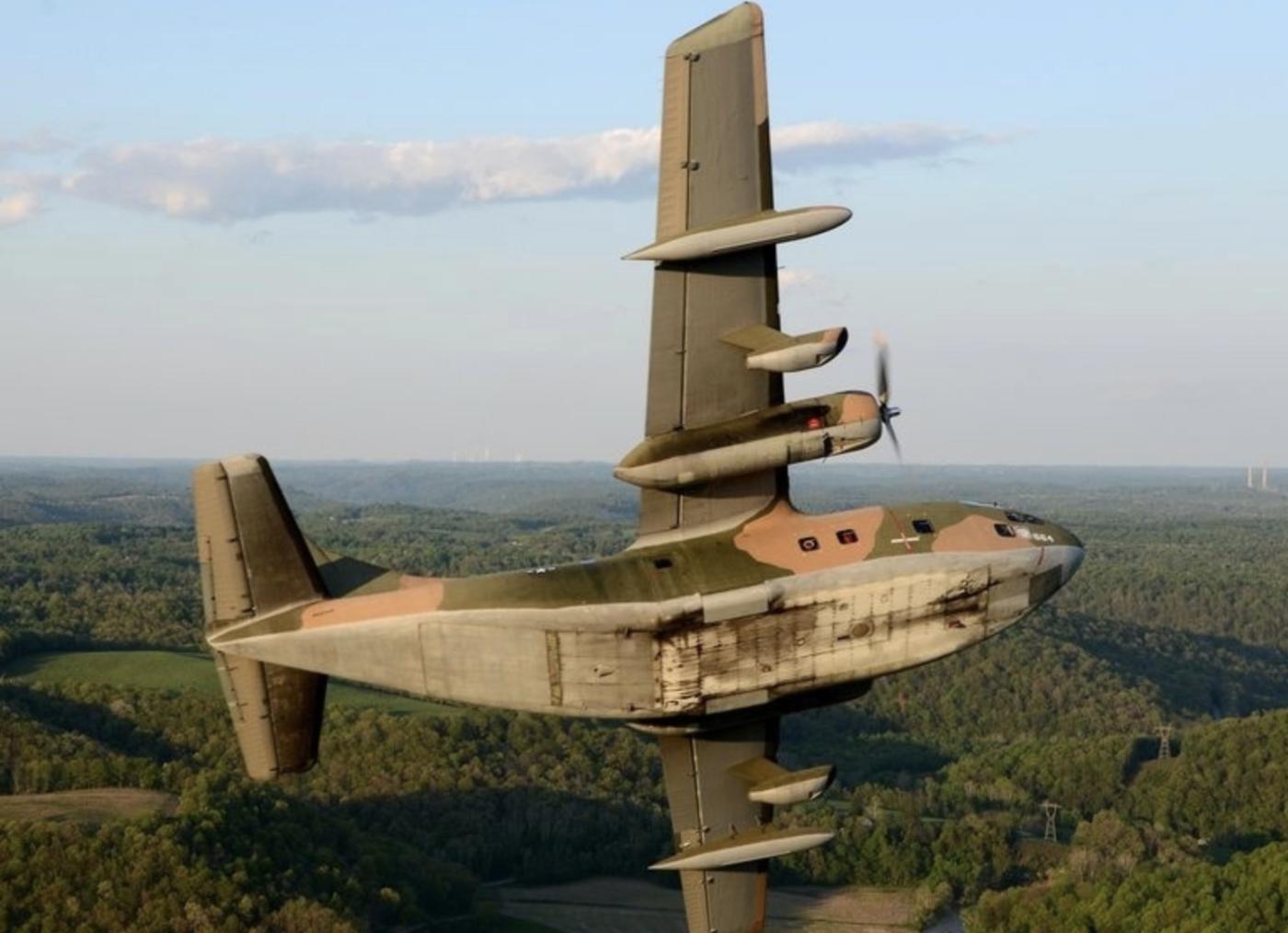
C-123 Provider Plane
What many people refer to as the “Fairchild UP-123” is actually a misunderstanding of U.S. military designation practice. The aircraft in question is the C-123 Provider family, particularly the UC-123 variants that served in Vietnam. The letter “U” simply indicated a utility role, not a completely separate aircraft. In Southeast Asia the Provider became one of the most distinctive and hard-working transport aircraft of the war, remembered both for its rugged cargo missions and for its controversial use in herbicide spraying.
The Provider was originally conceived not as a powered aircraft at all, but as an assault glider. Chase Aircraft designed the XCG-20 glider for the U.S. Air Force in the late 1940s, intended to land troops and equipment directly onto rough forward areas. The Air Force soon realized that a powered version would be far more practical, and Chase developed the XC-123 and later C-123 prototypes by adding engines to the basic airframe. Chase, however, was a small manufacturer and could not easily meet large production demands. After a complicated industrial and political process that briefly involved Henry J. Kaiser, full production was eventually taken over by Fairchild. As a result, the aircraft is often described as “designed by Chase and built by Fairchild,” which explains why both names are associated with it.
A total of 307 C-123s of all variants were built. These included standard transport versions, upgraded models, and specialized utility aircraft. The versions most closely tied to Vietnam were the C-123B transport and the improved C-123K, along with the UC-123B and UC-123K utility variants used for spraying missions. The K-model upgrade was particularly important in Southeast Asia. It added small turbojet engines under the wings to supplement the main piston engines, improving takeoff performance from short or damaged runways in hot and humid conditions.
The C-123 was well suited to Vietnam because it was designed to operate from rough, unimproved airstrips. Its high wing gave good ground clearance, its landing gear was strong, and its rear loading ramp allowed vehicles, pallets, and stretchers to be rolled directly on and off. In daily service it carried troops, ammunition, fuel, food, and building supplies into forward areas that were inaccessible to larger transports. It also evacuated wounded personnel, often flying back out under fire, and performed parachute airdrops when landing was impossible. In many remote locations the Provider was the only reliable air link.
The most famous and controversial role of the aircraft in Vietnam was its use in Operation Ranch Hand. Spray-equipped UC-123s were fitted with internal tanks and spray booms and flew at very low altitude to disperse herbicides over jungle and farmland. The goal was to strip foliage that concealed enemy forces and to destroy crops believed to support them. These missions were dangerous, slow, and highly exposed to ground fire. Over time, Agent Orange became the best-known of the chemicals used, and the UC-123 became permanently associated with this aspect of the war. Long after the conflict ended, the health effects linked to these missions ensured that the aircraft’s Vietnam legacy would remain controversial.
In terms of performance, the C-123K represents the most typical Vietnam-era configuration. It carried a crew of four. Its maximum speed was about 228 miles per hour, with a normal cruise speed closer to 170 miles per hour. With a useful payload, its range was just over 1,000 miles, while ferry range with additional fuel tanks could exceed 3,000 miles. The aircraft’s service ceiling was a little over 21,000 feet, although in Vietnam it usually operated far lower, especially on supply drops and spray missions. Physically, the aircraft stood a little over 34 feet high on the ground.
There were also many lesser-known and unusual uses of the Provider during the war. Some aircraft were adapted for night operations, illumination duties, or special missions involving intelligence and covert supply. The type was also used for VIP transport within the theater, despite its utilitarian appearance. One Provider even carried President John F. Kennedy’s limousine on a domestic trip, demonstrating how adaptable the rear-ramp cargo design could be.
Perhaps the most telling stories about the C-123 in Vietnam concern its durability. Aircraft routinely returned riddled with bullet holes, patched and sent back into service again and again. One surviving example became famous for the sheer number of repairs visible on its skin, a physical record of years spent flying low, slow, and exposed. This toughness, combined with simple systems and excellent short-field performance, made the Provider indispensable even as more modern aircraft entered service.
By the end of the Vietnam War the C-123 was already becoming obsolete, but during the conflict it filled a niche that few other aircraft could. Whether hauling supplies into jungle strips or flying hazardous spray missions at treetop height, the Provider proved that a blunt, practical design could have an outsized impact on how a war was fought.