British Victorian Tunic
The red tunic worn by British soldiers at Rorke’s Drift in January 1879 was one of the most recognisable military garments in the world, already steeped in nearly two centuries of tradition by the time it was seen on the Zulu War battlefield. Its bright scarlet colour, its cut, and even its buttons were the product of long historical evolution, and by the Victorian period it had become a symbol not just of British military power but of imperial identity itself.
The red coat had first been adopted by the English army in the mid-seventeenth century during the English Civil War. When Parliament raised the New Model Army in 1645, it chose red cloth for its soldiers’ coats because it was cheap, widely available, and took dye well. At a time when uniforms were not yet standardised across Europe, this decision quickly gave English troops a visual identity. Over time, red became firmly associated with English and later British soldiers, so much so that by the eighteenth century foreign armies often referred to them simply as “the redcoats.” By the Victorian era, the red tunic was no longer just practical clothing but a powerful symbol of continuity, discipline, and national pride.
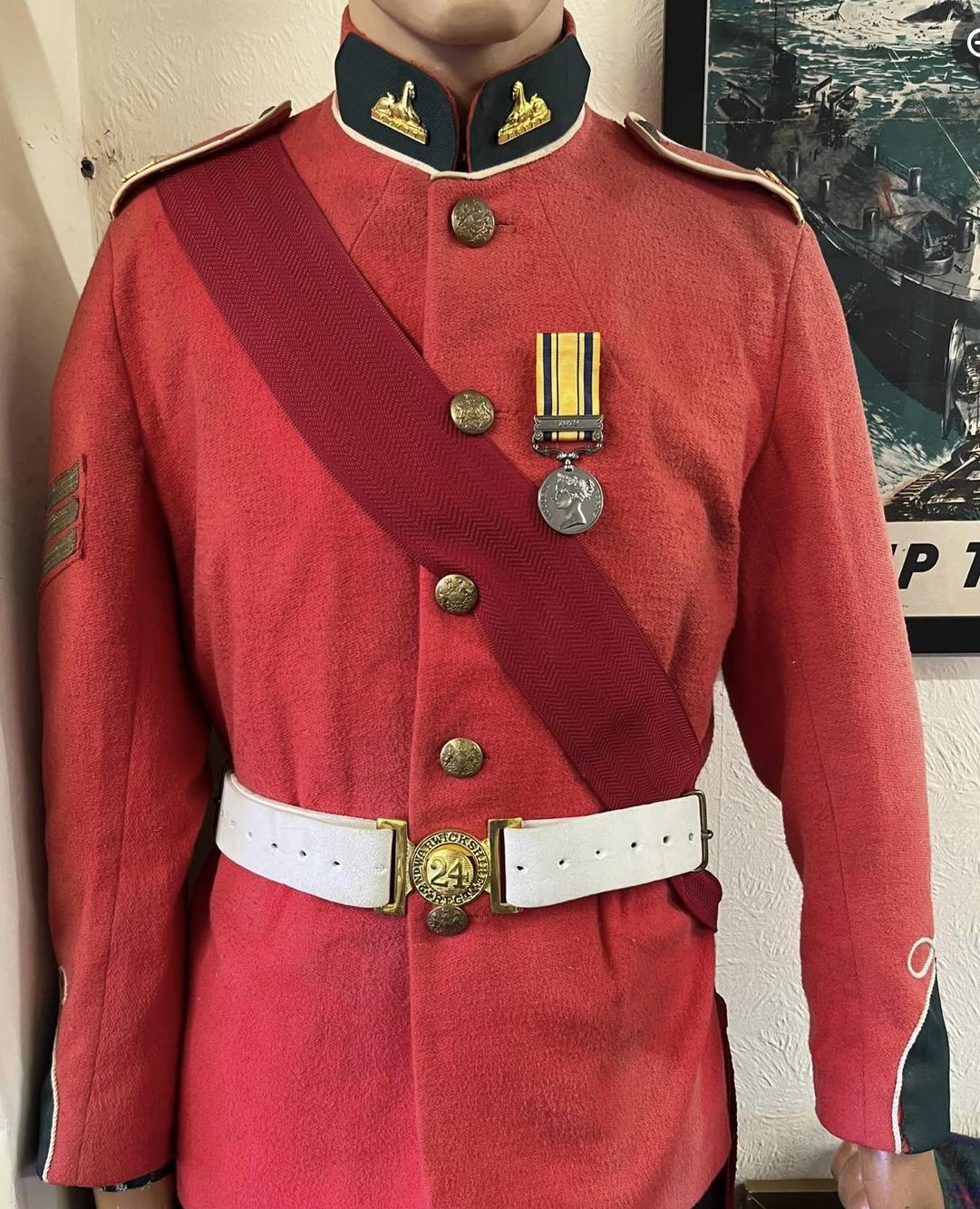
By 1879, when British forces fought the Zulu at Rorke’s Drift in Natal, the red tunic was technically known as the 1874 pattern tunic, a development of earlier Victorian designs. It was made of wool, dyed scarlet, with a standing collar and cuffs in regimental facing colours. The tunic fastened down the front with brass buttons stamped with regimental insignia, and shoulder straps and piping also carried distinctive colours. The tunic was worn with dark blue trousers, often with a red stripe, and a white or blackened leather equipment set. In theory this created a striking and imposing appearance; in practice, in the heat of southern Africa, the heavy wool and bright dye made life uncomfortable and sometimes dangerous.
The red colour had several origins and justifications. Originally, red dye was relatively cheap because it could be made from madder root and later cochineal, and it produced a strong, colourfast result on wool. But there were also psychological and practical reasons. Red was thought to be bold and intimidating, projecting confidence and martial spirit. It also had the supposed advantage of disguising bloodstains, making wounds less visible and helping to preserve morale in battle. In the age of black powder muskets and close-order fighting, the bright colour also helped officers see their men through the smoke and chaos of combat. These ideas were already somewhat outdated by the late nineteenth century, but tradition and conservatism in the British Army ensured the red tunic survived far longer than pure battlefield logic might have allowed.
At Rorke’s Drift, the red tunic was worn mainly by soldiers of the 24th Regiment of Foot, later known as the South Wales Borderers. The defenders included both the 1st and 2nd Battalions of the regiment, along with a small number of Royal Engineers, Army Service Corps personnel, and Natal Native Contingent troops. The regular infantrymen of the 24th wore the red tunic as their standard field dress. In reality, campaign conditions meant that many had modified their uniforms; some wore open collars, some had replaced their tunics with lighter shirts, and others wore their red coats faded and stained from weeks in the field. Nonetheless, the iconic image of red-coated soldiers firing from behind biscuit boxes and mealie bags is rooted in the fact that the tunic was still the official fighting uniform of the regiment.
The red tunic had been in continuous service, in one form or another, for well over 200 years by the time of the Zulu War. However, it was already nearing the end of its role as a practical combat garment. Experiences in colonial wars, especially against enemies who were skilled at concealment and marksmanship, demonstrated that bright colours made soldiers easy targets. During the Indian Mutiny, the Crimean War, and later campaigns in Africa, troops increasingly adopted khaki or drab clothing for field service. In southern Africa, many soldiers wore improvised or issued khaki covers over their white helmets and sometimes over parts of their uniform, but the red tunic itself remained standard.
One interesting aspect of the red tunic at Rorke’s Drift is how it affected the battle visually and psychologically. Zulu warriors later reported being able to see the British defenders clearly because of their bright clothing, even in the fading light, which made aiming and mass attacks easier. At the same time, the sight of disciplined lines of red-coated soldiers, firing in volleys and standing firm behind makeshift barricades, left a deep impression on both sides. For the British public back home, illustrations and paintings of Rorke’s Drift almost always emphasised the scarlet uniforms, reinforcing the idea of heroic “thin red lines” holding back overwhelming odds.
The red tunic was worn by most regular British infantry units of the time, though each regiment had its own facing colours and details. The 24th Regiment had dark green facings, which appeared on their collars and cuffs, while other regiments used colours such as blue, yellow, or white. Cavalry and artillery wore different styles and colours, but red was still dominant across much of the army. Even some colonial and auxiliary units adopted red coats in imitation of the regulars, though they were often of different cut and quality.
After the Zulu War, the red tunic gradually disappeared from the battlefield. By the 1880s and 1890s, khaki became the standard service dress for overseas campaigns, and eventually for home service as well. The red tunic survived only as full dress or ceremonial wear, a role it still holds today in some regiments and guards units. What was once a practical uniform for war became a symbol of heritage and tradition.