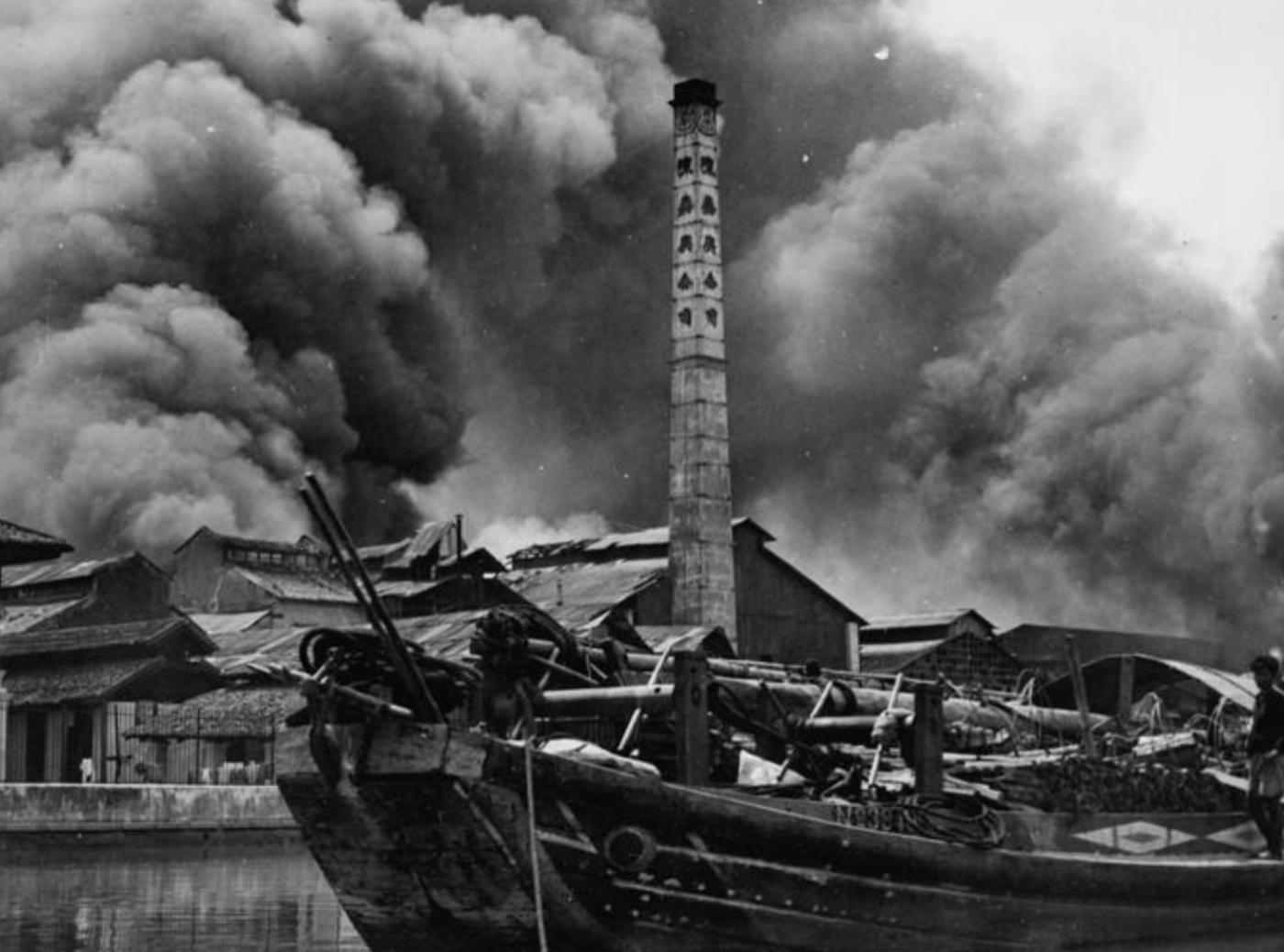
Bombing of Singapore
In the early hours of 8 December 1941, just hours after Japanese forces struck Pearl Harbor, another attack unfolded thousands of miles away in Southeast Asia. While much of the world associates that day with events in Hawaii, Singapore in fact experienced its first air raid a full seventy minutes before the bombs fell on Pearl Harbor, because the International Date Line placed Malaya ahead by almost a full day. This made Singapore one of the very first Allied territories to come under Japanese attack in the Pacific War.
The Japanese aircraft that approached Singapore in the darkness came from airfields in southern Indochina, primarily bases around Saigon and Tourane in what is now Vietnam. These locations had been secured earlier after Japan pressured Vichy France into allowing Japanese military presence. From these airfields, long-range bombers could reach British Malaya and Singapore with considerable ease. The main attacking force consisted of Mitsubishi G3M and G4M bombers of the 1st and 2nd Air Groups, aircraft known for their long range and ability to strike without refuelling. The crews were well-trained in night navigation and had rehearsed their routes across the South China Sea.
The raid began shortly after 4:00 a.m. local time. Singapore was largely asleep, its residents unaware that war had already started across the region. Air-raid sirens did not provide timely warning; in fact, there are accounts that an alert had been issued and then cancelled moments before the attack, partly due to uncertainty in British command and a reluctance to provoke panic. As the Japanese formations descended through the dark sky, anti-aircraft crews struggled to identify them, and the first bombs hit their targets with unsettling accuracy.
The initial targets were the key airfields at Tengah, Seletar, and Sembawang. Neutralising these bases was essential to Japanese plans for their rapid invasion of Malaya. Bombs also fell on the harbour facilities around Keppel, fuel depots, and industrial areas linked to British logistics. Fires broke out across the waterfront, especially where wooden structures ignited quickly and spread flames into nearby neighbourhoods. The damage disrupted both civilian life and military operations within minutes of the raid’s beginning.
Civilians bore much of the early suffering. Approximately 60 people were killed in the attack, with many more injured. Homes near the docks and along the city’s older streets were damaged or destroyed. The first British fatality of the Pacific War occurred during this raid, an anti-aircraft gunner killed while attempting to engage the enemy. RAF aircraft were scarcely able to respond; many planes had already been moved to northern Malaya or were not ready for night action. Only a few British fighters attempted to intercept the raiders, with little effect.
The bombing shattered confidence in Singapore’s supposed status as an “impregnable fortress.” Before the war, British planners had emphasised the colony’s naval facilities, big-gun defences, and perceived strategic position, but the weakness of its air defences and the failure to anticipate a night raid quickly became apparent. For many residents, the sight of bombed streets and burning warehouses marked the abrupt end of any lingering belief that Singapore was beyond the reach of war.
Strategically, the attack served as the opening act of Japan’s sweeping Southeast Asian offensive. It demonstrated the speed, coordination, and ambition of Japanese military planning. As bombs fell on Singapore, Japanese troops were already landing in northern Malaya and pushing south, while simultaneous attacks were underway in Hong Kong, the Philippines, and across the Pacific. The raid on Singapore ensured that British air power would be weakened at the very moment it was most needed to resist the ground invasion.
The events of that morning also helped set the stage for later disasters, including the sinking of HMS Prince of Wales and HMS Repulse on 10 December. These capital ships had been sent to deter Japanese expansion, but without adequate air cover—made even more limited after the initial raids—they were left vulnerable to Japanese land-based torpedo bombers. The loss of these ships underscored how decisively Japan had seized control of the air and sea in the region.
Communication delays added to the confusion in Singapore. News from Pearl Harbor had not yet reached British commanders when the bombs fell, leaving officials unsure whether this was an isolated strike or part of a wider conflict. For several hours, the only reliable information came from eyewitness accounts and scattered military reports, creating an atmosphere of uncertainty and disbelief. Only later in the day did the scale of Japan’s coordinated offensive become clear.
As the consequences of the attack rippled across the Empire, formal political responses followed swiftly. Britain declared war on Japan on 8 December 1941, making the conflict official within hours of the raids in both Singapore and Malaya. New Zealand, closely aligned with Britain and already fully committed to the Allied cause, issued its own declaration the same day, underscoring the global unity against Japanese expansion. These declarations signalled that the war in Asia was not merely a regional contest but part of a much larger struggle that now spanned nearly half the globe.