Bloody Sunday
On Sunday 30 January 1972, an event that would become known worldwide as Bloody Sunday unfolded in Derry/Londonderry, Northern Ireland, turning a civil-rights protest into a lethal confrontation that reshaped the course of the Troubles. What began as a march against internment without trial ended with British soldiers shooting unarmed civilians, killing 13 people on the day and fatally wounding a fourteenth who later died. The killings triggered outrage far beyond Northern Ireland, hardened political divisions, and created decades of pressure for accountability that culminated in a court case heard more than half a century later.
The march took place against the background of internment, introduced in August 1971, which allowed the detention of suspects without trial and was used almost exclusively against the nationalist and Catholic community. Civil-rights groups organised the protest to challenge internment and wider discrimination in housing, voting, and employment. Although marches were frequently restricted or banned at the time, organisers planned a large demonstration from the Creggan area into the city, intending to highlight opposition to British security policy. Derry was already a centre of unrest, with areas such as the Bogside effectively no-go zones for the authorities, and relations between residents and the British Army deeply strained.
Security responsibility in the city rested with the British Army, supported by the Royal Ulster Constabulary. Among the units deployed was 1st Battalion, The Parachute Regiment, known as 1 PARA, a unit with a reputation for aggressive crowd-control tactics. Within the battalion, Support Company was assigned a prominent role in an arrest operation planned in response to anticipated rioting. The battalion’s commanding officer, Lieutenant Colonel Derek Wilford, led 1 PARA’s actions on the ground, operating within the wider command structure of 8 Infantry Brigade and the overall British Army command in Northern Ireland.
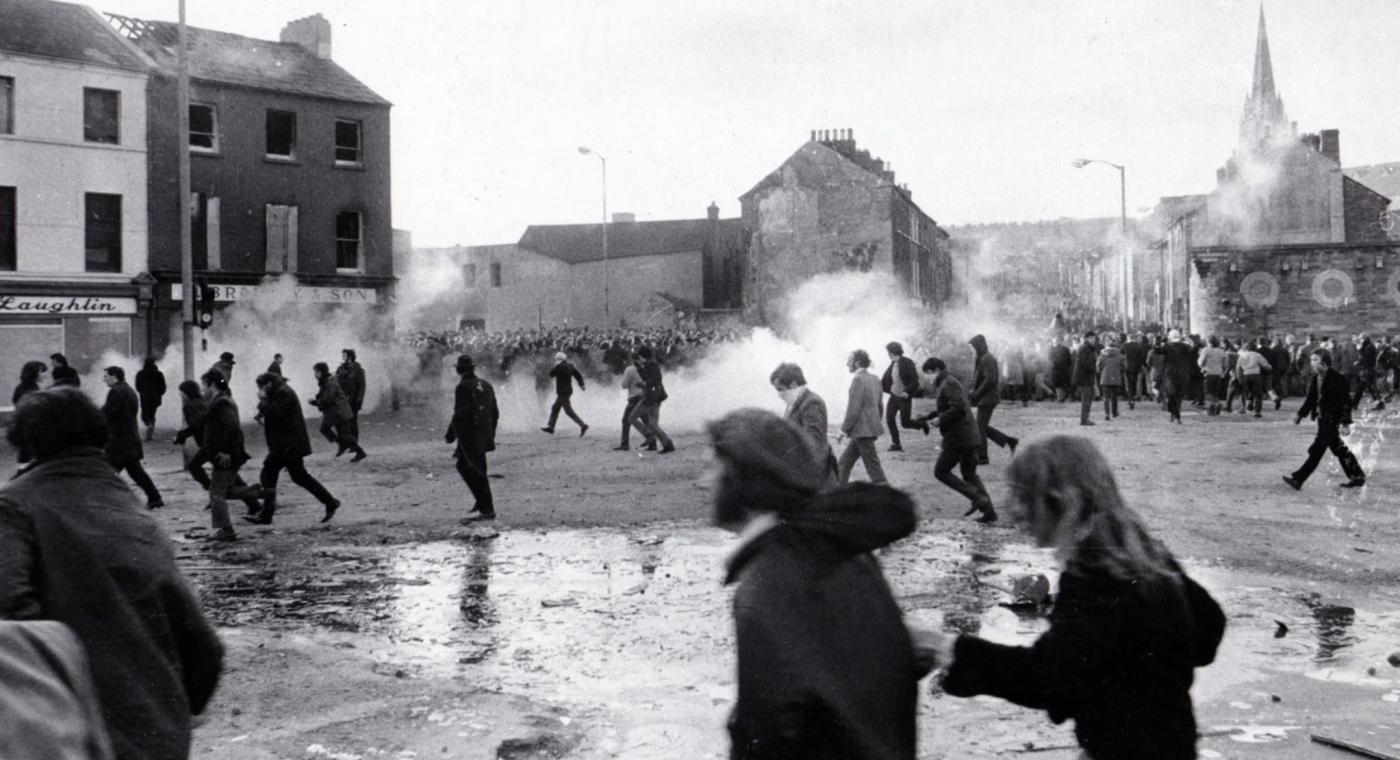
As the march developed, army barriers blocked access to the city centre and diverted crowds toward the Bogside. Stone-throwing and confrontations occurred at several points, a pattern familiar from earlier demonstrations. While organisers attempted to direct the main body of marchers toward a rally, the situation fragmented, with people scattered across Rossville Street, the area around the Rossville Flats, and adjoining open spaces and courtyards. It was during this period, in the mid to late afternoon, that paratroopers moved in and opened fire with live ammunition.
The shootings took place at several locations that would become permanently associated with Bloody Sunday: the forecourt of the Rossville Flats, the open ground along Rossville Street, the courtyard of Glenfada Park, and nearby alleyways and walls. Victims were shot while running away, while attempting to help the wounded, or while lying on the ground. None were found to be armed or posing a lethal threat. The suddenness and intensity of the gunfire shocked the city and left families and witnesses traumatised, with images and accounts rapidly spreading across the world.
In the immediate aftermath, the British government ordered an inquiry chaired by the Lord Chief Justice of England, Lord Widgery. The Widgery Tribunal, reporting later in 1972, largely accepted soldiers’ claims that they had been fired upon or confronted by nail bombers. Its findings were widely rejected by the nationalist community and by the victims’ families, who viewed the report as an attempt to justify the killings and protect the Army. Rather than closing the issue, the inquiry entrenched bitterness and convinced many that justice through official channels was impossible.
Bloody Sunday quickly became a turning point in the Troubles. Support for the Provisional IRA increased sharply in nationalist areas, hostility toward the British Army deepened, and political polarisation intensified. International opinion also shifted, damaging Britain’s reputation and placing Northern Ireland firmly in the global spotlight as an example of a violent internal conflict within a Western democracy.
For decades, families of the dead campaigned to overturn the Widgery findings. Their persistence led to the establishment of a second inquiry in 1998, chaired by Lord Saville. The Saville Inquiry was one of the longest and most expensive in British legal history, hearing evidence from hundreds of witnesses, including soldiers, civilians, journalists, and politicians. When it reported in 2010, it concluded that all those shot were unarmed, that none posed a threat justifying lethal force, and that the killings were unjustified and unjustifiable. It also found that some soldiers had knowingly given false accounts. The British government formally accepted these conclusions, and Prime Minister David Cameron issued an apology in the House of Commons, acknowledging that the killings were wrong.
Despite the apology, the question of criminal accountability remained unresolved. Families argued that acknowledgment without prosecutions fell short of justice, while others contended that bringing cases so long after the event was unfair and legally unsound due to faded memories, lost evidence, and the age of those involved. Bloody Sunday therefore became central to a wider political and legal debate about how, or whether, to deal with crimes committed during the Troubles.
The most significant prosecution to emerge focused on a former paratrooper known publicly only as Soldier F, whose identity was protected by court order and kept hidden from the press. He was charged with the murders of James Wray and William McKinney and the attempted murder of five other men. In 2025, his case was heard in Belfast Crown Court in a non-jury trial, reflecting concerns about security and the sensitivity of legacy cases. The prosecution relied heavily on historical statements, inquiry evidence, and witness testimony given many years after the events.
The court ultimately returned a not guilty verdict on all counts. The judge cited the difficulty of meeting the criminal standard of proof beyond reasonable doubt in a case more than five decades old, highlighting inconsistencies in evidence and the inherent problems of relying on recollections formed under chaotic conditions and revisited many years later. The verdict was a devastating blow for many families, as Soldier F was the only former soldier to face murder charges directly linked to Bloody Sunday.
The acquittal reignited controversy over how Northern Ireland addresses its past. For some, it confirmed the belief that the legal system is incapable of delivering justice for state killings during the conflict. For others, it illustrated the limits of criminal law when applied to historical events and reinforced arguments for alternative approaches such as truth recovery and historical record rather than prosecutions.
Editors personal view of above , there was never any mention of the safety to soldiers from petrol bombs ,bricks been thrown which would have been deadly if hit on head ,there were reports of gun shots been fired by IRA members ,the chasing for prosecution of an old paratrooper following orders under extreme pressure was him been made a scape goat ,whilst Terrorists who had murdered have never been equally hunted down or tried , the Good Friday agreement protects these………….
Make your own minds up.