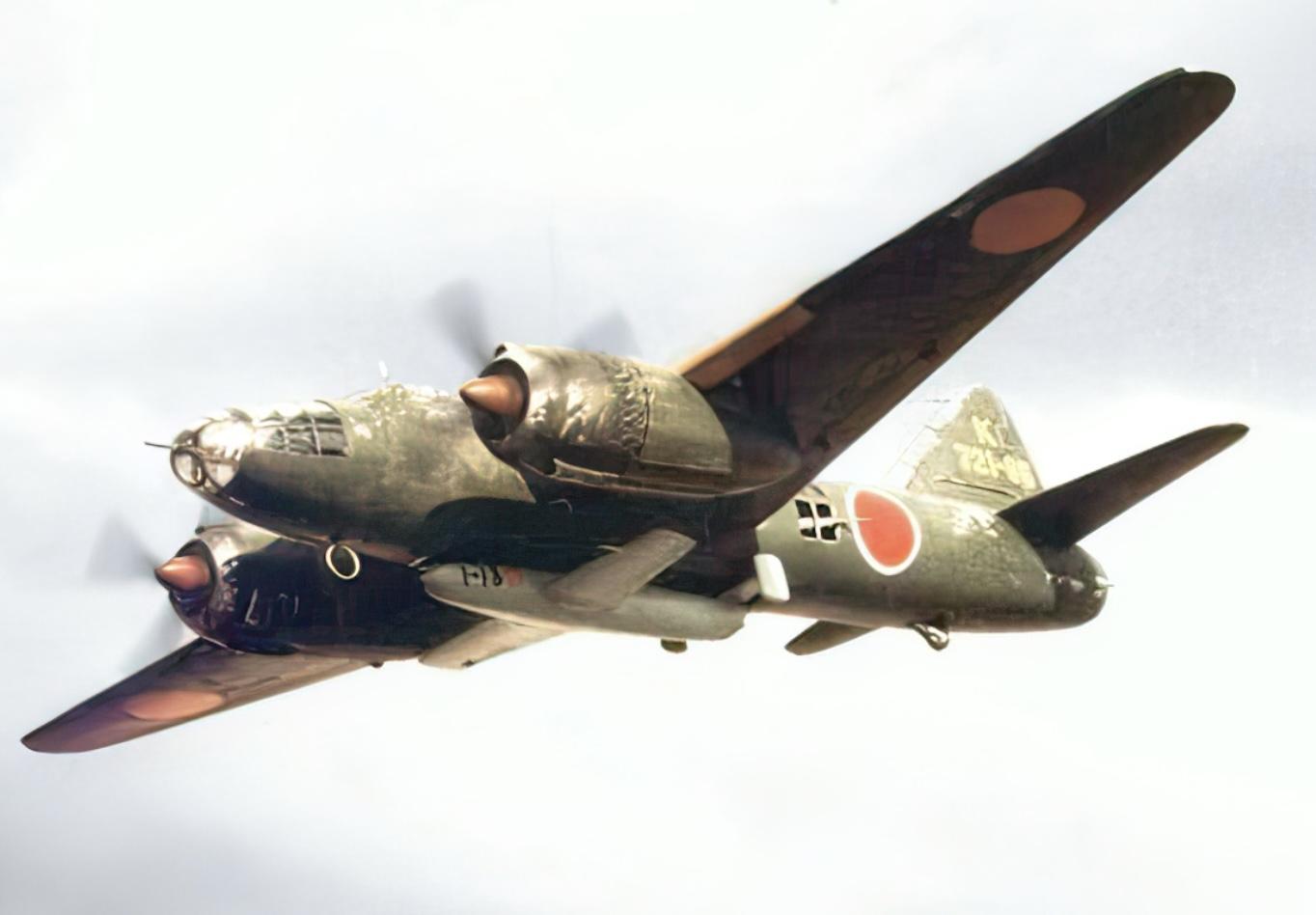
“Betty “ Japanese Bomber
Often known by the Allied name Betty, this Japanese long-range naval bomber became one of the most recognizable aircraft of the Pacific War. Introduced in 1941, it was engineered for speed and exceptional range, allowing Japan to strike deep across the Pacific. The aircraft was designed by Kiro Honjo of Mitsubishi and built by Mitsubishi Heavy Industries, which produced the type in multiple variants over the course of the war.
To achieve its long reach, the design sacrificed protective features such as armor and self-sealing fuel tanks. This made the aircraft light and efficient but left crews extremely vulnerable. In the early stages of the war, however, its strengths dominated. Flying from remote island bases, it could reach far-off targets with ease and deliver torpedo attacks or bombing raids at distances unmatched by most contemporary aircraft. Its most famous success came during the Malayan campaign, when coordinated strikes helped sink the British capital ships Prince of Wales and Repulse.
Inside the aircraft, conditions were tight and unprotected. The crew worked in a narrow fuselage, exposed to the threat of fire from the bomber’s large, unshielded fuel tanks. Defensive armament varied by model but generally included a 20 mm Type 99 cannon in the tail position and several 7.7 mm Type 92 machine guns in the nose, dorsal, and side blister mounts. Later versions added a 12.7 mm machine gun in improved defensive stations as Allied fighter pressure increased.
For offensive loadouts, the aircraft could carry either a single Type 91 aerial torpedo or a selection of bombs, typically up to 1,000 kilograms in total weight. Common bomb loads included 250 kg general-purpose bombs for anti-shipping strikes or land attacks, smaller 60 kg bombs for area bombing, and occasionally 500 kg bombs for heavier targets. This versatility helped crews adapt to a wide range of missions, from maritime strikes to long-range bombardment.
As the war advanced, Allied fighters grew faster and more numerous, exposing the aircraft’s critical vulnerabilities. Mitsubishi attempted to address the shortcomings with upgraded models, including the G4M2 with improved engines and the G4M3 with self-sealing fuel tanks and redesigned wings. These improved variants arrived too late and in too small numbers to change the aircraft’s overall reputation for fragility.
By the end of production in 1945, roughly 2,435 examples had been built. The bomber continued to serve throughout the conflict, performing bombing, torpedo, reconnaissance, and transport duties. Its final notable mission occurred in August 1945, when two were painted white with green crosses to carry Japanese envoys for surrender negotiations.
Today, the aircraft is remembered as a design that combined remarkable range and offensive capability with severe defensive weaknesses. It stands as a clear reflection of Japan’s strategic priorities and the difficult trade-offs that shaped its wartime aviation development.