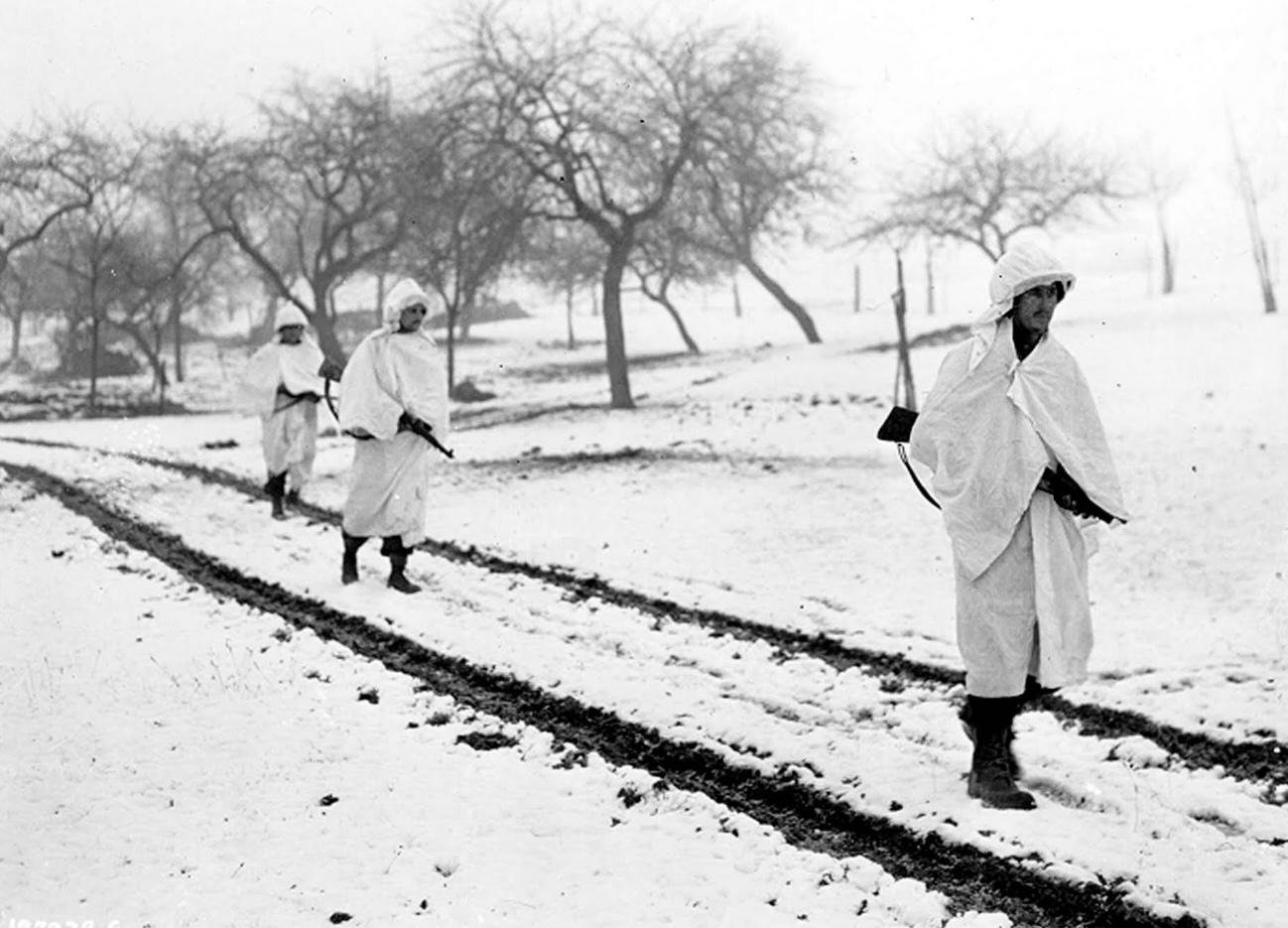
Bed Sheet Snow Uniforms
During the Second World War, U.S. troops fighting in winter conditions faced a significant disadvantage compared with some of their enemies: they were generally not issued specialized white camouflage clothing for snow-covered environments. Unlike German and Finnish forces, which often fielded reversible white winter smocks and overtrousers, American soldiers entered many cold-weather campaigns wearing standard-issue uniforms that stood out sharply against snow.
At the start of the war, U.S. military doctrine placed more emphasis on mobility and layered clothing for warmth rather than concealment. Troops were issued a range of cold-weather garments, but these were designed primarily for insulation, not camouflage. Common items included the wool-lined field jacket, the M-1941 field jacket and its improved successor the M-1943 field jacket, wool trousers, long underwear, heavy overcoats, knit caps, and leather gloves. In very cold regions, some units received pile-lined jackets or parkas, but these were usually olive drab or brown, colors that contrasted strongly with snowy terrain.
This lack of white camouflage became especially apparent during winter fighting in Europe, most notably in late 1944 during the Battle of the Bulge. As American units rushed to stop the German offensive in the Ardennes, soldiers found themselves moving and fighting in deep snow and frozen forests while dressed in dark uniforms. German troops, many of whom had access to white camouflage smocks or snow-patterned clothing, were often better able to blend into their surroundings, giving them an advantage in ambushes and defensive positions.
Faced with this problem, U.S. soldiers adapted by improvising. White bed sheets, mattress covers, hospital linens, tablecloths, and even curtains were taken from homes, aid stations, and abandoned buildings. These items were worn as makeshift cloaks, ponchos, or hoods, sometimes secured with rope, belts, or rifle slings. Some soldiers cut holes for their heads and arms, creating crude but effective overgarments that helped break up their outlines against the snow. Vehicles, machine guns, and artillery positions were occasionally draped with white fabric to reduce their visibility from a distance.
These improvised solutions had clear drawbacks. Sheets absorbed water easily, becoming heavy when wet, and they tore or snagged on branches and equipment. In windy conditions they could flap, risking exposure. Even so, they provided enough concealment to be worthwhile, especially for patrols, scouts, and soldiers manning forward positions. When limited quantities of official winter camouflage did arrive late in the war, units often issued them first to those whose roles depended most on stealth.
The experience exposed a shortcoming in American wartime planning. While U.S. troops were generally well supplied with warm clothing by the later stages of the war, camouflage suited to specific environments had been overlooked. The lessons learned in snow-covered battlefields influenced postwar thinking, leading to greater attention to environment-specific uniforms in later conflicts.