Battle of Phuoc Long
The battle of Phuoc Long began in December 1974 as the first major conventional offensive conducted by the North Vietnamese Army after the signing of the Paris Peace Accords. Although fighting is often associated with early January 1975, the operation started in mid-December when North Vietnamese units began isolating the province and probing South Vietnamese positions. The attack on Phuoc Long was both a military and political test designed to evaluate whether the United States would intervene again on behalf of South Vietnam. Its outcome would have profound consequences for the final months of the Vietnam War.
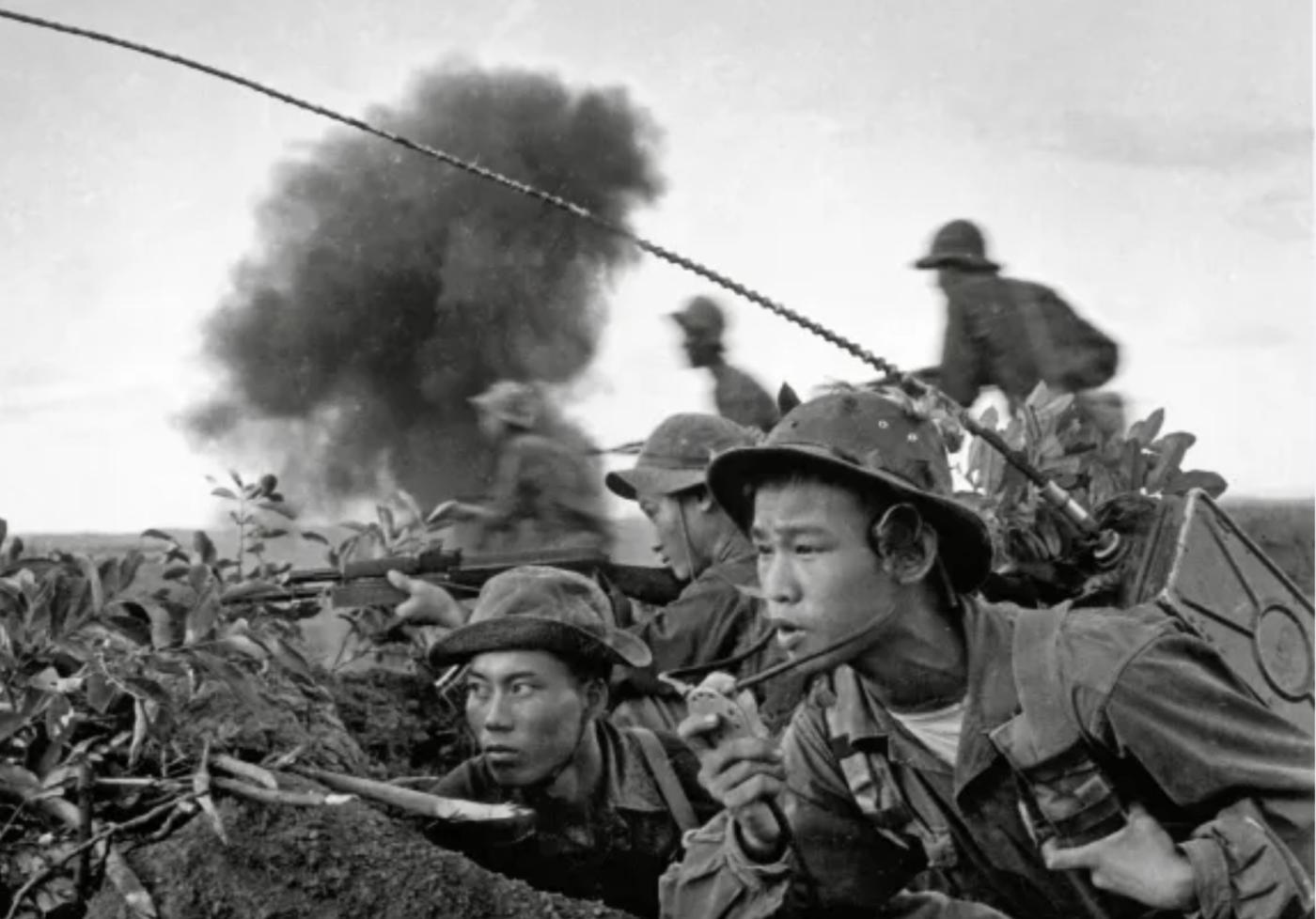
North Vietnam initiated the campaign with forces from Military Region 7 under the overall control of Lieutenant General Tran Van Tra. The main combat formation was the B2 Front. The spearhead included the 3rd Infantry Division, often referred to as the Yellow Star Division, commanded by Colonel Nguyen Huu Hanh. They were supported by the 7th Infantry Division under Colonel Le Duc Anh and the 341st Infantry Division under Colonel Nguyen Van Tuan. Additional units included the 165th and 209th Regiments, independent artillery battalions armed with 122 mm and 130 mm guns, engineer elements, and local Viet Cong forces already based in Phuoc Long province. Altogether, the attacking force numbered roughly 15,000 to 20,000 personnel, depending on the stage of the battle and reinforcement cycles.
South Vietnamese forces in the province were far smaller. The defense of Phuoc Long was the responsibility of the Army of the Republic of Vietnam’s III Corps, commanded by Lieutenant General Du Quoc Dong. Within the province itself, the key units were the 5th ARVN Division, led by Brigadier General Le Van Hung, which provided a reduced regimental force. In addition, the South had two Ranger battalions present: the 340th Ranger Battalion and the 363rd Ranger Battalion, each commanded by a major-level officer. Local Regional and Popular Force units contributed approximately 3,000 lightly armed militia. All told, fewer than 6,000 South Vietnamese defenders were available to hold the province’s main positions, including Phuoc Long City, Song Be, and Don Luan.
The battle formally began in mid-December 1974 when North Vietnamese forces overran a series of outposts south and east of Phuoc Long City. These opening actions severed most road links to the province and isolated the defenders. On December 26, the 3rd Division launched a larger assault that captured the town of Don Luan after heavy fighting. Artillery fire intensified around Song Be airstrip, preventing effective aerial resupply. By late December the NVA brought forward more artillery, enabling them to bombard the city’s central defenses and ARVN command posts.
South Vietnamese commanders repeatedly requested reinforcements, but III Corps lacked reserves, and President Nguyen Van Thieu refused to deploy airborne units or the 18th Division for fear of exposing other areas. Meanwhile, American advisers and intelligence officials reported the growing size of the North Vietnamese assault but confirmed that the United States would not return with airpower. This was the decisive political component of the battle: Hanoi was testing Washington’s willingness to re-enter the conflict, and the absence of any U.S. response encouraged North Vietnam to press forward with full force.
The final assault on Phuoc Long City began on January 2, 1975. The 7th Division attacked from the northeast while the 341st Division advanced from the west, coordinating with local Viet Cong units infiltrating through the city’s outskirts. By January 6, after house-to-house fighting and continuous artillery bombardment, all ARVN positions collapsed. General Le Van Hung attempted to organize a breakout but the remaining defenders were overwhelmed. Phuoc Long province became the first provincial capital captured by the North since the 1973 ceasefire.
The importance of the battle lay not in the size of the forces involved but in its political and psychological impact. It demonstrated the severe weakness of the South Vietnamese military without direct American assistance. It also convinced Hanoi’s leadership that the United States would not return to intervene militarily, even when a major population center fell. This realization encouraged North Vietnam to accelerate planning for the 1975 Spring Offensive, which ultimately led to the rapid collapse of South Vietnam and the fall of Saigon.
Phuoc Long thus marked the true beginning of the end of the war. The December 1974 offensive and its January 1975 conclusion signaled that balance of power had decisively shifted. The North Vietnamese gained a strategically valuable staging area near the Cambodian border, boosted morale, and secured a test case showing that large-scale conventional operations could be carried out with minimal risk of American retaliation. For the South, the loss revealed deep structural weaknesses in command, logistics, and political decision-making. The battle of Phuoc Long was therefore a turning point that shaped the final outcome of the Vietnam War.