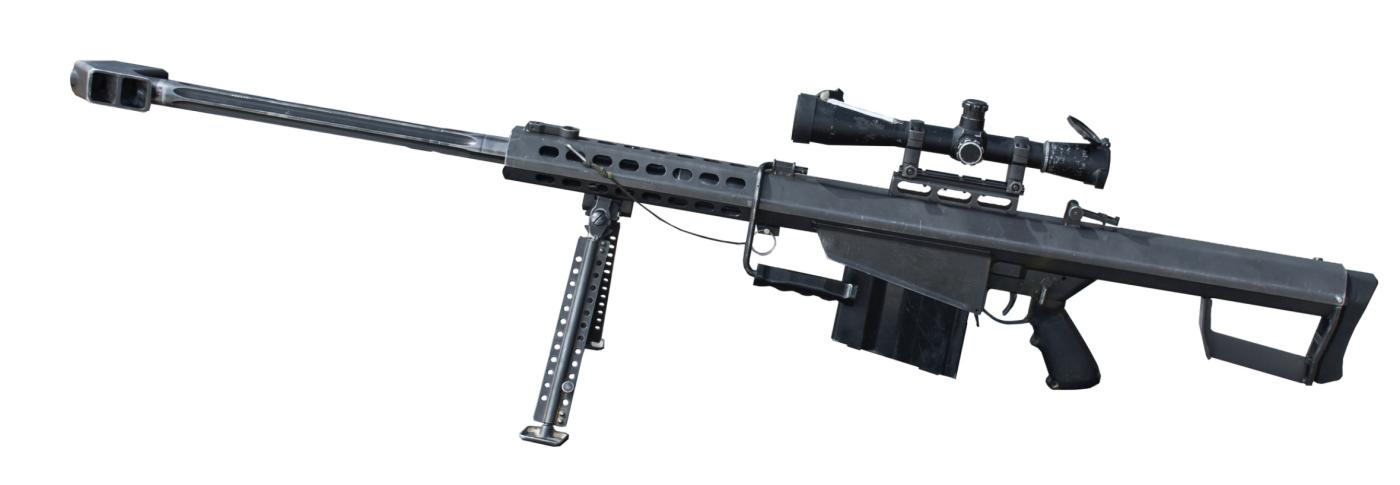
Barret .50 cal rifle
The rifle most widely recognized as the benchmark for .50-caliber long-range sniper capability is the Barrett M82, also known in U.S. military designation as the M107. Though sometimes misspelled or referred to informally as the “Barest .50 cal,” the weapon is properly known as the Barrett .50-caliber rifle. It is one of the most influential and iconic anti-materiel rifles ever built.
The rifle was designed by Ronnie G. Barrett, a self-taught firearms inventor from Tennessee who began working on the concept in the early 1980s. Barrett built the first prototypes in his garage before founding Barrett Firearms Manufacturing, a company that would become synonymous with long-range heavy-caliber rifles. Production of the Barrett M82 began in 1982 in Murfreesboro, Tennessee, where the company continues to manufacture the weapon today.
The M82/M107 fires the .50 BMG (12.7×99 mm NATO) cartridge, originally developed for the Browning M2 machine gun. The rifle accepts standard .50 BMG ammunition, meaning it can chamber a wide range of round types including ball, armor-piercing (AP), armor-piercing incendiary (API), API-T (tracer), Raufoss multipurpose rounds, and various specialized military and commercial long-range loads. This versatility is one of the reasons the rifle is valued for anti-materiel work, such as disabling vehicles, radar arrays, and communication equipment, in addition to extreme-range sniper engagements.
Barrett has produced many thousands of these rifles since the 1980s. Exact production totals are not publicly released, but estimates generally place the number well above 30,000 when including military and civilian markets across all M82 and M107 variants. The rifle has been adopted by dozens of countries and numerous military and law-enforcement units.
In terms of accuracy and range, the rifle is not designed to be a benchrest-precision weapon; instead, it offers reliable, repeatable results at exceptionally long distances with a massive payload. Effective accuracy for a trained sniper is generally stated at around 1,800 meters, though the .50 BMG round is capable of traveling well beyond 6,000 meters. Confirmed military hits have occurred past 2,000 meters, and specialized ammunition can push practical engagement distances even farther. The rifle’s recoil-reducing muzzle brake and semi-automatic action allow rapid follow-up shots, a rare ability in such a powerful platform.
One of the most interesting aspects of the Barrett story is how quickly the rifle rose from an experimental design to a global standard. Barrett’s first major military customer was Sweden in the late 1980s. Shortly afterward, the United States Marine Corps and U.S. Army adopted it, using it extensively during Operations Desert Storm, Iraqi Freedom, and Enduring Freedom. The rifle proved so effective at disabling equipment that it helped define the modern category of “anti-materiel rifles.” Its distinctive silhouette, large muzzle brake, and oversized magazine have made it a recognizable symbol in films, documentaries, and video games.
Although often regarded as a sniper rifle, its primary military role is the destruction of matériel at long distances. However, its ability to deliver heavy, stable projectiles accurately over extreme ranges has also made it a valuable option for specialized long-range marksmen. The rifle’s ruggedness, simple maintenance requirements, and powerful reach continue to ensure its presence in arsenals around the world.
The Barrett .50-caliber rifle remains a testament to the impact a single designer’s vision can have on modern military technology, transforming an ambitious idea crafted in a garage into one of the most respected long-range weapons of the last forty years.