Barrage Balloon Command
In the years before the Second World War, British air-defence planners feared that fast, low-flying enemy aircraft could evade fighters and heavy anti-aircraft guns and strike vital targets with little warning. To counter this threat, the Royal Air Force created a specialised organisation dedicated to a deceptively simple idea: blocking the sky itself. This organisation became RAF Balloon Command, officially formed on 1 November 1938, and it was responsible for the operation of Britain’s barrage balloon defences throughout the war.
Barrage balloons were large, hydrogen-filled balloons tethered to the ground by strong steel cables. When raised, they formed an invisible forest of wires above key targets such as cities, ports, factories, power stations and government centres. Aircraft attempting to fly at low altitude risked colliding with these cables, which could rip through wings, tailplanes or propellers, often destroying the aircraft outright. Even when no collision occurred, the presence of balloons forced enemy pilots to fly higher, reducing bombing accuracy and placing them squarely in the engagement zone of anti-aircraft guns and RAF fighters.
The balloons themselves were typically around 60 feet long and shaped like elongated blimps for stability. They were normally flown at heights ranging from about 5,000 feet up to 15,000 feet, depending on weather conditions and the nature of the threat. Each balloon was controlled by a winch mounted on a lorry or a fixed ground installation, allowing crews to raise or lower them quickly. In bad weather, balloons had to be hauled down to prevent loss, while during alerts they were rapidly deployed to full height.
Manufacture of barrage balloons was a major industrial effort. The envelopes were made from layers of cotton fabric coated with rubber to make them gas-tight, while the cables were engineered to combine extreme strength with manageable weight. One of the most important centres for balloon production, storage and training was RAF Cardington in Bedfordshire, which already had long experience with airships and lighter-than-air technology. Civilian factories across Britain were also involved, producing fabric, cables, valves and winching equipment.
Before the war, Britain planned to deploy about 1,450 barrage balloons nationwide, but combat conditions quickly showed this was insufficient. Losses to weather were heavy, especially during storms, and coverage had to be expanded as the air threat evolved. By mid-1940 the authorised establishment had risen to around 2,600 balloons, and production increased dramatically to keep pace with demand. Balloons were consumable defensive assets, constantly needing repair or replacement, and Balloon Command had to balance protection with the realities of supply.
Operating a balloon site required skill, discipline and teamwork. Each balloon was crewed by a detachment responsible for inflation, mooring, cable inspection, winch operation and emergency procedures. A snapped cable or runaway balloon could be deadly on the ground. Many of these crews included women from the Women’s Auxiliary Air Force, who became a familiar and vital presence at balloon sites across the country. Their work was physically demanding and often carried out under fire during air raids.
Balloon Command proved its value during the Blitz of 1940–41, when German bombers were repeatedly forced to higher altitudes, reducing the effectiveness of attacks on British cities. Its most dramatic success, however, came later in the war during the German V-1 flying bomb campaign of 1944–45. The V-1 “buzz bomb” flew at relatively low altitude on a straight, predictable course toward London and other targets. Barrage balloons were uniquely suited to counter this threat, as they could engage continuously without needing radar, ammunition or human reaction time. When a V-1 struck a balloon cable, it was usually destroyed before reaching its target. In total, barrage balloons were credited with stopping 278 V-1 flying bombs, saving thousands of lives and preventing widespread damage.
Balloon Command operated under the RAF’s wider air-defence system and was led by senior RAF officers who coordinated closely with Fighter Command and Anti-Aircraft Command. Although its leaders and crews rarely received public recognition, their contribution was immense. By denying the enemy the ability to attack freely at low level, they shaped enemy tactics and strengthened every other layer of Britain’s defences.
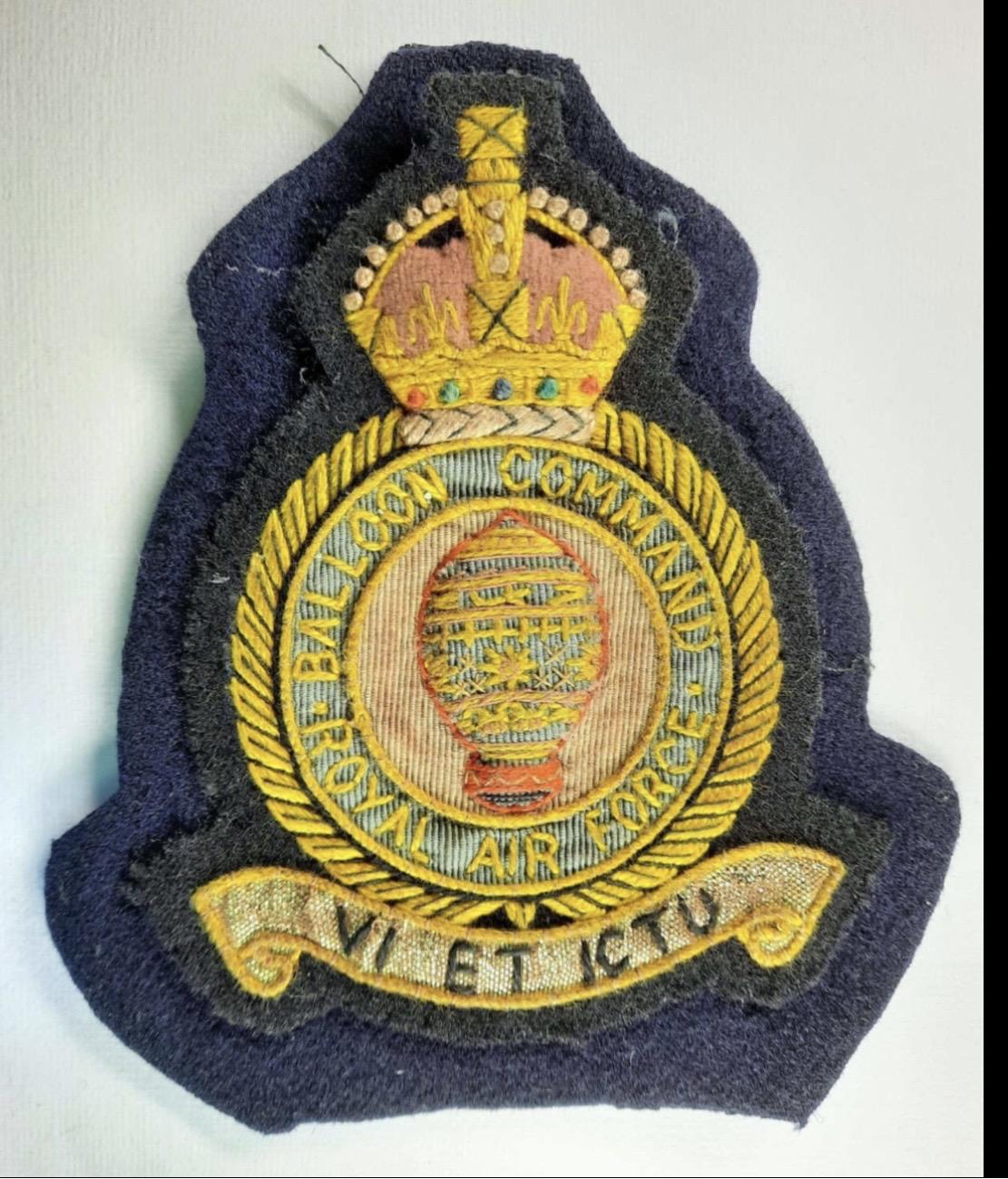
By the end of the war, barrage balloons had become an iconic feature of Britain’s wartime landscape, looming silently above streets and skylines. Their military insignia, bearing the identity of Balloon Command, symbolised an organisation that combined ingenuity, endurance and quiet effectiveness. Though lacking the glamour of fighters or the thunder of guns, RAF Balloon Command demonstrated that control of the air could sometimes be achieved not by firepower, but by obstacles, planning and persistence.