Bagnolds Sun Compass
The sun compass developed by Ralph Bagnold for use in the North African desert during the Second World War was one of the simplest yet most effective navigational tools of the campaign. Standard magnetic compasses were notoriously unreliable in the desert, where vast stretches of iron-rich sands and the steel hulls of vehicles produced magnetic interference. The sun compass avoided this problem entirely by relying on the predictable movement of the sun rather than magnetic fields. For the vehicles of the Long Range Desert Group and other units operating hundreds of miles beyond established tracks, this innovation proved indispensable.
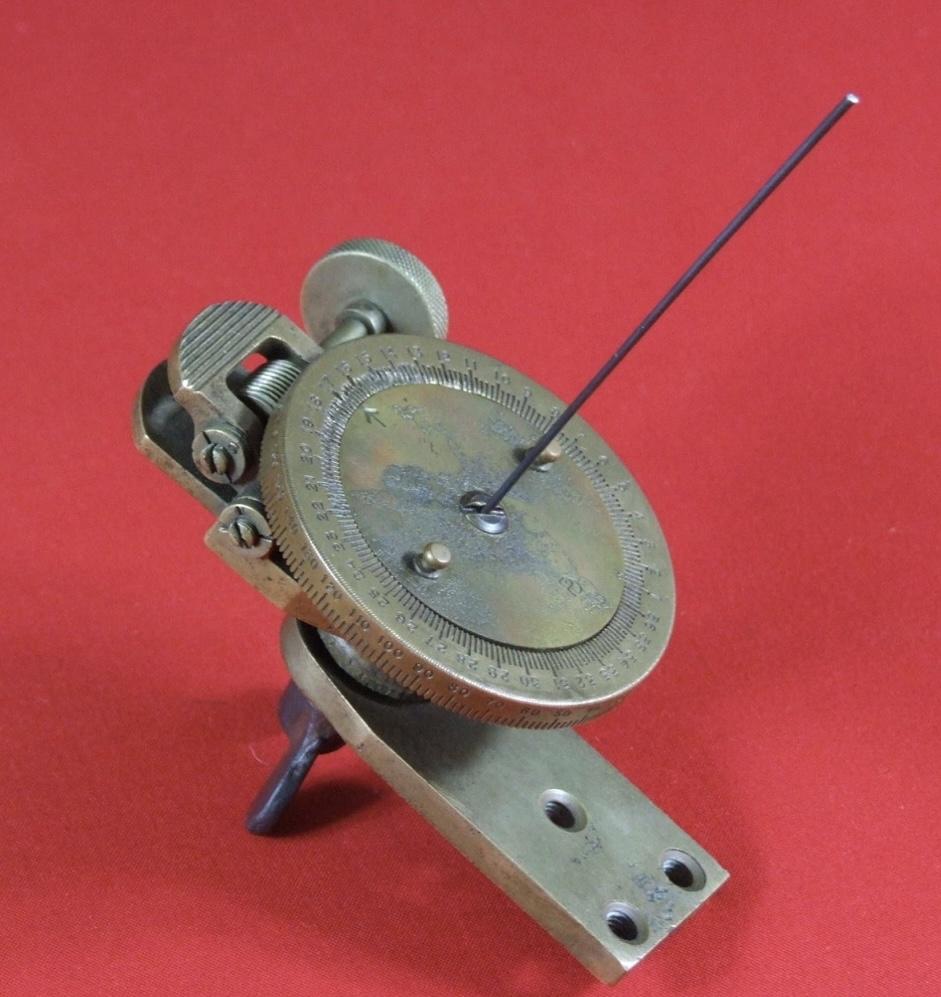
Bagnold’s design was straightforward. A horizontal baseplate was marked with degree graduations, and at its center stood a small vertical gnomon, essentially a short pin that cast a shadow on the plate. Before setting out each day, navigators calibrated the instrument using the known solar azimuth at a given time and date, information commonly found in navigation tables. As the sun moved, the shadow cast by the gnomon traced a predictable path across the plate. By aligning the shadow with the expected position corresponding to their desired bearing, drivers could maintain a remarkably accurate course. This method eliminated the errors caused by vehicle vibration, magnetic interference, and the often chaotic environment of a moving convoy. Unlike a magnetic needle, the sun could not be thrown off course by a lorry engine or a passing tank.
One reason the sun compass worked so well was its immunity to environmental distortion. Desert temperatures shifted dramatically throughout the day, and magnetic compasses responded poorly to the scorching heat and metal vehicle frames expanding in the sun. The sun compass, by contrast, became more accurate the clearer the sky. It performed flawlessly in an environment where clouds were rare, and it provided consistent readings even when a vehicle was tilted or bouncing over dunes. Proper training allowed LRDG crews to use the instrument with precision, often navigating hundreds of miles across featureless sand seas where even minor errors could lead to disaster.
There are several fascinating details associated with Bagnold’s instrument. It required an understanding of solar movement that was unusual among ordinary soldiers, yet became second nature to desert navigators after practice. Because the device depended on accurate timekeeping, many crews carried high-quality chronometers protected in padded boxes. The LRDG also learned to use the compass in reverse when traveling at night by setting it for the sun’s position just below the horizon and reading the starlight-generated shadow faintly, or by extrapolating bearings gained earlier in the day. In some cases, crews preferred the sun compass so strongly that even when standard magnetic compasses were available, they continued to rely on Bagnold’s design.
Perhaps the most remarkable testament to the sun compass’s effectiveness is that its basic form is still studied today in survival training and desert expeditions. It was a tool born of necessity, engineered by someone who understood the desert better than almost anyone of his era. In a landscape where tracks vanished within minutes and there were no landmarks to guide a traveller, Bagnold’s sun compass transformed the sun itself into a dependable navigational partner, turning an unforgiving environment into one that could be read with skill and confidence.