Adolf Galland
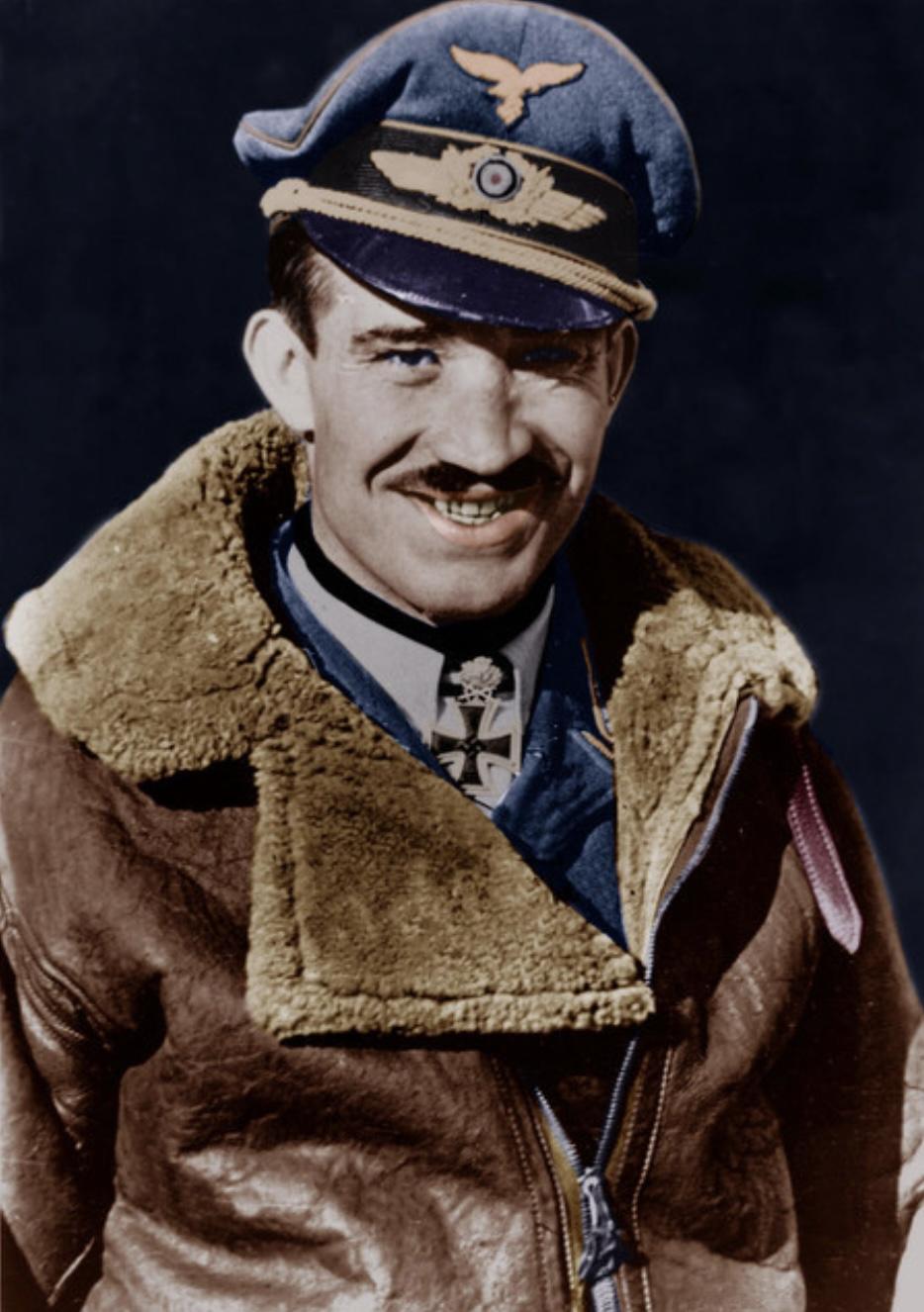
Adolf Josef Ferdinand Galland was one of the most famous fighter pilots produced by Germany during the Second World War and became a symbol of the Luftwaffe’s fighter arm at its height. He was born on 19 March 1912 in Westerholt, Westphalia, into a Catholic family with French ancestry. Aviation fascinated him from an early age, but Germany’s defeat in the First World War and the restrictions imposed by the Treaty of Versailles meant that powered flight training was officially forbidden. Like many future Luftwaffe pilots, Galland began his flying career in gliding clubs during the late 1920s, where he quickly proved himself to be a skilled and confident flyer. These years gave him an excellent foundation in aircraft handling, navigation, and flying by instinct rather than instruments, qualities that later served him well in combat.
In 1932 Galland entered the Deutsche Verkehrsfliegerschule, a civilian flying school that secretly trained future military pilots. He initially dreamed of becoming an airline pilot, but the rapid expansion of the Nazi regime’s rearmament program soon drew him into military aviation. When the Luftwaffe was officially announced in 1935, Galland joined as a young officer and began advanced fighter training. Early in his career he suffered a serious eye injury that temporarily grounded him and threatened his future as a pilot, but he recovered and returned to flying duties, a setback that reinforced his determination and toughness.
Galland gained his first combat experience during the Spanish Civil War, where he served with the Condor Legion from 1937 to 1938. Although he flew ground-attack missions rather than air combat, Spain taught him valuable lessons about modern warfare, the importance of air superiority, and the limitations of aircraft and tactics. He was critical of ineffective doctrines and was already forming strong opinions about how fighter units should be used, often clashing with more conservative senior officers. These traits would later define both his success and his controversies within the Luftwaffe.
At the outbreak of the Second World War in September 1939, Galland was a Staffelkapitän flying the Messerschmitt Bf 109. He scored his first aerial victories during the campaign in France in 1940, quickly establishing himself as an aggressive and highly capable fighter pilot. During the Battle of Britain he became one of Germany’s leading aces, achieving victory after victory against Royal Air Force fighters and bombers. Galland was not only a gifted marksman but also an excellent tactician, known for his calmness under pressure and his ability to read the flow of an air battle. By the end of 1940, he had become a national hero in Germany, frequently featured in propaganda and awarded high decorations.
Galland rose rapidly through the ranks. He was awarded the Knight’s Cross of the Iron Cross in May 1940, followed by the Oak Leaves, Swords, and eventually Diamonds, making him one of only a handful of Luftwaffe officers to receive the highest grade of the award. In November 1941, at just 29 years old, he was appointed General der Jagdflieger, effectively becoming the commander of Germany’s fighter force. This role placed him at the center of Germany’s air war, responsible for defending the Reich against increasing Allied bomber offensives.
As General der Jagdflieger, Galland was a strong advocate for concentrating fighters against bomber formations and for accelerating the development of jet aircraft, particularly the Messerschmitt Me 262. He frequently argued with Hermann Göring and Adolf Hitler, criticizing unrealistic orders and strategic mistakes. Galland believed the Me 262 should be used primarily as a fighter rather than a bomber, a view that was ultimately correct but ignored for too long. His outspoken nature and refusal to blindly follow orders led to growing tension with the Nazi leadership.
Despite his high rank, Galland continued to fly combat missions whenever possible, believing a commander should share the risks of his men. Over the course of the war, he was officially credited with 104 aerial victories, all achieved on the Western Front. His victories included fighters and bombers, with a significant number of four-engine heavy bombers shot down during the defense of Germany. He was shot down several times but always survived, reinforcing his reputation for resilience and luck.
By early 1945, Galland’s relationship with Göring had deteriorated completely. He was dismissed as General der Jagdflieger after criticizing the leadership and defending younger fighter pilots who were blamed for failures beyond their control. However, rather than being sidelined, Galland was allowed to form a special jet fighter unit, Jagdverband 44, equipped with the Me 262. Flying jets himself, he returned to combat in the final weeks of the war and scored additional victories, demonstrating once again his adaptability and skill even in revolutionary aircraft.
At the end of the war, Galland was captured by American forces. He spent time as a prisoner of war but was not charged with war crimes, as he was regarded as a professional soldier rather than a political ideologue. After his release, he lived in Argentina for several years, where he worked as an aviation consultant and adviser to the Argentine Air Force. He later returned to Germany and remained closely involved with aviation, writing his memoirs, which offered candid and often critical insights into the Luftwaffe’s leadership and the conduct of the air war.
In his postwar life, Galland became a respected figure in aviation circles and maintained friendships with former Allied pilots, including British and American veterans he once fought against. He married several times and lived a relatively quiet life in later years, occasionally appearing at air shows and historical events. Adolf Galland died on 9 February 1996 at the age of 83. Today, he is remembered as one of the most capable fighter pilots of the Second World War, a brilliant tactician, and a commander who consistently placed the welfare of his pilots and the realities of air combat above politics and propaganda.