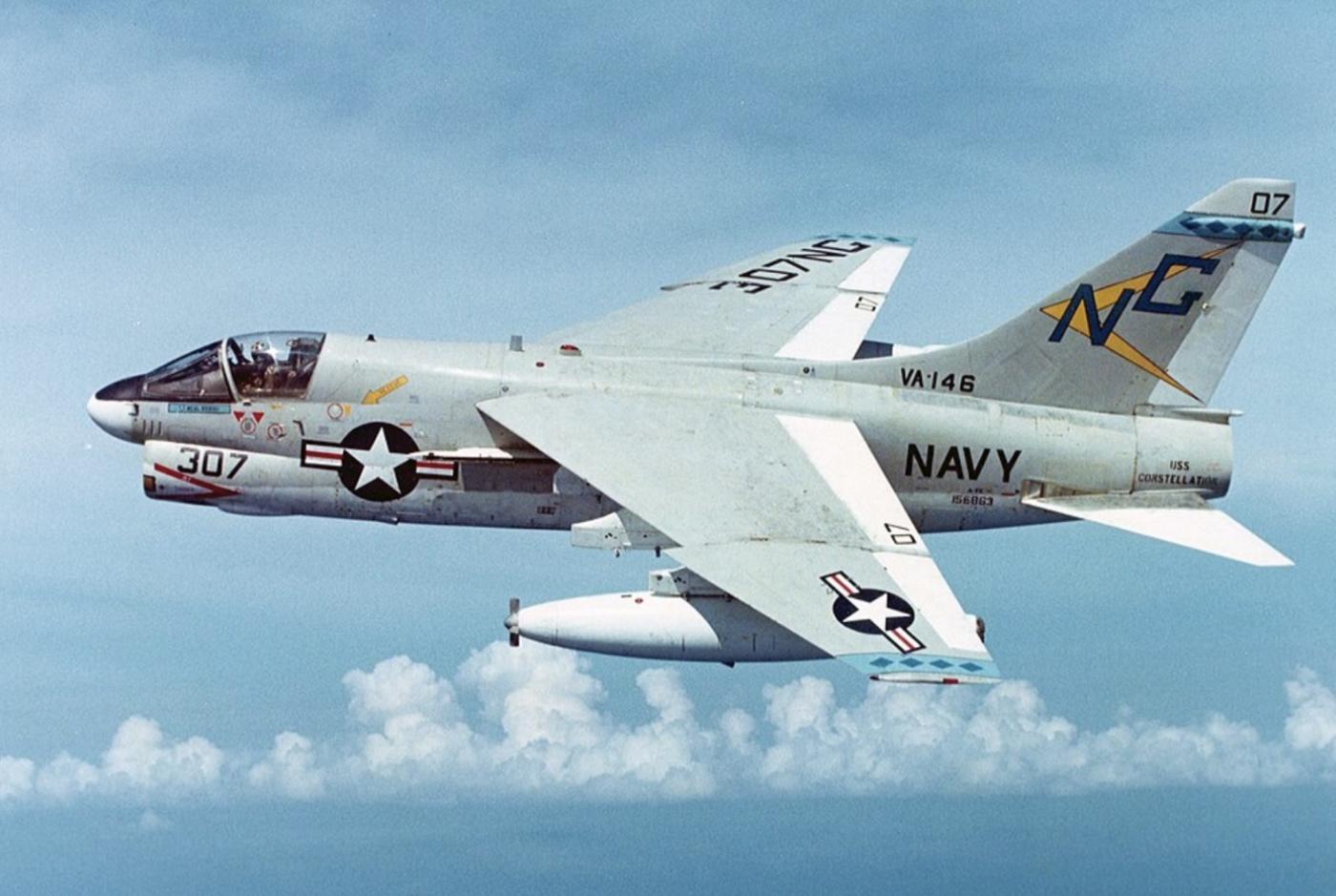
A-7 Corsair 11
The Ling-Temco-Vought A-7 Corsair II was a United States light attack and fighter-bomber aircraft built to replace the Douglas A-4 Skyhawk and provide the U.S. Navy with a modern, carrier-capable strike platform. It was designed by the Vought division of Ling-Temco-Vought (LTV), headquartered in Dallas, Texas, with major manufacturing at Vought’s facility in Grand Prairie. The aircraft first flew in 1965 and entered service the following year, becoming one of the most efficient and reliable attack aircraft of its era. Its development drew on the design lineage of the earlier F-8 Crusader, but the A-7 adopted a shorter, broader fuselage, a high-mounted swept wing, and a large internal capacity for fuel and avionics that made it a stable, accurate bombing platform rather than an air-superiority fighter.
The A-7 Corsair II was notable for being one of the first combat aircraft equipped with a modern heads-up display, projected map display, and advanced navigation and attack systems that allowed for precise delivery of ordnance in nearly any weather. These avionics gave it levels of accuracy unusual for the Vietnam era and made it extremely cost-effective to operate, earning the aircraft a reputation for reliability and ease of maintenance. Over its production run, from 1964 to 1984, a total of 1,569 A-7s were built for the U.S. Navy, U.S. Air Force, and several allied nations including Greece, Portugal, and Thailand.
The aircraft served extensively with the U.S. Navy during the Vietnam War, where it conducted strike missions, close air support, and interdiction flights. It participated in the 1972 Operation Linebacker and Linebacker II campaigns, delivering precision ordnance against strategic targets in North Vietnam. After Vietnam, the A-7 continued to see action, including U.S. Air Force operations during the 1983 invasion of Grenada and the 1986 U.S. strikes against Libya. Its final major combat involvement came during Operation Desert Storm in 1991, where Navy A-7Es flew strike missions early in the conflict before being phased out in favor of the F/A-18 Hornet. Beyond American service, Greek A-7s continued flying operationally into the 2010s, making them the last users of the type.
The A-7 was capable of operating from U.S. aircraft carriers and was fitted with folding wings, a strengthened landing gear, and an arrestor hook. Its range and payload exceeded that of many aircraft in its class, making it suitable for both front-line naval strike missions and land-based USAF roles. The aircraft could carry a wide variety of weapons, including unguided iron bombs, cluster munitions, AGM-65 Maverick missiles, AGM-62 Walleye glide bombs, guided laser munitions on later models, and AIM-9 Sidewinder missiles for limited self-defense. It also carried an internal M61 Vulcan 20 mm cannon on most versions. With a maximum external load of over 15,000 pounds, it delivered more ordnance per sortie than many larger aircraft of the period.
Performance varied by variant, but the widely used A-7E was powered by the Allison TF41-A-2 turbofan engine, giving it a maximum speed of about 690 mph (around Mach 0.9). The aircraft was not designed for supersonic flight, prioritizing fuel efficiency and range instead; its combat radius was roughly 700 miles, and its ferry range could exceed 2,000 miles with external tanks. The service ceiling was approximately 42,000 feet, allowing it to operate safely above many threats while still carrying out precision strike missions. Its economical turbofan engine contributed to long loiter times, making the aircraft highly valued for close air support.
Although the A-7 Corsair II was never intended as a pure fighter, it filled a multirole niche by combining heavy strike capability, carrier operation, modern avionics, and reliable performance in a compact airframe. Its legacy includes decades of combat service, international exports, and significant technological contributions to later aircraft. Even after retirement from U.S. service, it remains a respected example of a purpose-built attack aircraft that exceeded expectations and influenced the evolution of modern multirole naval aviation.