A-4 Skyhawk
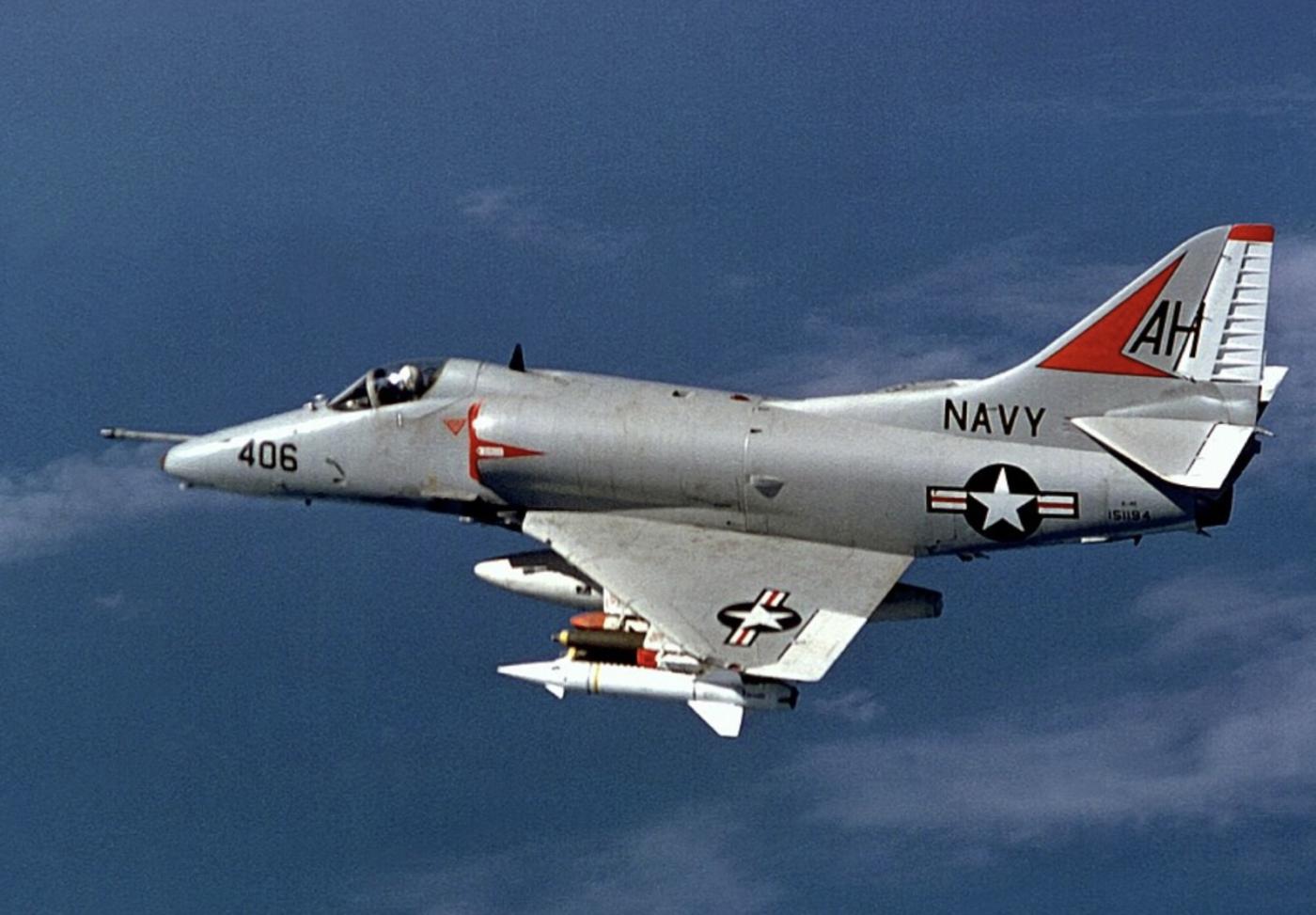
The Douglas A-4 Skyhawk was one of the most important carrier-based attack aircraft used by the United States Navy and Marine Corps during the Vietnam War. It was a small, lightweight jet that packed a surprising amount of punch, which is why pilots often called it “Heinemann’s Hot Rod,” after its chief designer Ed Heinemann of the Douglas Aircraft Company. Heinemann believed that aircraft should be simple, reliable, and as light as possible. His design philosophy produced a jet that was so compact it didn’t even need folding wings to fit on an aircraft carrier.
The Skyhawk was built by the Douglas Aircraft Company, which later became part of McDonnell Douglas. Production began in the mid-1950s, and more than 2,900 aircraft were eventually manufactured. The engine most commonly used in the Vietnam-era models was the Pratt & Whitney J52 turbojet. It provided enough power to launch the aircraft from a carrier deck while still keeping fuel consumption relatively low for its time.
In terms of speed, the A-4 could reach around 670 miles per hour, just below the speed of sound. What impressed pilots and commanders most was how agile it was. Its small size and tight turning ability made it harder for enemy gunners to hit, and its handling qualities were praised by many of the aviators who flew it in combat.
Despite its compact shape, the Skyhawk could carry a heavy amount of ordnance. It had two internal 20 mm cannons and several external hardpoints that could mount bombs, rockets, missiles, napalm, and external fuel tanks. Fully loaded, it could deliver up to 9,000 pounds of weapons. During the Vietnam War, A-4s were used for ground attack missions, close air support, and even as early guided-missile platforms. One variant, the A-4E, was especially common due to improvements in radar, weapon capability, and engine performance.
The aircraft gained a special place in naval history because it was the main aircraft used by the Navy’s Blue Angels demonstration team for more than a decade. This showed how maneuverable and reliable the Skyhawk was even after many years of front-line service. Another interesting fact is that the Skyhawk was flown by several countries, including Israel and Argentina. In the 1982 Falklands War, Argentine A-4s managed to strike British ships while flying extremely low to avoid radar detection.
One well-known event involving the Skyhawk happened on the aircraft carrier USS Forrestal in 1967. A malfunction on another aircraft accidentally launched a rocket across the flight deck, striking an A-4 and causing a devastating fire. Future U.S. Senator John McCain was sitting in the cockpit of that Skyhawk and survived the incident after escaping the flames.
The A-4 Skyhawk stayed in U.S. service long after the Vietnam War and remained a favorite training aircraft thanks to its reliability and low operating cost. Its combination of simplicity, toughness, and firepower made it one of the most respected naval aircraft of its era, and many aviation historians still regard it as one of the most successful combat jets ever built.