1937 type Webbing
The British Army’s 1937 Pattern webbing, officially titled “Equipment, Web, 1937 Pattern,” emerged from interwar efforts to modernise a load-carrying system that had remained largely unchanged since the First World War. After 1918, the army retained vast stocks of older 1908 pattern equipment, but by the early 1930s it was clear that modern warfare, with its increasing mechanisation and varied battlefield roles, required a more flexible and universal system. In 1932 the British Army convened the Brathwaite Committee to examine improvements to infantry equipment, and one of its central conclusions was that any new webbing must be modular and adaptable rather than tied to a single branch of service.
The design process was closely linked to industry. The Mills Equipment Company, which had pioneered earlier webbing systems, played a major role by submitting several prototype designs to the committee. One of these was selected around 1934, but adoption was delayed until decisions were finalised on new infantry weapons such as the Bren light machine gun. The final design was formally approved on 8 June 1938, with large-scale issue beginning in 1939 just before the outbreak of the Second World War.
Manufacture of the 1937 Pattern webbing was widespread and international. Although the Mills Equipment Company remained the principal contractor, wartime demand required production by numerous firms across Britain and the wider Commonwealth, including Canada, Australia, India and South Africa. Canadian firms such as Zephyr Loom and Textile Limited produced large quantities, often marked with their own factory stamps. The webbing itself was made from tightly woven cotton yarn that had been pre-shrunk, dyed and waterproofed before weaving, giving it durability and resistance to weather. Metal fittings were initially stamped brass, but as the war progressed and brass became strategically important for ammunition production, mild steel fittings treated against corrosion began to replace it.
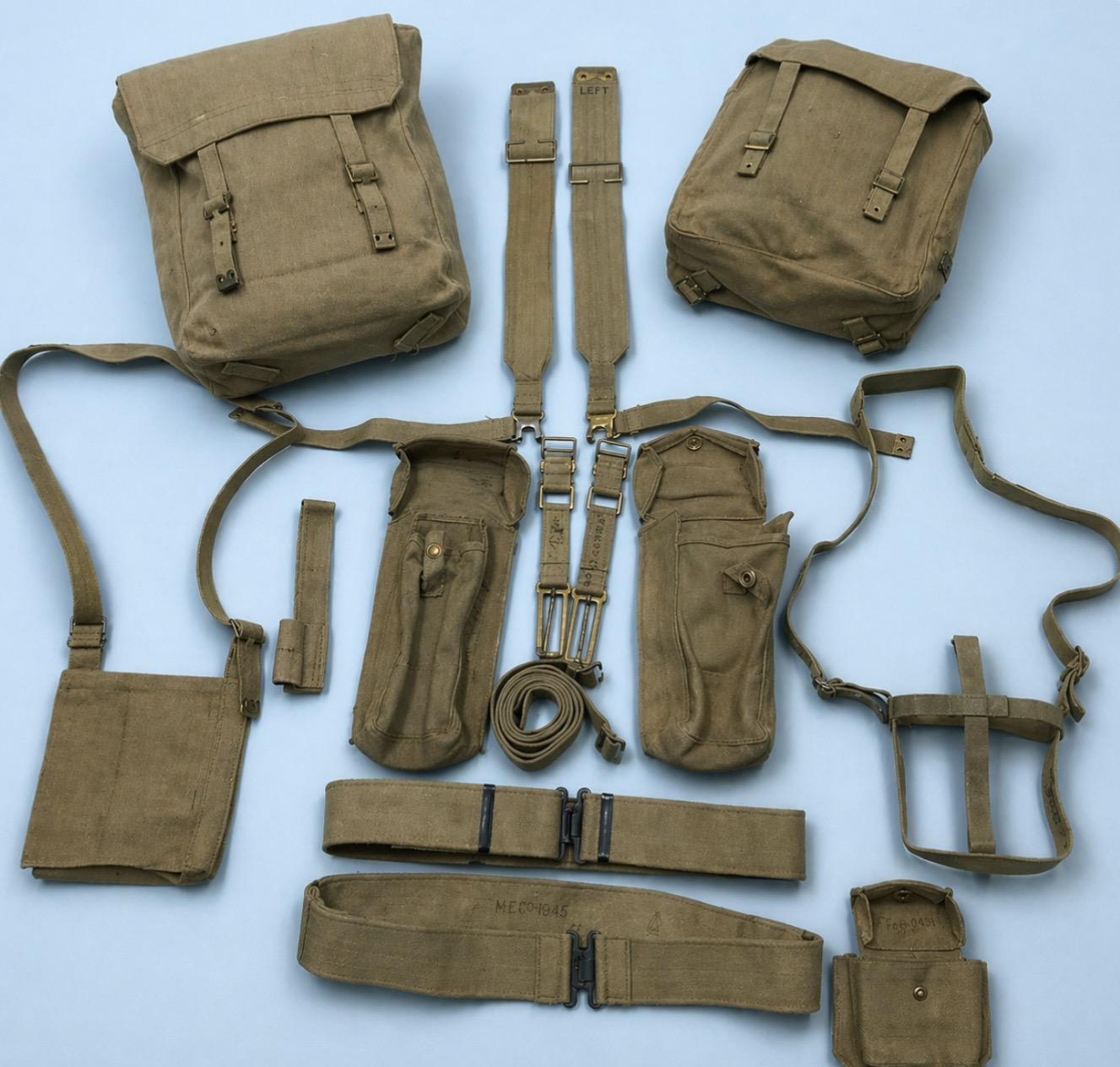
In conception, the 1937 Pattern represented a major departure from earlier British systems. Previous webbing had been tailored to specific arms of service, but the new design was intended as a universal platform usable by infantry, artillery, engineers and specialists alike. This was achieved through a system of interchangeable components attached to a basic framework consisting of a waistbelt and shoulder braces. From this foundation, soldiers could configure their equipment depending on their role, whether carrying rifle ammunition, Bren gun magazines, grenades, or specialist tools.
A standard infantry set typically consisted of a belt, a pair of cross straps or braces, ammunition pouches, a bayonet frog, a water bottle carrier, and a small pack or haversack. Additional items could include an entrenching tool carrier, binocular case, compass pouch, pistol holster, and officer-specific items such as a haversack for maps and documents. The system also incorporated legacy elements from earlier patterns, notably the large pack originally introduced with the 1908 equipment, which was usually carried in transport except when marching in full order. The modularity allowed soldiers to adopt different configurations such as “battle order” for essential fighting equipment or “marching order” for full kit, reflecting the increasing tactical flexibility demanded by modern warfare.
The webbing was issued in a standard khaki colour but could be treated with a substance known as Blanco to alter its shade, commonly to green hues suited to different environments. Variants were also produced for specific services, such as blue-grey webbing for the Royal Air Force and white for Military Police. Late in the Second World War, jungle-green versions were produced for use in the Pacific theatre, although these were partially supplanted by the 1944 Pattern webbing designed specifically for tropical conditions.
In service terms, the 1937 Pattern webbing became the defining British and Commonwealth load-bearing system of the Second World War. It equipped soldiers across every theatre, from North Africa to Europe and the Far East, and continued in widespread use after 1945 during the early Cold War period. It was eventually replaced in frontline service by the 1958 Pattern webbing, introduced from 1959 onward, but the older system did not disappear immediately. Instead, it remained in use with second-line units, reservists and support troops well into the 1970s, and continued to appear in cadet organisations into the 1980s, a testament to its durability and adaptability.