On this day in military history…
On 14 May 1940 the city of Rotterdam suffered one of the most devastating air attacks of the early Second World War when the German Luftwaffe bombed the city centre during the German invasion of the Netherlands. The destruction became known as the Rotterdam Blitz and shocked the world because of the scale of civilian devastation caused in only a few minutes. The attack also directly led to the surrender of the Dutch armed forces and demonstrated the terrifying power of modern aerial warfare.
Germany had invaded the Netherlands on 10 May 1940 as part of its wider offensive against Western Europe during World War II. The German strategy was based on speed, surprise and overwhelming force. German airborne troops landed near key bridges and airfields while armoured divisions advanced rapidly through Dutch territory. The Dutch military fought stubbornly in several areas, but the Germans aimed to seize Rotterdam because it was one of the largest ports in Europe and a key transportation hub linking rivers, railways and roads.
Rotterdam quickly became a battleground. German paratroopers had captured bridges over the River Maas, including the important Willemsbrug bridge, but Dutch forces still controlled parts of the city and resisted strongly. Fighting continued for several days, with street battles taking place between Dutch defenders and German airborne troops trapped inside the city. The Germans wanted to avoid a prolonged urban battle because they needed Rotterdam intact for logistical purposes and wanted to push rapidly toward France and Belgium.
General Rudolf Schmidt, commanding German ground forces around Rotterdam, demanded that the Dutch surrender the city. Negotiations began on 14 May, but confusion, poor communication and German impatience would soon lead to catastrophe. While talks were underway, Luftwaffe bombers had already been ordered into the air.
The bombing force mainly consisted of Heinkel He 111 medium bombers from Kampfgeschwader 54, one of the Luftwaffe’s bomber wings. Around 90 Heinkel bombers were dispatched for the operation, although not all reached the target or released their bombs. Approximately 54 aircraft actually dropped bombs over the city. Escort fighters and reconnaissance aircraft also accompanied the formation.
The bombers approached Rotterdam in the early afternoon of 14 May 1940. German commanders on the ground realised negotiations were progressing and attempted to halt the attack. Red signal flares were launched to warn the bombers to abort or redirect. Some crews saw the signals and turned away, but many aircraft either failed to notice them or continued their bombing run regardless.
At approximately 1:27 pm the bombs began falling on the heart of Rotterdam. The attack lasted only about fifteen minutes, but the results were catastrophic. Around 97 tons of bombs were dropped, including large numbers of high explosive bombs combined with incendiary devices designed to start fires. The mixture proved deadly because the explosions shattered buildings and water mains while the incendiaries ignited massive fires that spread rapidly through the old city centre.
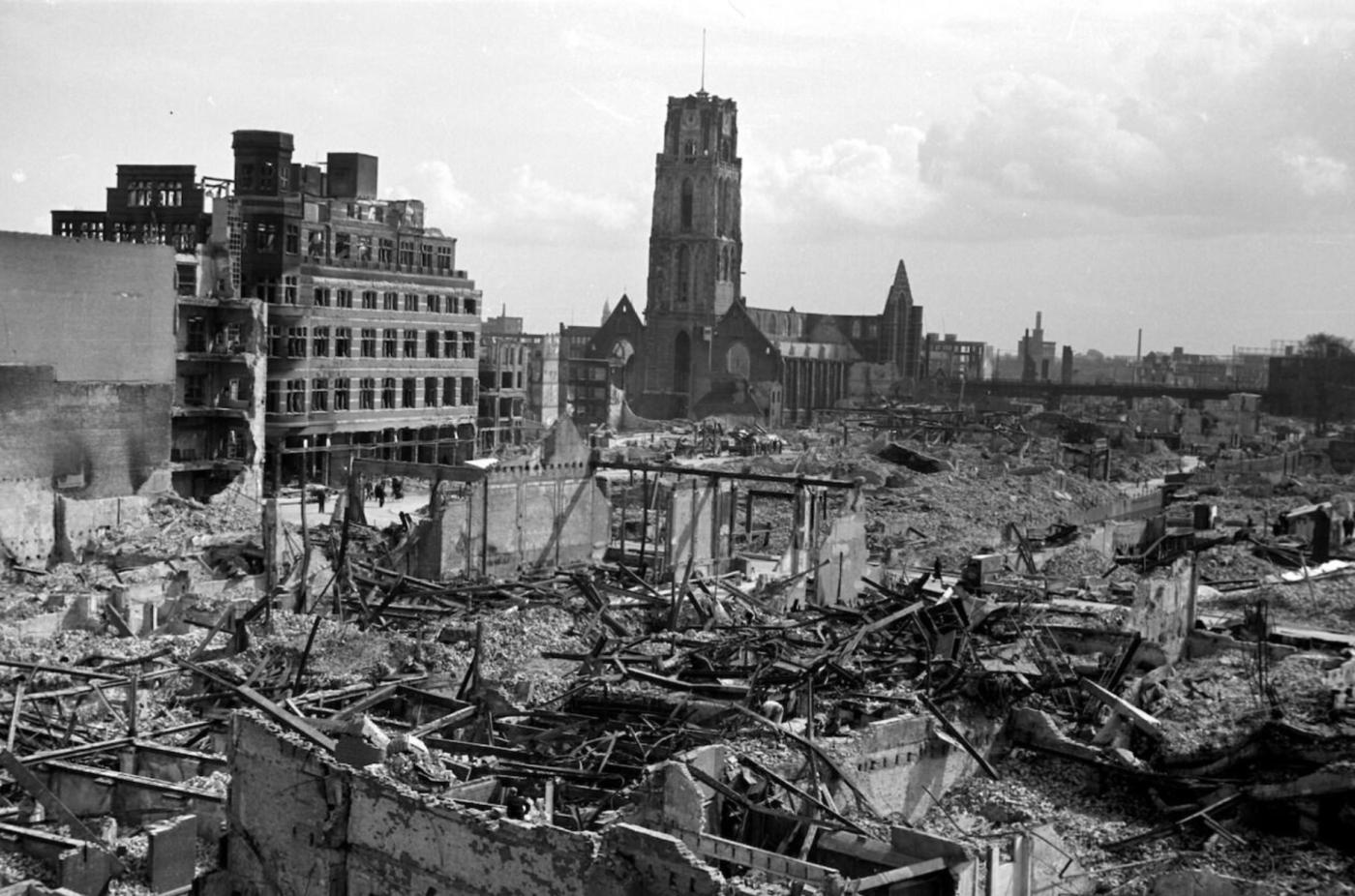
Rotterdam was particularly vulnerable to fire. Many buildings in the central districts were older structures packed closely together, and weather conditions helped flames spread quickly. Strong winds turned isolated fires into a gigantic firestorm. Entire streets vanished beneath smoke and flames. Warehouses, homes, offices, churches and historic buildings collapsed or burned uncontrollably.
An estimated 800 to 900 civilians were killed, although some early reports exaggerated the number into the tens of thousands due to the scale of destruction. Roughly 80,000 people were left homeless almost immediately. Nearly 25,000 homes were destroyed or badly damaged. About 2.6 square kilometres of the historic city centre were devastated. More than 24,000 buildings were damaged or destroyed.
One of the most tragic aspects of the attack was that many civilians believed negotiations might spare the city. Some residents had remained indoors thinking surrender discussions would prevent further fighting. Instead, the bombardment came suddenly and with terrifying force.
Photographs taken afterward showed an almost apocalyptic landscape. Large sections of central Rotterdam had become smoking ruins. Only isolated structures remained standing among the destruction. One of the few surviving landmarks was the white stone city hall building, which miraculously endured despite severe surrounding devastation. Another surviving structure was St. Lawrence Church, though it was heavily damaged.
The psychological impact was immense. The bombing demonstrated what modern strategic bombing could do to a civilian population. News of the attack spread internationally and became a symbol of ruthless German tactics. The phrase “Rotterdamed” even entered political vocabulary as shorthand for total destruction by aerial bombardment.
Immediately after the attack the Germans threatened to destroy other Dutch cities in the same way if resistance continued. German commanders specifically warned that Utrecht could suffer the same fate. Faced with the destruction of Rotterdam and unable to defend against further bombing, Dutch Commander-in-Chief General Henri Winkelman concluded continued resistance would only lead to more civilian deaths and destruction.
On 15 May 1940 the Netherlands formally surrendered, although Dutch forces in the province of Zeeland continued fighting briefly alongside French troops. Queen Wilhelmina and the Dutch government escaped to Britain, where they established a government-in-exile and continued supporting the Allied war effort.
After the surrender, Rotterdam remained under German occupation for nearly five years. The destroyed city centre was largely cleared away during the occupation period. The Germans initially considered rebuilding parts of Rotterdam according to their own plans, but wartime conditions limited large-scale reconstruction.
The people of Rotterdam endured severe hardship during the occupation years. Food shortages worsened, especially during the terrible “Hunger Winter” of 1944–45, when thousands across the Netherlands died from starvation and cold. Rotterdam’s port facilities were heavily used by the Germans and later became targets for Allied bombing raids aimed at disrupting German logistics.
When the war ended in 1945, Rotterdam faced the enormous challenge of rebuilding almost from scratch. Rather than recreate the medieval street layout that had been destroyed, Dutch planners decided to design a modern city with wide roads, open spaces and contemporary architecture. This decision permanently changed Rotterdam’s appearance.
Today Rotterdam is famous for its modern skyline, something largely born from the destruction of 1940. Unlike many historic Dutch cities, Rotterdam developed into a centre of innovative architecture with bold modern buildings, bridges and skyscrapers. The reconstruction became a symbol of resilience and determination.
One famous memorial connected to the bombing is “The Destroyed City” sculpture by Ossip Zadkine. The statue depicts a figure with its heart torn out, symbolising Rotterdam losing its heart during the bombing. It remains one of the most powerful war memorials in Europe.
Several interesting facts surround the Rotterdam Blitz. German bomber crews later reported confusion over the abort signals, and historians still debate exactly how much of the attack could have been prevented. Some scholars argue communication failures were primarily responsible, while others believe German commanders were willing to allow the bombing to proceed to force Dutch surrender quickly.
Another striking fact is that the Luftwaffe originally intended a more limited bombardment focused on military resistance around the bridges. However, the use of incendiaries and the dense urban environment caused destruction far beyond what some German planners may have anticipated.
The Rotterdam Blitz also influenced military thinking worldwide. British and German leaders both studied the attack closely. Later in the war, massive bombing campaigns against cities such as London, Hamburg and Dresden would dwarf Rotterdam in scale, but in May 1940 the attack shocked observers because such urban devastation from the air was still relatively new.
The bombing remains deeply important in Dutch national memory. Every year Rotterdam commemorates the victims on 14 May with ceremonies, moments of silence and memorial events. At 1:27 pm, the exact time the bombing began, church bells and sirens are often heard across the city in remembrance of those who died.
Although rebuilt into a thriving modern metropolis, Rotterdam still carries scars from that afternoon in 1940 when German bombers transformed the centre of one of Europe’s great port cities into an inferno within minutes.