First Telescopic Sights
Long before the age of laser rangefinders, thermal optics and precision-guided weapons, soldiers fought with little more than iron sights and instinct. Hitting a distant target depended heavily on eyesight, experience, and luck. Yet as early as the seventeenth century, inventive minds began wondering whether the newly invented telescope could somehow be attached to a firearm. The idea seemed obvious in theory but maddeningly difficult in practice. Telescopes were fragile, recoil was violent, lenses distorted images, and early guns were nowhere near accurate enough to justify magnified aiming. Still, the concept refused to die.
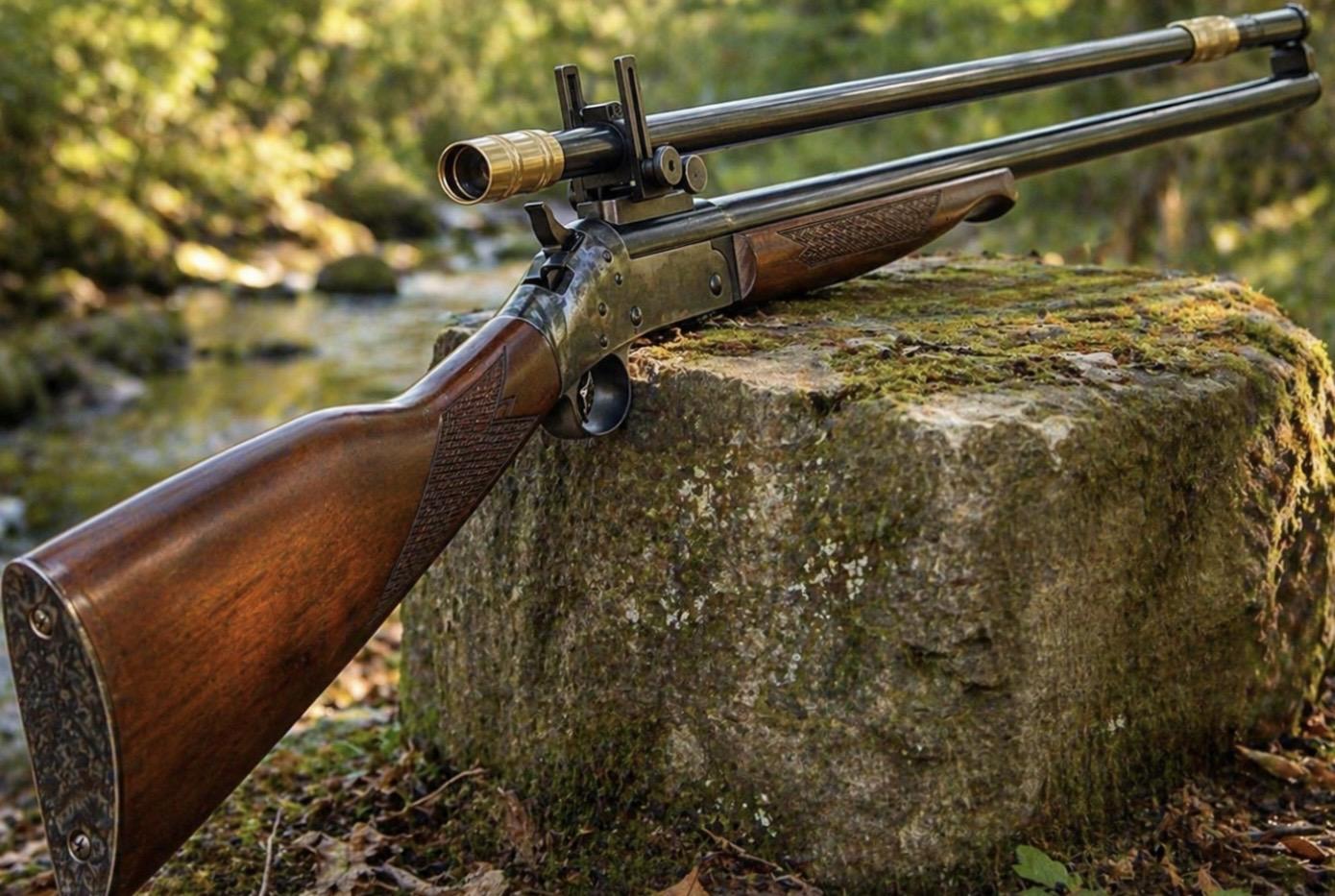
The true birth of the military telescopic sight emerged gradually through a chain of inventors, engineers, gunsmiths and marksmen rather than through one single dramatic breakthrough. Among the most important figures was John Ratcliffe Chapman, an American engineer whose work in the 1830s and 1840s transformed crude experimental optics into the world’s first practical rifle telescopic sights. Chapman collaborated with gunsmith Morgan James in New York to produce what became known as the Chapman–James sight, generally regarded as the first truly workable telescopic rifle sight for military-style shooting.
The story really begins much earlier, however. Telescopes themselves had appeared in Europe around 1608. Within decades, scientists and amateur inventors experimented with ways to use magnification for aiming weapons. English astronomer William Gascoigne discovered in the 1630s that objects placed inside a telescope could appear sharply aligned with distant targets, a principle that later became central to optical sights. Yet firearms technology lagged badly behind optics. Muskets were inaccurate, slow-loading and unreliable, so magnified sights offered little practical advantage.
One of the first documented attempts to place a telescope on a rifle came during the American Revolution. In 1776, American painter and inventor Charles Willson Peale worked with astronomer David Rittenhouse on a rifle fitted with a telescope. Peale recorded his experiments in diary entries, describing the construction and testing of “a rifle with a telescope to it.” The idea fascinated intellectuals and inventors, but the technology simply was not ready. The telescope had to sit dangerously close to the shooter’s eye, and recoil risked smashing the eyepiece into the user’s face.
For decades, telescopic sights remained curiosities seen mostly at shooting competitions and among wealthy enthusiasts. What changed everything was the dramatic improvement in rifles during the early nineteenth century. Rifled barrels became more precise, percussion ignition replaced unreliable flintlocks, and specialist marksmen began achieving astonishing accuracy at long range. Suddenly, magnified aiming devices became genuinely useful.
This was the world that John Ratcliffe Chapman entered. Chapman was not merely an inventor; he was a highly skilled rifleman obsessed with precision shooting. In his influential 1844 book The Improved American Rifle, he described the telescopic sight designs he had developed with Morgan James. Their scopes were long metal tubes mounted above the rifle barrel using adjustable fittings. By modern standards they looked primitive, but they solved critical problems that had defeated earlier attempts.
Most importantly, Chapman’s designs could survive repeated firing without instantly losing alignment. That sounds simple today, but at the time it was revolutionary. Recoil shook earlier optical systems apart. Chapman and James improved mounting stability and alignment mechanisms so the sight could remain accurate after multiple shots. Their work effectively transformed the telescopic sight from a novelty into a practical weapon accessory.
The idea spread rapidly because it arrived at precisely the right historical moment. Military thinking was changing. Armies were beginning to recognize the value of trained marksmen who could engage officers, artillery crews and scouts at long distances. Rifles were becoming more accurate every year. Industrial manufacturing also made precision metalwork more achievable than ever before.
By the 1850s, another major innovator entered the field: William Malcolm of Syracuse, New York. Malcolm refined Chapman’s concepts dramatically, introducing better-quality achromatic lenses that produced sharper images with less distortion. He also improved windage and elevation adjustments, allowing shooters to compensate for distance and crosswinds. Malcolm scopes varied from roughly three-power to twenty-power magnification, extraordinary for the era.
These improvements arrived just before the outbreak of the American Civil War, a conflict that unexpectedly became the proving ground for military telescopic sights. Sharpshooters on both Union and Confederate sides began using scoped rifles in combat. For perhaps the first time in history, soldiers could deliberately target enemy personnel hundreds of yards away with frightening precision.
The psychological effect was enormous. Traditional warfare still relied heavily on visible formations and officers leading troops openly from horseback or the front ranks. Scoped rifles suddenly made such visibility dangerous. Officers became prime targets. Soldiers learned to avoid exposing themselves unnecessarily. Warfare was beginning to evolve into something more modern, more cautious and far deadlier.
Union sharpshooter units led by Colonel Hiram Berdan became particularly famous for their use of precision rifles equipped with telescopic sights. Confederate sharpshooters used imported Whitworth rifles fitted with Davidson optical sights. These rifles achieved legendary reputations for accuracy during the war. Some marksmen reportedly made successful shots at ranges previously considered impossible.
The military establishment initially viewed telescopic sights with skepticism. Many officers believed scopes were delicate gimmicks unsuitable for battlefield conditions. In fairness, early optics did have serious flaws. Fogging, poor light transmission, narrow fields of view and fragile mounts remained constant problems. Yet battlefield success steadily overcame resistance.
What makes the story especially fascinating is how quickly the technology evolved once its usefulness became clear. Within only a few decades, telescopic sights progressed from experimental handmade tubes to increasingly sophisticated precision instruments. Improvements in glass manufacturing, machining and ammunition all accelerated development together. Each innovation in rifles encouraged better scopes, while better scopes encouraged more accurate rifles.
By the late nineteenth century, Europe had joined the race. German and Austrian optical firms, particularly those connected to Carl Zeiss, began revolutionizing lens quality and optical engineering. Their work laid the foundation for the modern sniper scope. During the First World War, telescopic sights became standard equipment for specialist snipers on all sides. By the Second World War, sniper rifles equipped with advanced scopes had become among the most feared weapons on the battlefield.
Yet the roots of all this modern precision warfare trace back to those early pioneers struggling to combine fragile telescopes with heavy recoiling rifles. John Ratcliffe Chapman stands at the center of that transformation because he helped turn a centuries-old idea into a practical military reality. His work bridged the gap between scientific curiosity and battlefield application.
Today’s sniper scopes, with their illuminated reticles, ballistic computers and night-vision systems, are descendants of those long brass tubes mounted awkwardly atop nineteenth-century rifles. The principle remains astonishingly similar: magnify the target, align the shot, and strike accurately at distance. What began as a daring experiment by inventive gunsmiths and determined marksmen became one of the most influential developments in military history.