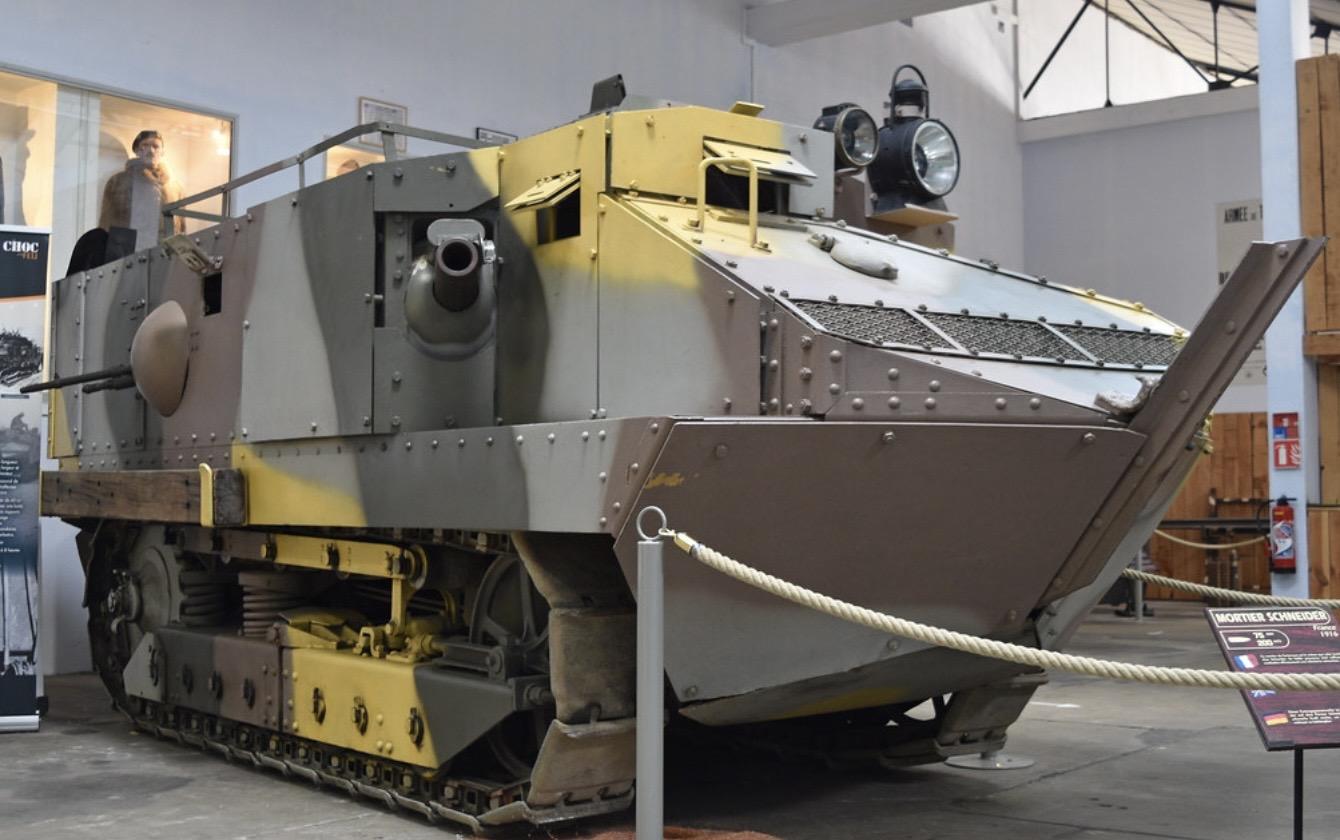
WW1 first French Tank
The French tank Schneider CA.1 holds the distinction of being the first operational tank used by the French Army during the First World War, and its creation was closely tied to the desperate search for a way to break the deadlock of trench warfare on the Western Front. By 1915 the French, like the British, were searching for machines that could cross trenches, crush barbed wire and protect soldiers from machine-gun fire while advancing across the shattered battlefield. This early French armoured vehicle emerged from that urgent requirement and represented one of the first serious attempts anywhere in the world to turn the concept of the tank into a practical weapon.
The vehicle was designed under the direction of Eugène Brillié, an engineer working for the industrial firm Schneider et Cie. Brillié had been involved with experiments using American Holt tractors before the war, and these machines provided the inspiration and mechanical basis for the new design. The project gained momentum in late 1915 when Colonel Jean Baptiste Eugène Estienne, often called the “father of the French tank,” became a strong advocate for the development of armoured tracked vehicles. Estienne believed such machines could restore mobility to the battlefield, and he successfully persuaded the French high command to support the project. Schneider et Cie, based at Le Creusot in eastern France, received the contract to build the new tanks, with production carried out at their large industrial works there. Manufacturing began in early 1916 and the first vehicles were completed later that year. In total about 400 were produced.
The design reflected the experimental nature of early tank development. Rather than being a completely new machine, it was built around a modified Holt tractor chassis, which imposed limitations on its performance. The hull consisted of an armoured box mounted over the tracks, with a distinctive short nose projecting forward. This front overhang was intended to help the vehicle crush barbed wire and obstacles but unfortunately created serious problems when crossing trenches, as the nose could dig into the ground and cause the tank to become stuck. The tracks themselves did not extend the full length of the hull as on later tanks, which further reduced its trench-crossing ability.
The tank carried a crew of six men consisting of a commander who also acted as the main gunner, a driver, a mechanic responsible for maintaining the engine and mechanical systems, and three machine-gunners. Conditions inside were extremely cramped, noisy and hot, particularly because early tanks lacked proper ventilation systems. The engine was located inside the fighting compartment, filling the interior with heat, fumes and smoke during operation. Communication between crew members was difficult and often relied on shouting or simple physical signals.
Its main armament consisted of a short-barrelled 75 mm Blockhaus Schneider gun mounted on the right front side of the hull. This weapon was derived from a fortress gun and was intended to destroy machine-gun nests, bunkers and other fortified positions encountered during an assault. The gun had limited traverse, meaning the entire vehicle often had to be turned in order to aim effectively. In addition to the main gun, two 8 mm Hotchkiss machine guns were mounted in ball mounts on the sides of the hull to defend against infantry approaching from the flanks. Later modifications sometimes added extra machine guns to strengthen defensive capability.
Armour protection ranged from about 5.5 mm to roughly 11 mm depending on the location. This thickness was sufficient to stop rifle bullets and shrapnel fragments, which were the most common battlefield threats at the time, but it offered little protection against artillery fire or the specialised anti-tank weapons that would appear later in the war. The armour plates were bolted onto the vehicle’s frame rather than welded, a typical method used in early armoured vehicle construction.
The machine weighed approximately 13.5 tonnes and was powered by a Schneider four-cylinder petrol engine producing around 60 horsepower. This gave it a top speed of roughly 8 kilometres per hour on roads, though its speed across rough ground was usually much slower. Its operational range was around 45 kilometres depending on terrain and fuel consumption. Mechanical reliability was a constant concern, and the harsh battlefield conditions of the Western Front placed great strain on the suspension and track systems.
These tanks first saw combat on 16 April 1917 during the Nivelle Offensive near Berry-au-Bac, marking the first large-scale use of French armoured vehicles in battle. The attack quickly exposed several weaknesses in the design. Of the 132 machines committed to the operation, many were destroyed, disabled or became stuck before reaching their objectives. German artillery rapidly targeted the slow-moving vehicles, and the prominent fuel tanks mounted along the sides of the hull proved dangerously vulnerable. When struck, these fuel tanks frequently ignited, leading to catastrophic fires that trapped or killed the crew inside. The heavy losses suffered during this first engagement shocked French commanders and demonstrated the risks of employing tanks without careful planning or sufficient infantry support.
Despite these problems, the vehicle still contributed to the development of armoured warfare. Engineers introduced improvements after the early battles, including better armour arrangements and protective shielding for the fuel tanks. Tactical doctrine also evolved, with tanks being used in closer cooperation with infantry and artillery rather than being sent forward in isolation.
The design continued to see service throughout 1917 and into 1918, though it was gradually supplemented and eventually overshadowed by the far more effective Renault FT light tank. The Renault’s rotating turret, lighter weight and improved mobility made it much better suited to the conditions of the Western Front. Compared with that later design, this early French tank represented an awkward transitional step, still heavily influenced by the tractor technology from which it had developed.
Even with its shortcomings, the vehicle deserves recognition as one of the pioneers of armoured warfare. It was among the earliest tanks ever used in combat and represented France’s first serious attempt to harness armoured vehicles to break the stalemate of trench fighting. The experience gained from its design, construction and battlefield service directly influenced later tank development both in France and abroad, demonstrating the importance of mobility, improved crew protection and better integration with infantry tactics.
Today only a single surviving example remains, preserved at the Musée des Blindés tank museum in Saumur, France. This rare survivor stands as a reminder of the experimental beginnings of armoured warfare and of the engineers and soldiers who worked with these early machines under extremely dangerous conditions. Although far from perfect, it played an important role in the early evolution of the tank as a decisive weapon on the modern battlefield.