Winston passes
Winston Churchill died in London on 24 January 1965 at the age of ninety, bringing to an end one of the most formidable and influential lives in British history. His death followed a long period of failing health, marked by several strokes, the most serious occurring in 1953 and leaving lasting physical effects. In his final years he withdrew almost entirely from public life and was cared for at his home in Hyde Park Gate. The date of his death carried a poignant symmetry, as it fell exactly seventy years after the death of his father, Lord Randolph Churchill, a coincidence that many at the time felt would not have escaped his notice.
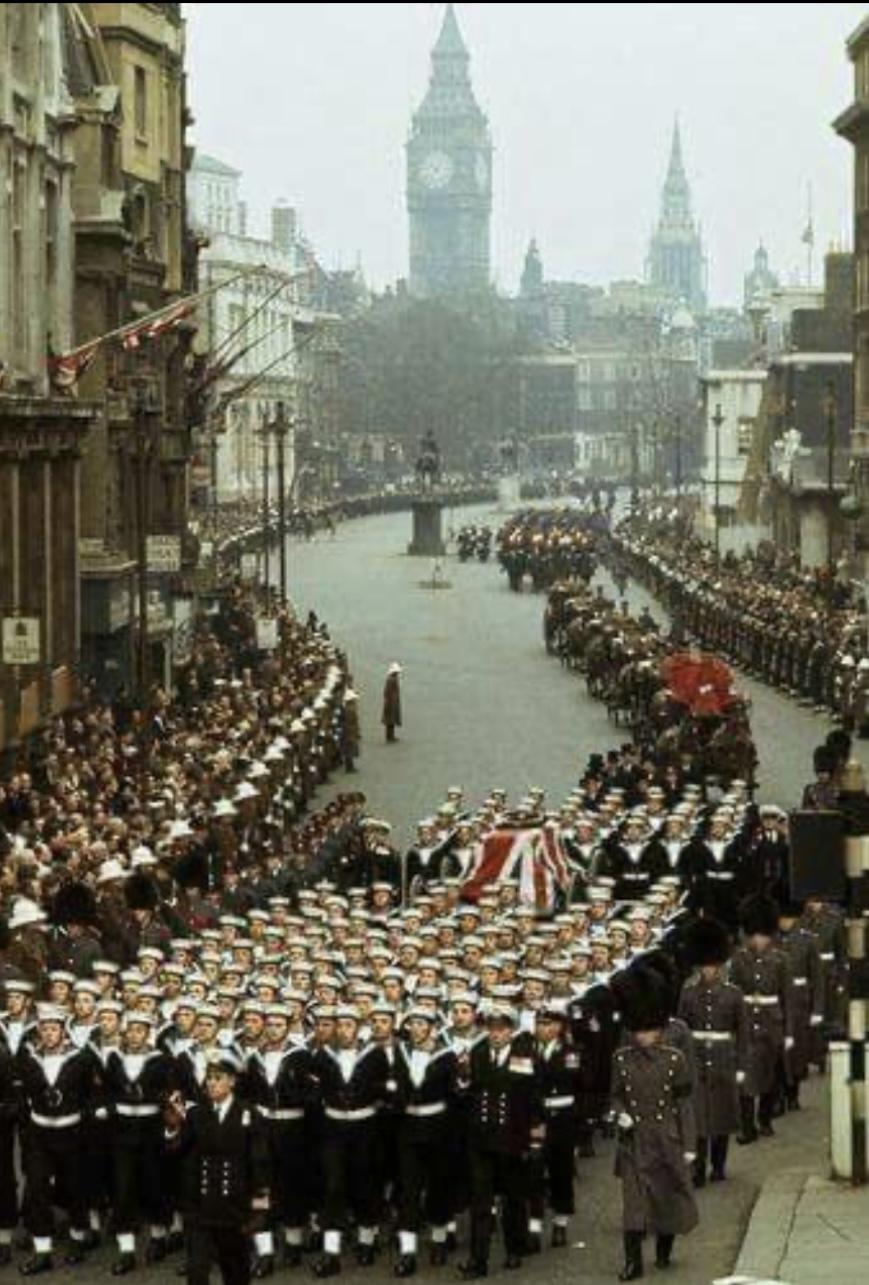
The response to his passing was immediate and immense, both in Britain and across the world. He was accorded a state funeral, an honour granted only to the most exceptional figures in national life and one not given to a non-royal since the Duke of Wellington in 1852. The state funeral took place on 30 January 1965 and became one of the most significant ceremonial events of the twentieth century. On that day, London was the focus of a remarkable public expression of respect. Hundreds of thousands of people lined the streets in silence as his coffin lay in state at Westminster Hall and was then borne through the capital, while millions more followed the proceedings on television and radio.
The funeral combined centuries-old tradition with powerful modern symbolism. After the service at St Paul’s Cathedral, the coffin was carried along the River Thames aboard the launch Havengore. As it passed, the cranes lining the river lowered their jibs in a spontaneous salute by dockworkers, an unscripted gesture that became one of the defining images of the occasion. He was later buried in a private family ceremony at St Martin’s Church in Bladon, near Blenheim Palace, where he had been born.
His enduring reputation rests above all on his leadership during the Second World War. Without his bulldog determination, refusal to compromise, and fierce belief in ultimate victory, Britain’s survival in 1940 would have been far from assured. When much of Europe had fallen and invasion seemed imminent, he mobilised the entire nation, not only in practical terms but in spirit. Through speeches that blended defiance, historical perspective, and emotional force, he transformed fear into resolve and convinced the public that endurance itself was an act of resistance.
Leadership extended well beyond words. He reshaped government to meet the demands of total war, pressed military commanders relentlessly, and insisted that Britain continue fighting even when prospects appeared bleak. Crucially, he understood that victory could not be achieved alone. By cultivating a close relationship with the United States, particularly with President Franklin D. Roosevelt, he worked tirelessly to secure American support long before the country formally entered the conflict. Measures such as Lend-Lease flowed from this effort, and when the United States did join the war, it did so as a vital ally in the struggle against Nazi Germany.
Beyond wartime leadership, there were many lesser-known facets to his character. He was a prolific writer and historian, awarded the Nobel Prize in Literature in 1953 for his historical works and oratory. He was also an accomplished painter, taking up art seriously as a way of coping with depression, which he famously described as his “black dog.” Despite popular imagery, he never actually owned a bulldog; the animal became associated with him purely as a symbol of stubborn courage and national resilience.
He was a complex and sometimes controversial figure, even in his own lifetime, and he readily acknowledged personal flaws and mistakes. Yet the scale and dignity of the response to his death reflected a widespread belief that his leadership had been decisive at a moment when Britain’s future, and that of much of Europe, hung in the balance. The silence of the crowds on 30 January 1965, the presence of world leaders at the funeral, and the enduring power of his wartime words testified to a legacy forged in crisis, marking not merely the passing of a man but the closing of an era defined by courage, endurance, and an unshakeable belief in eventual victory.