British submarine Badge
The distinctive badge worn by members of the British Royal Navy Submarine Service first appeared during the First World War. Before this time, submariners had no special insignia to distinguish them from the rest of the fleet. Submarines were still a relatively new and sometimes controversial weapon, and many senior naval officers in the early years regarded them as experimental craft rather than a fully accepted arm of the navy. Nevertheless, the men who served in them quickly developed a strong sense of identity and pride in their specialised role beneath the sea. By 1917 the Admiralty recognised that this growing branch of the navy deserved its own symbol.
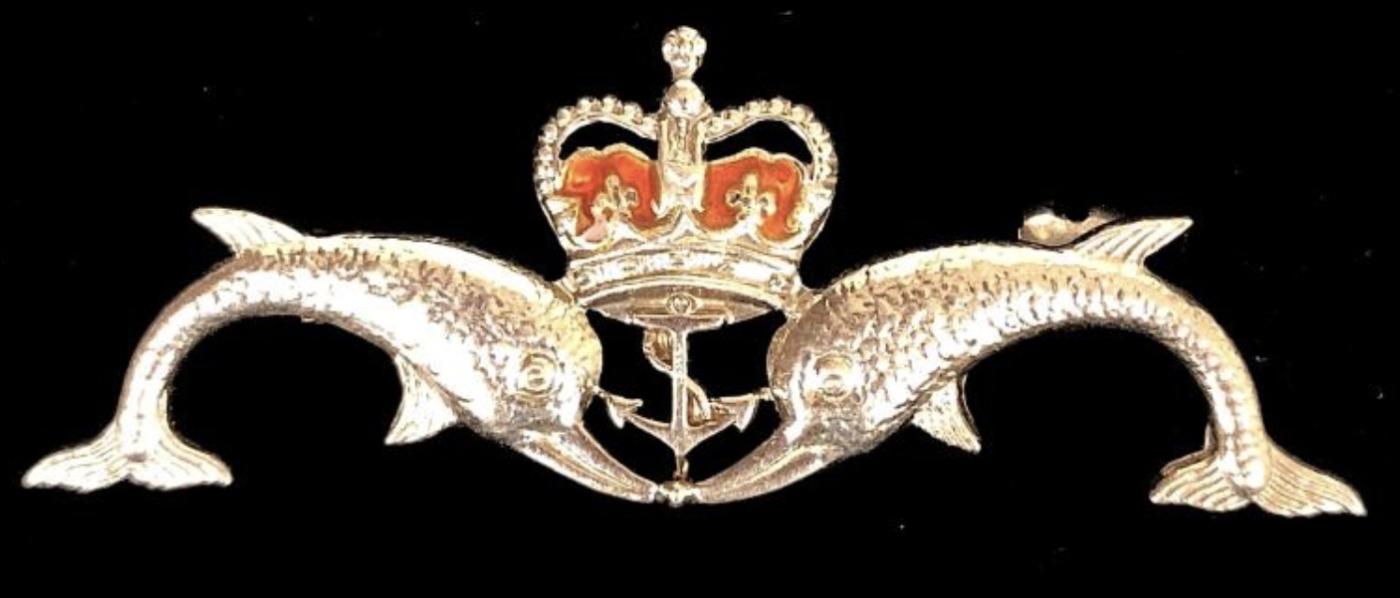
The badge that emerged from this decision became known officially as the Submarine Service badge, although sailors soon adopted the informal name “Dolphins.” The emblem consisted of a stylised submarine positioned horizontally in the centre, flanked on each side by a dolphin facing outward. The design was simple but striking and could be recognised easily on naval uniform.
The concept and design of the badge are widely attributed to Admiral Sir Arthur Wilson. Wilson had previously served as First Sea Lord and remained an influential figure within the Admiralty. Earlier in his career he had famously expressed scepticism about submarines, yet he was later involved in discussions about creating a suitable emblem for those serving in the underwater fleet. His design placed a submarine between two heraldic dolphins, a symbol long associated with the sea and maritime tradition.
Dolphins had appeared in naval art and heraldry for centuries and were commonly used to represent speed, skill, and mastery of the ocean. Their curved forms also complemented the shape of the submarine, creating a balanced composition that worked well as a small metal badge. The submarine shown in the design was not meant to represent a specific class but rather a generalised profile with a long hull, raised bow, and conning tower, ensuring that the badge would remain appropriate as submarine technology evolved.
The Admiralty officially approved the badge in 1917, at a time when British submarines were playing an increasingly important role in naval operations during the First World War. Submarine crews had already carried out successful patrols against enemy warships and merchant vessels, and the service had gained growing respect within the navy.
Once authorised, the badge was awarded to officers and ratings who had successfully qualified for submarine service. Qualification required technical training and operational knowledge, including understanding submarine systems, navigation, torpedoes, and emergency procedures. Submarines of the period were small, mechanically complex, and extremely hazardous, so earning the badge became a mark of both technical competence and personal courage.
The badge was worn on the left breast of the naval uniform. Officers typically wore a gilt or gold-coloured version, while ratings usually wore a bronze or brass example. Although the basic design remained the same, small differences in finish and construction appeared depending on the manufacturer.
Production of the earliest submarine badges was carried out by several well-known British military insignia makers. Among the most prominent was J. R. Gaunt & Son, a major manufacturer with workshops in London and Birmingham. Gaunt produced a wide range of military badges and regalia and became one of the principal suppliers of insignia for the British armed forces during the late nineteenth and early twentieth centuries.
Another important manufacturer was Firmin & Sons of London. The firm had been producing uniform buttons, badges, and ceremonial metalwork since the eighteenth century and was highly respected for the quality of its military insignia. Firmin produced submarine badges for officers and was known for precise die-striking and fine detail in its metalwork.
Spink & Son, another London company well known for medals and decorations, is also believed to have produced some early examples. Companies such as these used hardened steel dies engraved with the badge design. Metal blanks were placed in the die and struck under heavy pressure, producing a sharply detailed emblem that could then be polished or plated.
Most early badges were made from brass or bronze. Officer versions were often gilded or gold plated to give a more distinguished appearance. In some cases a heavy gold wash or fire-gilding technique was used, producing a deep, rich finish. The reverse side usually featured small lugs or loops through which a pin or thread could pass so the badge could be attached securely to the uniform. Later versions adopted brooch-style fasteners.
The design itself showed careful sculpting in the dolphins, whose curved bodies and raised fins created a sense of movement around the central submarine. This flowing design contributed to the badge’s distinctive appearance and helped establish its enduring popularity.
Within the navy the badge quickly gained its familiar nickname. Sailors began referring to it simply as “Dolphins,” a name derived from the two dolphins framing the submarine. The phrase “earning your dolphins” soon became common among submariners, referring to the completion of training and acceptance into the Submarine Service.
Submarine duty during the First World War carried significant risk. Early submarines were cramped, mechanically fragile, and vulnerable to accidents, mines, and enemy countermeasures. Crews operated in difficult conditions for long periods underwater, often relying entirely on their training and teamwork to survive emergencies. For this reason the dolphins became a powerful symbol of belonging to a specialised and highly respected branch of the Royal Navy.
The badge also helped strengthen the identity of the Submarine Service. Submarine crews operated independently and frequently far from the main fleet, which encouraged a strong sense of camaraderie and professionalism. Wearing the dolphins signified membership in a close-knit community that shared unique responsibilities and dangers.
Despite changes in naval uniforms and manufacturing methods over the following decades, the basic design introduced in 1917 has remained almost unchanged. The central submarine and the two dolphins remain exactly as they were originally conceived, and modern Royal Navy submariners still wear a badge that is instantly recognisable as the same emblem created during the First World War.
Today the submarine dolphins are regarded as one of the most respected badges in the Royal Navy. The qualification process has become far more formalised and demanding, requiring sailors to learn every major system aboard their submarine and demonstrate their ability to deal with emergencies at sea. When a submariner finally receives the badge, it represents the continuation of a tradition that began more than a century ago.
Early examples of these badges produced by firms such as Gaunt and Firmin are now highly valued by historians and collectors. Maker marks, construction methods, and small design variations can often reveal which company produced a particular badge and during which period it was made. These original pieces provide a direct connection to the earliest days of Britain’s submarine service and to the sailors who first wore the dolphins during the dangerous patrols of the First World War.