FR F2 Sniper Rifle
The FR F2 sniper rifle is a French bolt-action precision rifle developed for the French Armed Forces during the Cold War. The designation FR F2 stands for “Fusil à Répétition modèle F2,” meaning repeating rifle model F2. It entered service in the mid-1980s and served as the primary sniper rifle of the French Army for more than three decades. The rifle was designed as an improvement of the earlier FR F1 sniper rifle and was intended to provide French infantry units with a reliable and highly accurate weapon capable of engaging targets at long ranges in both conventional and urban combat environments.
The design of the FR F2 originated from earlier French sniper programs after the Second World War. During the war France relied mostly on adapted infantry rifles rather than dedicated sniper systems. In the 1960s the French military introduced the FR F1 sniper rifle, which itself was based on the bolt-action mechanism of the MAS-36 infantry rifle. The MAS-36 action was simple, extremely durable and known for its reliability. The FR F1 used the French 7.5×54 mm cartridge, but when France standardized with NATO ammunition in the 1980s a new rifle was required that could fire the 7.62×51 mm NATO cartridge. Instead of designing a completely new weapon, engineers modified and upgraded the FR F1 platform, resulting in the FR F2.
The rifle was designed and produced by the French government arms manufacturer Manufacture d’armes de Saint-Étienne. This factory had produced military firearms for France since the eighteenth century and was responsible for many of the country’s rifles. Later the factory was integrated into the state defense company GIAT Industries, which eventually became Nexter. Most FR F2 rifles were not built entirely new but were conversions of existing FR F1 rifles. The conversion involved replacing the barrel with a new one chambered for the NATO cartridge, reinforcing parts of the receiver, improving the barrel mounting system, and fitting additional equipment designed to increase accuracy and durability.
Production numbers were relatively small compared with mass-issued infantry rifles. Approximately six thousand FR F1 rifles were produced during the original production run, and about three thousand five hundred of those were later converted into FR F2 configuration. Because the rifle was primarily a conversion program rather than a completely new production line, the total number of FR F2 rifles is usually estimated at around three to four thousand weapons. These rifles equipped French Army sniper teams for many years and were also used by other branches of the French military including the Air Force and Navy. Some rifles were supplied in small numbers to allied forces and special units.
The FR F2 is a manually operated bolt-action rifle. The bolt is derived from the MAS-36 system and locks securely into the receiver, providing strong support for the high-pressure 7.62 NATO cartridge. The rifle uses a detachable box magazine that holds ten rounds of ammunition. This capacity is relatively large for a bolt-action sniper rifle and allows the sniper to fire multiple shots without reloading. The 7.62×51 mm NATO cartridge used by the rifle is one of the most widely used sniper and marksman rounds in the world due to its balance of power, manageable recoil and long-range capability.
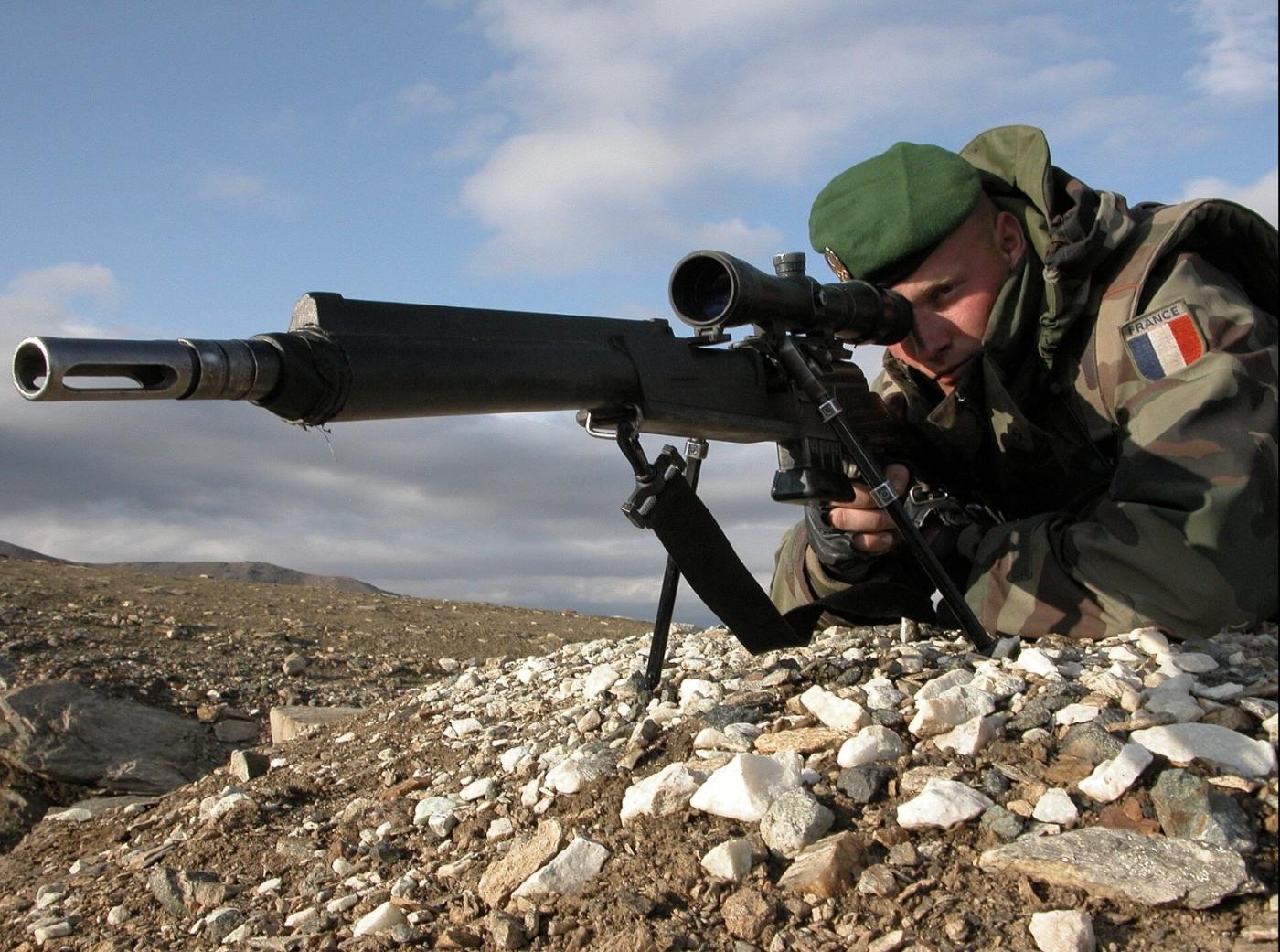
One of the most distinctive features of the FR F2 is the large thermal sleeve surrounding the barrel. This protective cover serves several purposes. It reduces the effect of temperature changes on the barrel, which helps maintain consistent accuracy during extended firing sessions. It also prevents heat waves rising from the barrel from distorting the sniper’s sight picture through the scope, a phenomenon known as mirage. The sleeve also provides protection against external impacts and environmental damage in rough field conditions.
The rifle uses a free-floating barrel design in which the barrel does not touch the stock along most of its length. This prevents pressure from the stock or the shooter’s grip from affecting the barrel’s vibration during firing. Controlling these vibrations is important for maintaining tight shot groups and consistent accuracy. The FR F2 also includes an adjustable bipod mounted near the front of the rifle. This allows the shooter to stabilize the weapon when firing from prone or supported positions.
Accuracy is one of the main strengths of the FR F2. Military testing showed that the rifle could produce very tight shot groupings at typical sniper engagement distances. At two hundred meters the rifle was capable of grouping ten shots within roughly twelve centimeters. In practical military use the rifle is considered effective against point targets out to around eight hundred meters, although the bullet itself can travel much farther. The muzzle velocity of the standard 7.62×51 mm NATO round fired from the FR F2 is approximately 820 meters per second.
The rifle weighs about 5.1 kilograms unloaded and has a total length of approximately 1.13 meters. The barrel length is about 600 millimeters. Its relatively heavy weight helps absorb recoil and stabilize the weapon during firing. The rifle is normally equipped with a telescopic sight rather than iron sights as the primary aiming system. Various scopes have been used with the rifle, including French military optics designed specifically for sniper operations.
Another interesting aspect of the FR F2 is its camouflage and concealment features. The rifle’s stock and barrel covering are often finished in matte black or dark coatings that reduce reflections. The thermal sleeve and barrel shroud also help break up the outline of the rifle, making it less noticeable in the field. Many rifles were also fitted with suppressors during specialized operations to reduce noise and muzzle flash.
The FR F2 saw extensive service with French forces in many conflicts and overseas deployments. It was used by French troops in peacekeeping missions, counterterrorism operations and combat operations in places such as the Balkans, Afghanistan and various African deployments. French military snipers used the rifle for both long-range precision fire and designated marksman roles within infantry units.
After more than thirty years of service the FR F2 began to be gradually replaced by newer sniper systems that offered improved modularity and longer range capabilities. The French military introduced newer rifles such as the PGM Ultima Ratio and later precision rifles designed for extended-range engagements. Despite this replacement process many FR F2 rifles remained in service for years because of their proven reliability and accuracy.