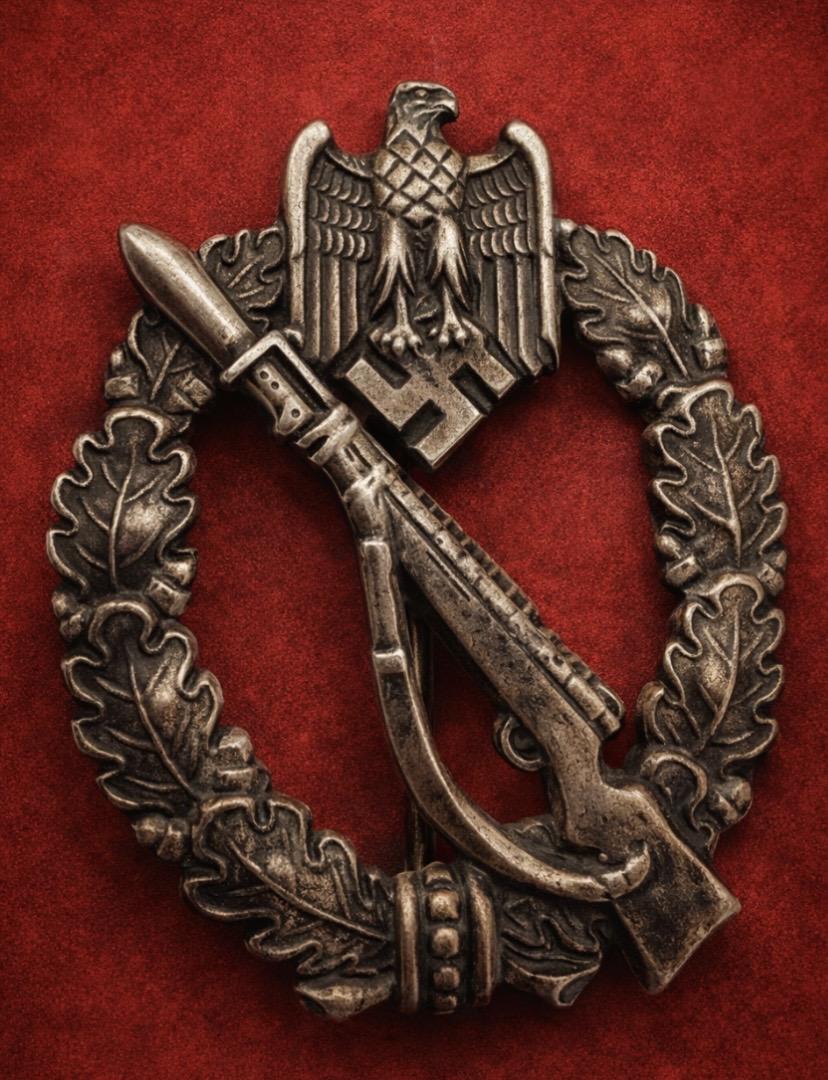
Waffen SS infantry Assault badge/award
The Infantry Assault Badge, known in German as the Infanterie-Sturmabzeichen, was one of the most widely awarded combat badges of the Second World War and was worn by both Wehrmacht infantry and Waffen-SS soldiers who met the qualifying conditions. It was introduced on 20 December 1939, shortly after the Polish campaign, as a way to recognise infantrymen who had actively taken part in front-line assault combat rather than simply serving in a combat zone.
The badge was awarded to soldiers who had participated in at least three separate infantry assaults on different days. These could include full attacks, counter-attacks, or close combat engagements. Because of the nature of the war on the Eastern Front especially, many Waffen-SS troops qualified for and wore this badge, as they were frequently involved in intense front-line fighting.
The design was created by the Berlin firm C. E. Junker, which was also one of the earliest producers. The badge has a very distinctive appearance, formed as an oval oak leaf wreath with the national eagle and swastika at the top, and a Karabiner 98k rifle with fixed bayonet running diagonally across the centre. The oak leaves symbolised strength and endurance, while the rifle represented the infantryman in combat, making the badge a clear visual representation of front-line service.
Although Junker produced the early examples, manufacture quickly expanded to many different companies as demand increased. Firms such as Wilhelm Deumer, Friedrich Orth, Steinhauer & Lück and B. H. Mayer all produced their own versions, often with slight differences in detail. As a result, there are many variations in existence today, with differences in the shape of the wreath, the detailing of the eagle, and the construction of the pin and hinge on the reverse.
Early badges were made from tombak, a brass-based alloy, and were usually silver-plated with a high-quality finish. As the war went on and materials became scarce, production shifted to zinc. These later badges often lost their finish over time, leaving a dull grey appearance which is very typical of late-war pieces.
There were two main wartime versions of the badge. The silver version was introduced first in December 1939 and was awarded to standard infantry and mountain troops. The bronze version followed on 1 June 1940 and was awarded to motorised and mechanised infantry units, later known as Panzergrenadiers. The bronze version was not a lower grade, it simply indicated a different type of infantry service.
Exact production numbers are not known, but it is generally accepted that very large quantities were made, likely well into the hundreds of thousands and possibly into the millions when all manufacturers are taken into account. This reflects how common the award was among front-line infantry units.
The badge was worn on the lower left breast pocket of the field tunic and was often seen alongside other combat awards. For many soldiers it became a symbol of having taken part in real front-line fighting, and it carried a certain level of respect among troops.
There are a wide range of variations that interest collectors today. These include differences in maker, construction type, and materials. Some badges are hollow stamped, others are solid, and there are even rarer screw-back examples instead of the usual pin fitting. Certain makers are much harder to find than others, and these can command higher prices.
After the war, in 1957, a new version was authorised for veterans in West Germany. This version removed the swastika but otherwise kept the same general design, allowing former soldiers to wear their awards again in a denazified form.
From a collecting point of view, the Infantry Assault Badge is one of the most commonly encountered German combat badges, but that does not mean it is uninteresting. The large number of makers and subtle variations makes it a very detailed area of collecting. Common zinc examples are relatively affordable, while early tombak badges with good finish or rarer maker variants are much more desirable. Prices can vary widely depending on condition, maker and originality, with better pieces attracting strong interest.