Tourniquet Strap
The U.S. Army tourniquet strap of the Second World War was a simple but extremely important item of battlefield medical equipment designed to control severe bleeding from wounds to the arms or legs. Although primitive by modern standards, these tourniquets saved countless lives across every theater of the war, from the beaches of Normandy and the jungles of the Pacific to the deserts of North Africa and the frozen forests of the Ardennes. The standard American tourniquet of the period reflected the military medical philosophy of the early 1940s, emphasizing rapid bleeding control using lightweight, easily mass-produced equipment that could be carried by every soldier or medic.
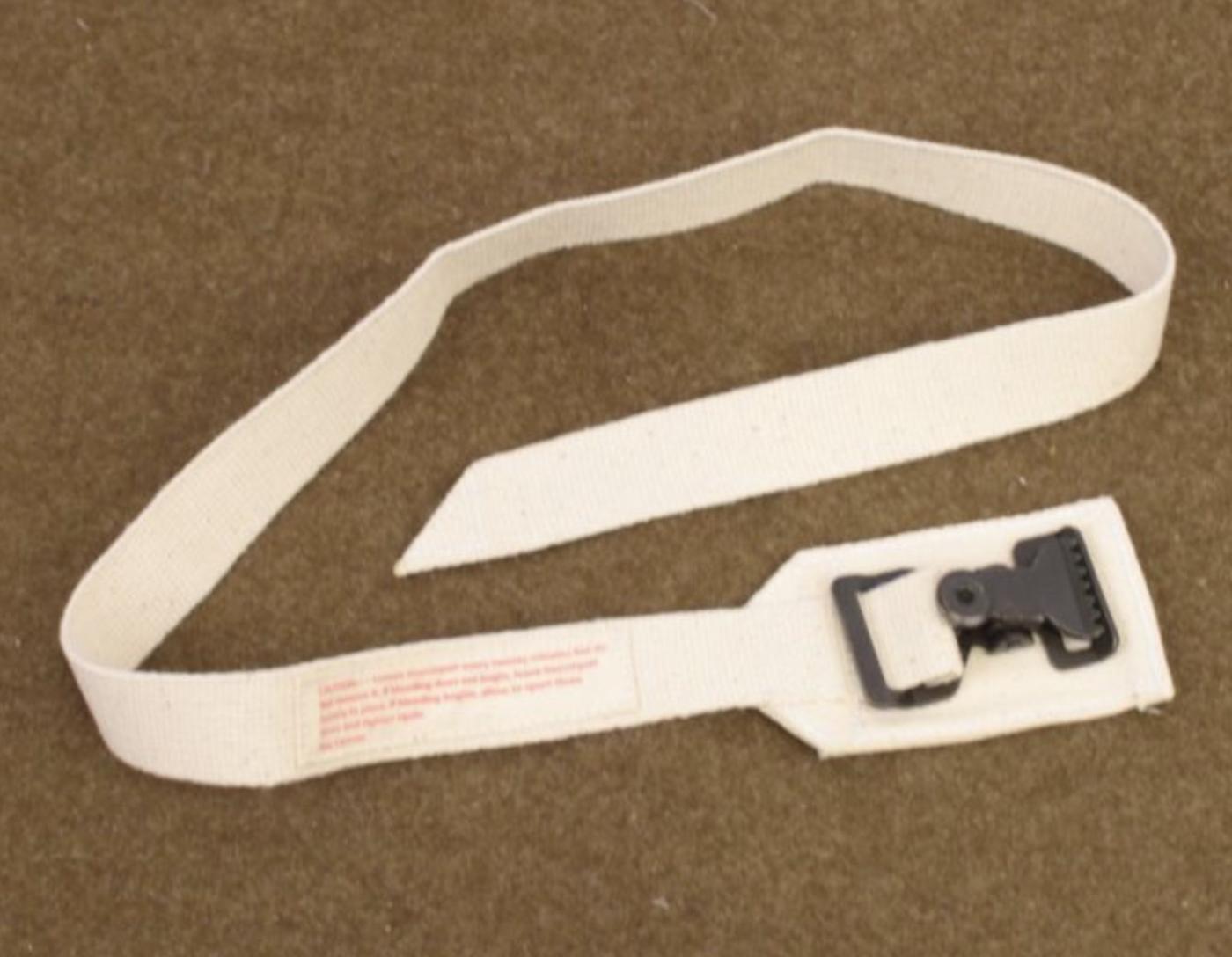
The most common U.S. tourniquet strap issued during the war was officially known as the Tourniquet, Medical Department, or simply the “tourniquet strap” in supply documents. It consisted of a length of strong olive drab webbing fitted with a metal buckle and tightening mechanism. Early-war examples were often made with khaki webbing left over from prewar stockpiles, while later wartime production standardized olive drab shades to match the rest of American field equipment. Most were compact enough to fit inside the individual first aid pouch carried on the soldier’s cartridge belt or attached to other combat gear.
The design was intentionally simple. A cloth or web strap encircled the injured limb above the wound, and the user tightened it to compress the arteries supplying blood to the injury. The tightening mechanism varied slightly between production runs and manufacturers, but most wartime U.S. tourniquets used either a friction buckle system or a metal clamp arrangement. Some models incorporated a small wooden or metal stick that could be twisted to increase pressure, functioning as a windlass. Once sufficient pressure was applied to stop arterial bleeding, the strap was secured in place until the casualty could reach surgical care.
Tourniquets were considered emergency devices rather than long-term treatments. Military doctors of the era understood that prolonged application could damage tissue or lead to loss of the limb due to restricted circulation. Soldiers and medics were trained to use them only in cases of severe hemorrhage where direct pressure or field dressings failed to stop bleeding. Medical manuals stressed placing the tourniquet several inches above the wound and loosening it only under medical supervision. Despite these instructions, battlefield chaos often led to prolonged use, especially during heavy combat or delayed evacuations.
The U.S. Army Medical Department supplied these tourniquets through a vast wartime manufacturing network involving numerous civilian contractors. Companies producing web gear and medical textiles frequently received contracts for tourniquet manufacture. Firms such as Bauer & Black of Chicago, known for surgical dressings and medical supplies, produced many wartime first aid items including tourniquets and bandages. Other contractors included companies already experienced in military web equipment production, such as the Russell Manufacturing Company, Mills Manufacturing Corporation, and various regional textile firms operating under Quartermaster or Medical Department contracts. Because wartime procurement emphasized speed and quantity, production was spread across many manufacturers, leading to small variations in stitching, buckle design, markings, and web color.
Markings on surviving examples often include the manufacturer’s initials, contract dates, or inspector stamps. Some tourniquets were marked “U.S.” while others carried only lot numbers or abbreviated company names. Collectors today identify production periods partly by examining the hardware finish, stitching style, and shade of the webbing. Brass hardware was more common early in the war, while blackened steel became increasingly common as wartime material shortages intensified.
The standard first aid packet issued to American troops frequently included a tourniquet or instructions for improvising one. Combat medics carried larger numbers of tourniquets in their aid bags, allowing them to treat multiple casualties quickly under fire. Infantrymen, paratroopers, tank crews, engineers, Marines, and other frontline personnel all potentially carried tourniquets either individually or within unit medical kits. Airborne troops in particular valued compact medical items because of the intense casualties often suffered during parachute assaults and isolated operations.
U.S. Navy corpsmen attached to Marine units in the Pacific also carried these straps extensively. Amphibious assaults frequently produced traumatic wounds from machine-gun fire, artillery fragments, and shrapnel, making rapid bleeding control essential. In the dense jungle fighting on islands such as Guadalcanal, Peleliu, and Okinawa, evacuation could be delayed for hours, increasing the importance of immediate field treatment. Marines themselves often carried individual first aid packets containing bandages and emergency medical supplies, although corpsmen remained the primary providers of battlefield care.
The tourniquet strap was also found in vehicle first aid kits, aircraft emergency packs, field hospital supplies, and medic satchels. Tank crews particularly relied on them because burns, crushing injuries, and metal fragmentation inside armored vehicles frequently caused catastrophic bleeding. Bomber crews carried medical kits aboard aircraft as well, though aviation survival equipment varied according to mission type and theater.
American military medical doctrine evolved throughout the war as combat experience revealed both the value and limitations of tourniquet use. Early-war concerns about tissue damage sometimes caused hesitation in applying them, but frontline experience demonstrated that immediate hemorrhage control often meant the difference between life and death. By late war, medics increasingly understood the importance of aggressive bleeding control, especially during mass casualty situations.
The materials used in these straps reflected wartime industrial priorities. Cotton webbing was standard because it was inexpensive, durable, and easy to manufacture in huge quantities. Metal hardware was usually steel or brass depending on production date and contractor availability. Some tourniquets included canvas tabs or sewn labels with instructions. Simplicity remained critical because battlefield conditions exposed equipment to mud, saltwater, blood, sand, and extreme temperatures.
Compared to modern combat tourniquets such as the CAT or SOFTT devices used by present-day military forces, the World War II U.S. tourniquet was relatively crude and less effective at consistently stopping arterial bleeding. Modern devices use advanced windlass systems and stronger materials designed through extensive trauma research. Nevertheless, the wartime American strap represented one of the best practical solutions available at the time and formed an important link in the development of battlefield emergency medicine.
Surviving examples today are highly collectible among military historians and equipment enthusiasts. Original straps appear in museums, reenactment collections, and private archives dedicated to U.S. military medical history. Authentic wartime specimens often show signs of field use, including faded webbing, corrosion on metal fittings, or handwritten markings from medics or soldiers. Because these items were heavily used and frequently discarded after combat, intact examples with clear manufacturer markings are especially valued.