Stickmine type -43
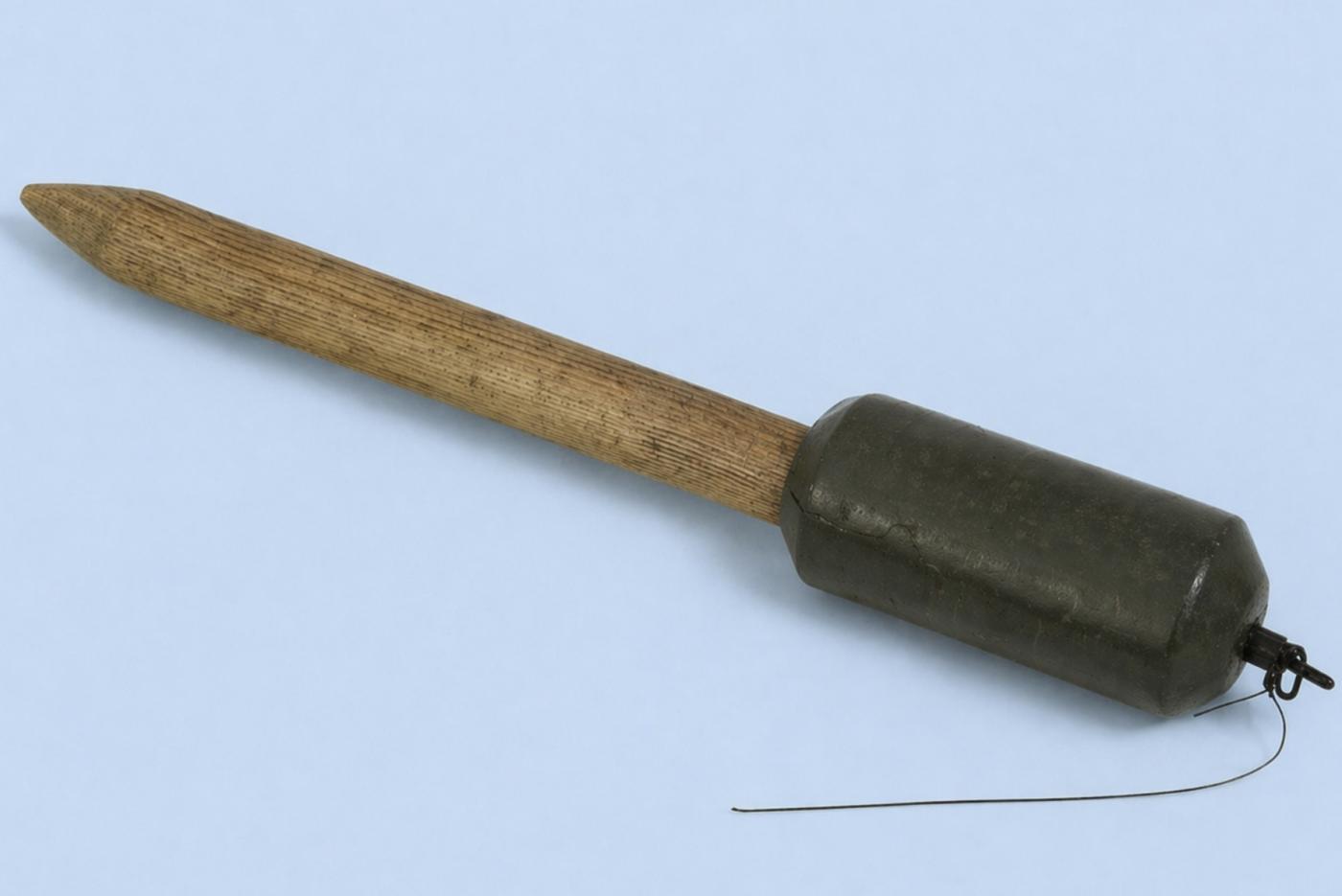
The Stockmine 43, often referred to as a concrete mine or “stick mine,” was a German anti-personnel weapon developed and introduced during the later stages of the Second World War, around 1943. It emerged at a time when Germany was facing increasing shortages of raw materials and industrial capacity, forcing engineers to design weapons that were cheap, simple, and easy to manufacture in large numbers. The result was a highly practical device that relied on basic materials and straightforward construction rather than precision engineering.
Unlike many earlier mines that used metal casings, the Stockmine 43 was built around a cylindrical body made of poured concrete. This concrete casing was often filled or mixed with scrap metal, ball bearings, or other fragments to enhance its lethality. The mine was mounted on a short wooden stake, which allowed it to be planted into the ground so that the main body sat above the surface. This elevated position was a key feature, as it ensured the explosion would occur at roughly waist height, increasing the likelihood of causing severe or fatal injuries to nearby soldiers.
Inside the concrete body was a relatively small explosive charge, typically around 100 grams of TNT or a similar high explosive. While this amount was modest compared to larger mines, the design did not rely on blast pressure alone. Instead, the explosive force shattered the concrete casing and propelled embedded fragments outward at high speed. This created a deadly spray of shrapnel, turning the mine into a directional fragmentation weapon. The lethal range was generally around 10 to 15 metres, although fragments could travel further and still cause injury depending on conditions and the materials used.
One of the strengths of the Stockmine 43 was its flexibility in deployment. It could be fitted with a variety of standard German fuzes, allowing it to be triggered in different ways. Most commonly, it was connected to tripwires that would detonate the mine when disturbed, either by tension or release. This made it effective for perimeter defence, ambush positions, and anti-infantry minefields, where it could be concealed among vegetation or along paths used by advancing troops.
The simplicity of the design meant it could be produced by a wide range of manufacturers, including smaller workshops that lacked advanced machinery. Because it used concrete instead of metal, it conserved valuable resources while still delivering effective results. Production numbers are not precisely known, but the mine was made in large quantities, likely numbering in the hundreds of thousands, reflecting its widespread use during the later years of the war.
Despite its advantages, the Stockmine 43 also had limitations. The concrete body could deteriorate over time, especially in wet or freezing conditions, which could affect reliability. In addition, the fragmentation pattern was less predictable than that of a purpose-designed metal casing, meaning its effectiveness could vary from one mine to another. Even so, its low cost, ease of production, and effectiveness at close range made it a valuable defensive weapon.
The concept behind the Stockmine did not disappear with the end of the war. Similar designs were later produced in several other countries, showing that the basic idea of a simple, elevated fragmentation mine remained useful.