SRCM Red Devil Grenade
The Italian hand grenade commonly nicknamed the “Red Devil” was one of the most distinctive infantry weapons used by Italy during the Second World War. Its bright red colour and unusual fuze system made it memorable to soldiers who encountered it on the battlefield. Designed in the mid-1930s for the Royal Italian Army, it represented part of a broader effort to modernise Italian infantry equipment with a compact and effective grenade suited for close-quarters fighting.
The weapon was introduced in 1935 during a programme that produced several new grenade designs intended to replace older First World War types. It was manufactured by the company Società Romana Costruzioni Meccaniche, whose initials provided the official designation of the weapon. Two other grenades were introduced around the same time under the same Model 35 series, produced by different manufacturers. Although the designs were broadly similar in concept, the version produced by SRCM proved to be the most widely issued and the most refined.
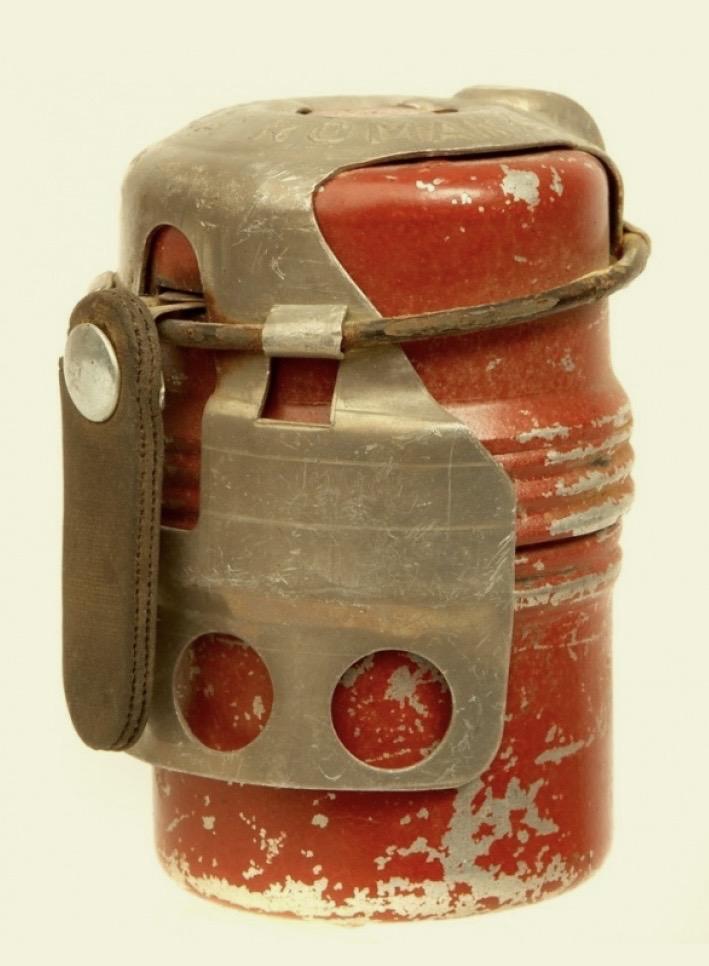
One of the most striking characteristics was its colour. Italian ordnance used colour coding to identify types of ammunition, and high explosive grenades were painted bright red. When British and Commonwealth troops first encountered them during the North African campaign, the vivid appearance combined with the grenade’s reputation for unpredictable unexploded examples quickly led to the nickname “Red Devil.” The name became widely used among Allied soldiers and remained associated with the weapon long after the war.
The design was compact and relatively lightweight compared with many contemporary grenades. Weighing only a few hundred grams, it could easily be carried in large numbers by infantrymen. The outer body was usually made from aluminium to keep the weight low, while the interior contained a cylindrical explosive charge surrounded by a coiled wire sleeve. When the explosive detonated, this wire broke apart and acted as fragmentation, scattering small metal fragments outward together with the blast.
This type of grenade was classified as an offensive weapon. Offensive grenades were intended for use during assaults, where soldiers needed to advance quickly after throwing them. Because the fragmentation effect was relatively limited, the danger area was smaller than that of heavier defensive grenades. This allowed attacking troops to throw the grenade into enemy positions such as trenches, dugouts, or rooms and then move forward immediately behind the explosion.
One of the most unusual features was the use of an impact fuze rather than a timed delay. Most grenades used by armies during the Second World War exploded several seconds after being thrown, allowing time for the soldier to take cover but also sometimes giving the enemy an opportunity to throw the grenade back. The Italian design attempted to eliminate this possibility by detonating instantly when it struck the ground or another solid object.
The arming process involved several safety features intended to prevent accidental explosions. Before throwing the grenade, the soldier removed a safety tab which released the first locking device. As the grenade travelled through the air, a protective cap separated from the body and a small internal chain removed another safety component. Once these safeguards had disengaged, the fuze mechanism was armed. On impact, a striker moved forward and hit the detonator, which immediately set off the explosive charge.
Although innovative, this impact system sometimes led to problems in service. Some grenades failed to detonate when they struck the ground, leaving them armed but unexploded. If such a grenade was later disturbed or picked up, the fuze could still activate, causing it to explode. This behaviour contributed to the weapon’s ominous reputation among Allied troops, who were often warned not to touch unexploded examples.
Several variations were produced. The standard combat version carried a high explosive charge and was easily recognised by its red body. Other versions were designed for smoke or signalling purposes, while training models were produced with reduced charges or inert components so soldiers could practise safely.
The grenade saw widespread use throughout the Second World War. Italian soldiers carried it in many theatres of fighting, particularly during the North African campaign, where Italian and German forces fought British and Commonwealth troops across the desert. It also appeared in combat during later battles in the Mediterranean and during the defence of Italy. After the Italian armistice in 1943, German forces captured large stocks and continued to issue them under their own designation.
Even after the war ended, the design remained in service for many years. It continued to be used by Italian military forces and was also issued by the armed forces of Malta. Later production versions were no longer painted bright red; instead, more subdued colours such as khaki were used, with smaller coloured markings indicating the type of grenade.
The long service life of this weapon reflected the practicality of its compact construction and simple internal mechanism.