Harley WLA
The Harley-Davidson WLA was one of the most recognizable military motorcycles used by the United States during the Second World War. Built for durability, simplicity, and easy maintenance, it became an important part of the U.S. Army’s transportation and communication system. Thousands of these rugged machines carried dispatch riders, military police, and messengers across battlefields and supply routes in Europe and other theatres of war. Although based on a civilian design, it was adapted for military service and quickly gained a reputation as a dependable workhorse.
The motorcycle was developed from Harley-Davidson’s civilian WL model, a 45-cubic-inch flathead V-twin machine that had already proven reliable in everyday use. As the United States prepared for war in the late 1930s and early 1940s, the Army needed a lightweight and flexible vehicle capable of travelling where larger vehicles could not. The WL design provided a strong foundation, and the military version was designated WLA, with the letter A indicating Army specification.
Production took place at the main Harley-Davidson factory in Milwaukee, Wisconsin. This long-established plant had been producing motorcycles since the early years of the twentieth century and was already experienced in building large numbers of machines. During the war the factory shifted heavily toward military production, turning out thousands of motorcycles alongside other wartime equipment. The Milwaukee facility became the centre of production for these Army machines, supplying both American forces and Allied nations.
Power came from a 739 cc side-valve V-twin engine designed with reliability in mind. The side-valve layout was simple and easy to maintain under field conditions and could tolerate rough treatment and varying fuel quality. With a top speed of around 65 miles per hour in good conditions, it was fast enough for military duties. Riders appreciated the strong low-speed pulling power, which was useful when travelling over rough ground or carrying equipment.
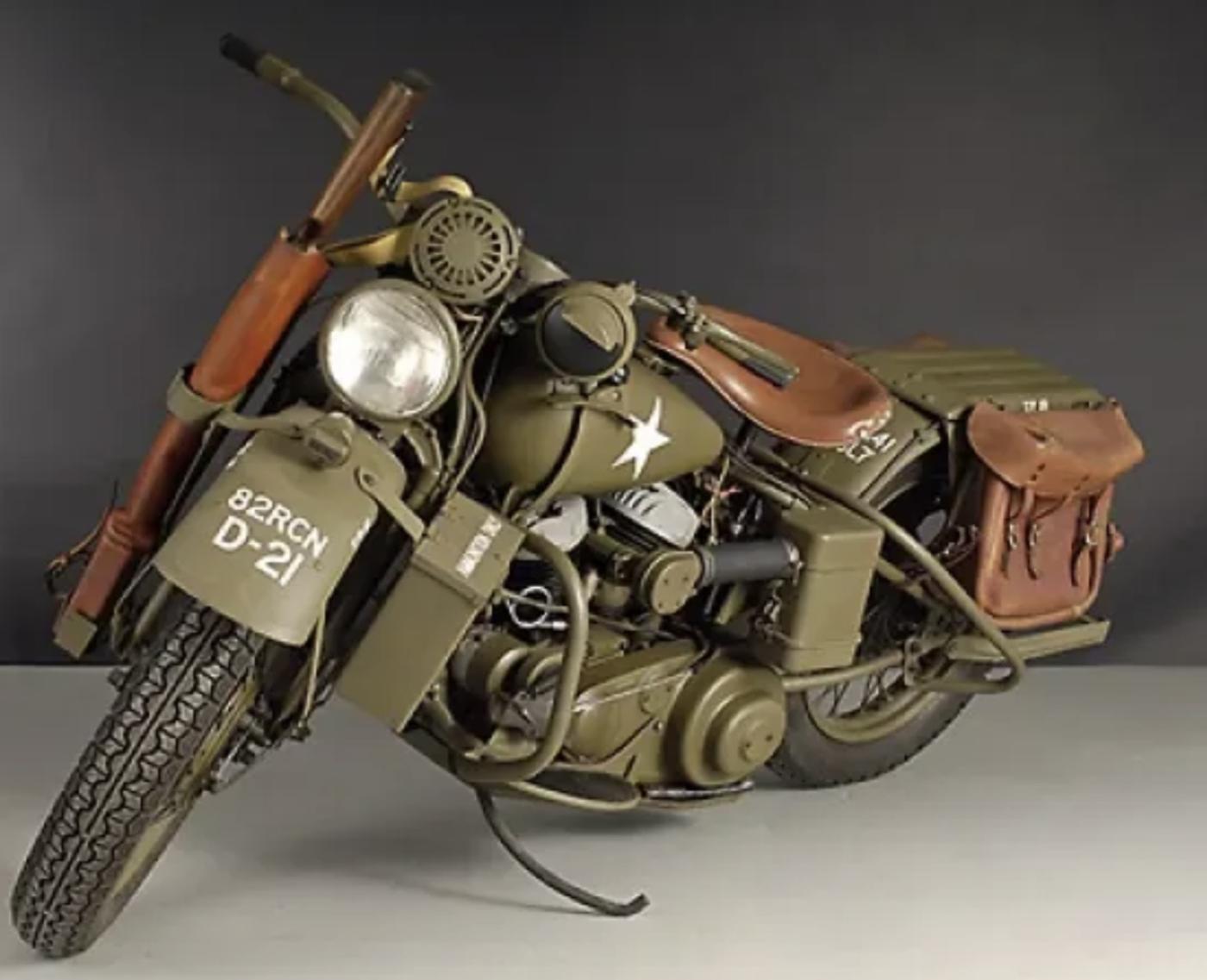
Military versions included a number of practical changes compared with civilian motorcycles. Instead of bright finishes they were painted in olive drab to reduce visibility. Blackout lights allowed riders to travel at night without drawing attention from enemy aircraft or observation posts. Leather saddlebags, heavy luggage racks, and a rifle scabbard mounted along the front fork were common fittings. Some machines were also equipped with skid plates to protect the underside of the engine during rough travel.
One of the most important roles for the motorcycle was carrying dispatch riders who delivered messages between units when radio communication was unavailable or unreliable. Radios during the early years of the war were not always portable or secure, so human messengers remained vital. Motorcycles allowed riders to travel quickly while still reaching narrow roads, tracks, and damaged areas where trucks could not operate.
Military police also used them extensively for escort duties, traffic control, and patrol work behind the front lines. Their agility made them ideal for moving through crowded supply areas and directing long convoys of military vehicles.
Production began in 1940 and continued throughout the war. More than 90,000 were produced for American and Allied forces. A large number were also sent to the Soviet Union under the Lend-Lease programme, where they served across the vast distances of the Eastern Front and were valued for their rugged design.
Riding one in wartime demanded skill and courage. Dispatch riders often travelled alone through areas that could be under enemy observation or attack. Roads were frequently damaged, and weather conditions could be severe. Despite these difficulties, the machines proved dependable and relatively easy to repair with basic tools.
After the war many were sold as surplus and entered civilian life. Some were used by police departments, while others were restored or modified by enthusiasts. Because of their sturdy construction and simple engineering, many continued to operate for decades after the conflict had ended.
Today the Harley-Davidson WLA remains one of the most famous military motorcycles ever built. Restored examples can be found in museums, historical collections, and vintage motorcycle events