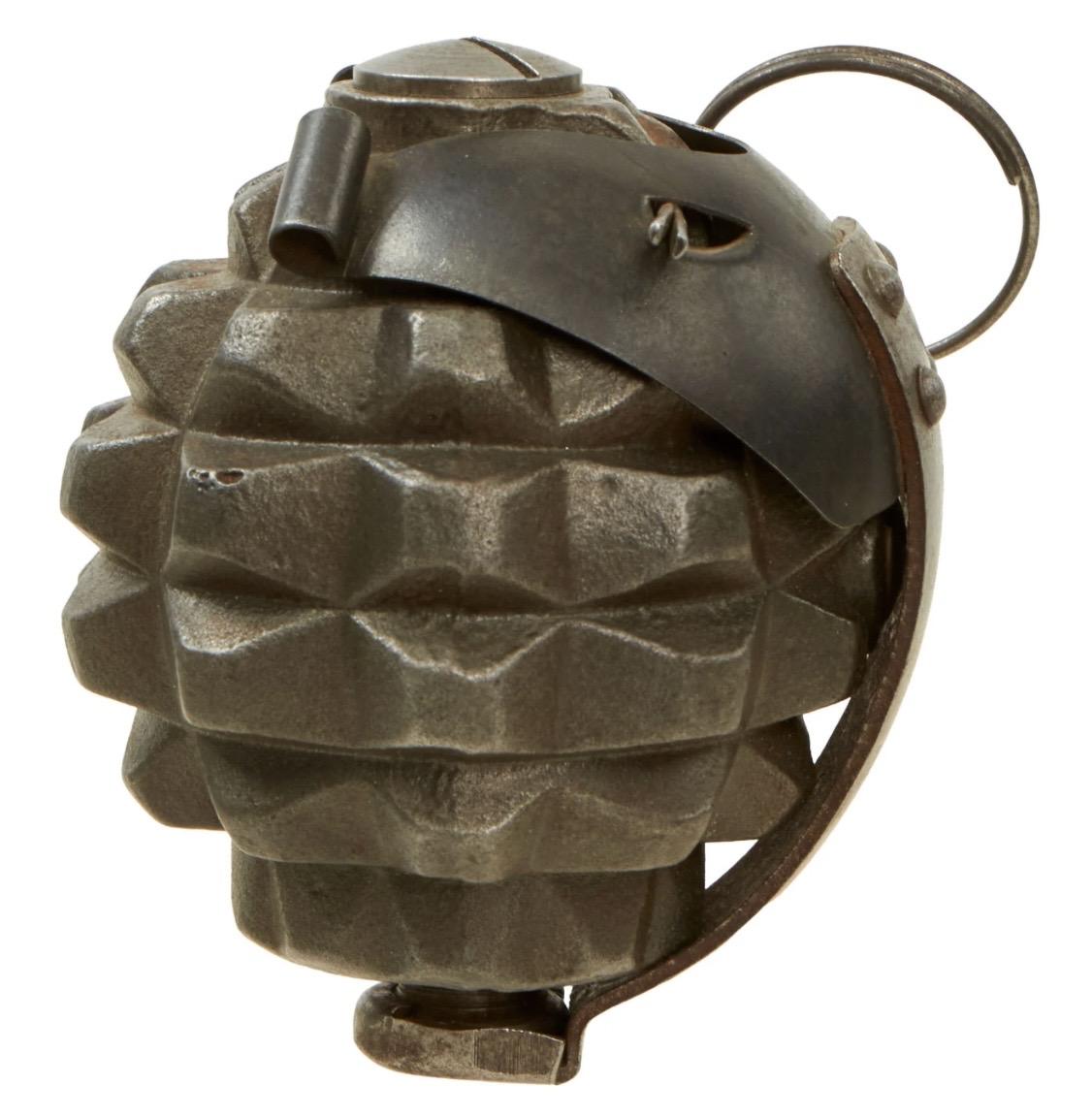
Shrinkle Grenade
The Shinkle grenade was an experimental American hand grenade developed during the final period of the First World War. It was designed by Major Edward Marsh Shinkle of the United States Army while he was working at the Frankford Arsenal in Philadelphia, Pennsylvania. Development began after the United States entered the war in 1917, when American forces urgently needed effective grenades for trench warfare on the Western Front. Work continued through 1917 and 1918, and surviving examples of the weapon show manufacturing dates as late as November 30, 1918. Only a limited number were produced, and the project ended shortly after the war concluded.
When the United States joined the conflict, European armies had already spent several years refining grenade technology for trench combat. American troops arriving in Europe quickly realized that similar weapons were essential, which led to a rapid period of experimentation with many different designs. Major Shinkle’s concept was one of several developed during this time as engineers attempted to create a device that would detonate immediately upon impact rather than relying entirely on a timed fuse.
The most distinctive feature of the design was its impact fuse. Most hand grenades of the period used a delay system in which the soldier pulled a safety pin, released a lever, and threw the weapon while a short fuse burned for several seconds before detonation. This delay allowed the thrower time to take cover but also created the possibility that an enemy might pick it up and throw it back. Shinkle’s idea aimed to remove that risk by producing an explosive that would detonate the moment it struck a surface.
Inside the casing was a mechanical impact-triggering system connected to a detonator and the main explosive charge. The internal mechanism contained a restrained striker component that remained secure while the weapon was being carried. When it struck the ground or another solid object after being thrown, the sudden shock caused the striker to move forward. This movement struck a percussion cap or similar ignition element, which then ignited the detonator. The detonator in turn set off the main explosive filling inside the metal body.
The outer casing was made of metal and usually featured grooves or ridges that improved grip when handling or throwing it, particularly in muddy trench conditions. These ridges could also produce small fragments when the device exploded, although the design relied more on blast pressure than on fragmentation. Because of this characteristic it functioned largely as a concussion weapon rather than a heavy fragmentation type.
The explosive filling was likely a standard military high explosive used at the time, most commonly TNT or a similar compound. Grenades of this era generally contained roughly 150 to 250 grams of explosive material. When detonated, this charge produced a powerful shockwave capable of causing fatal injuries within several meters. In confined areas such as trenches, dugouts, or buildings, the blast pressure could be especially destructive because the shockwave reflected off walls and enclosed surfaces, increasing its effect.
During testing, concerns arose regarding the reliability of impact-fused weapons in the muddy conditions typical of trench warfare. If the device landed in soft earth, the impact might not generate enough force to activate the mechanism. Because of this possibility the American Expeditionary Forces initially rejected the design and concentrated on other grenade types that used timed fuses.
Later in 1918 the need for a weapon that exploded instantly upon contact was reconsidered, and development resumed. A small production run was carried out, with several hundred examples manufactured for testing and possible distribution. However, the First World War ended in November 1918 before it could be widely issued to troops, and the project was soon discontinued.
Evidence suggests that two versions were created during its development. The earliest model relied entirely on the impact system for detonation. A later variation attempted to improve reliability by combining the impact mechanism with a backup delay feature, ensuring the explosive would still function even if the initial trigger failed to activate on contact with the ground.
Major Edward Marsh Shinkle continued working on explosive devices and grenade mechanisms after the war. His later work included patents describing improved impact fuse systems designed to remain safe during handling while still detonating reliably when thrown. These designs focused on ensuring detonation regardless of how the device landed, reflecting the same engineering ideas behind his earlier wartime work.
Although this experimental weapon never entered full military service, it represents an interesting stage in the development of hand grenade technology. The experiments conducted during the First World War helped engineers better understand the advantages and limitations of both impact and timed fuse systems. Lessons learned during these trials contributed to later improvements in grenade reliability, safety, and effectiveness.
Today surviving examples are extremely rare. Because only a small number were produced and most were never used in combat, intact specimens are highly valued by collectors and museums. The device remains an unusual and historically significant example of early twentieth-century weapons experimentation and illustrates the intense innovation that occurred as armies sought new solutions for trench warfare.