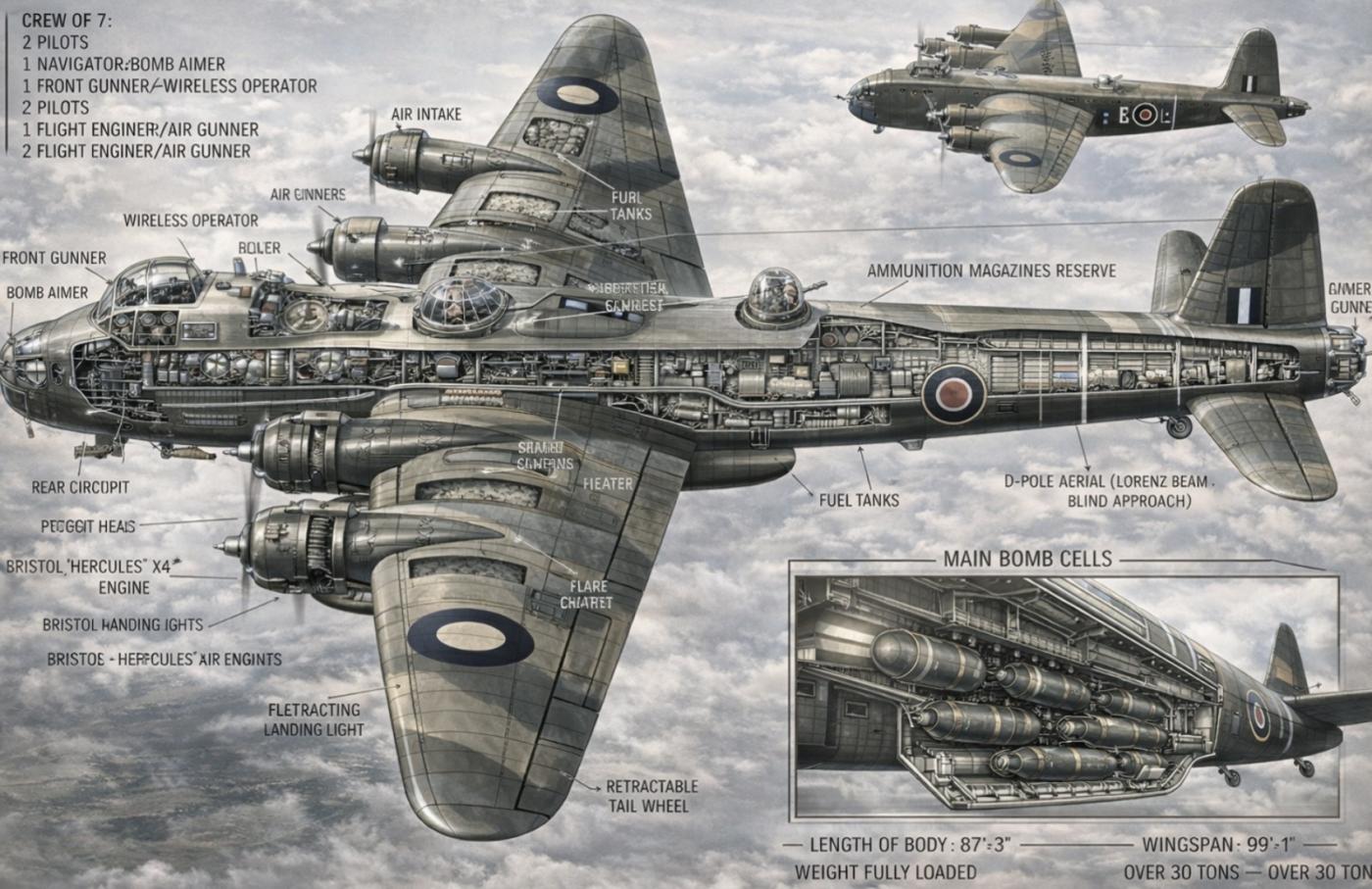
Short Stirling Plane
The Short Stirling was a pioneering aircraft of the Second World War and the first four-engined heavy bomber to enter service with the Royal Air Force. It marked a major step forward as the RAF moved from smaller twin-engined aircraft to large heavy bombers that would later dominate the air war over Europe. Although eventually overshadowed by the Avro Lancaster and Handley Page Halifax, it played a vital early role in establishing Britain’s heavy bomber capability.
The aircraft was designed by Short Brothers of Rochester, Kent, under the direction of Arthur Gouge. It originated from a 1936 Air Ministry requirement for a long-range heavy bomber. A key limitation imposed was a maximum wingspan of 100 feet so it could fit existing hangars. This restriction forced compromises in the wing design and ultimately limited its high-altitude performance.
Construction was carried out primarily by Short Brothers, with the prototype first flying in May 1939. It proved strong and reliable but showed clear limits in altitude and efficiency compared to later designs.
Power came from four Bristol Hercules radial engines, 14-cylinder air-cooled units known for reliability. Early versions used Hercules II engines, while later ones had more powerful variants such as the Hercules VI and XVI, producing around 1,400 to 1,650 horsepower each.
The bomber typically carried a crew of seven: pilot, co-pilot, navigator, bomb aimer, wireless operator, flight engineer, and gunners. Defensive armament included nose, dorsal, and tail turrets fitted with .303 inch Browning machine guns, often in twin or four-gun arrangements. Early models also had a ventral position, later removed.
It could carry up to about 14,000 pounds of bombs, though operational loads varied. The bomb bay design meant it could not accommodate some of the very large bombs used later in the war.
One of its main drawbacks was a relatively low service ceiling of around 16,500 feet when fully loaded. This made it more vulnerable to enemy fighters and anti-aircraft fire, contributing to its gradual withdrawal from frontline bombing duties as more advanced aircraft entered service.
Despite this, it proved highly adaptable. It became an effective glider tug, capable of towing large gliders such as the Airspeed Horsa and General Aircraft Hamilcar during major airborne operations like D-Day and Operation Market Garden. Its power and size made it suitable for these demanding roles.
It was also widely used to drop paratroopers. The spacious fuselage allowed large numbers of troops to be carried and deployed, usually exiting through side doors during night operations. This made it an important part of Britain’s airborne forces.
In addition, it carried out transport missions, mine-laying operations known as “gardening,” and special duties including supplying resistance groups and inserting agents into occupied Europe.
A total of 2,383 were built between 1939 and 1945 in several variants, including bomber and transport versions. Later models were adapted specifically for towing gliders and carrying troops, often with reduced armament.
The aircraft had a distinctive design, with a high-mounted wing, deep fuselage, and very tall landing gear to provide propeller clearance. This gave it a noticeable stance but also made handling on the ground more difficult.
Although later overshadowed, it was a crucial early heavy bomber and later a key transport and airborne support aircraft. Its development helped pave the way for more advanced bombers and it played an important role in both bombing and airborne operations throughout the war.