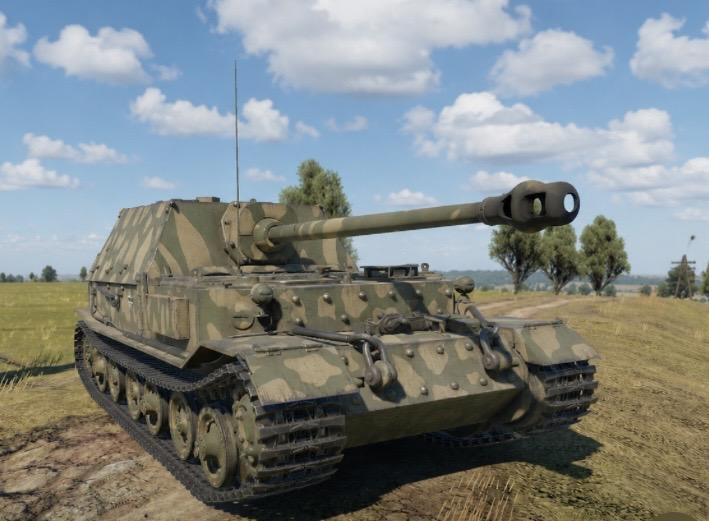
SDKFZ.184 Elephant
The Sd.Kfz. 184 Elefant was one of the most intimidating armoured vehicles ever placed on a battlefield during the Second World War. It was not really a tank in the normal sense, because it had no rotating turret, but a huge heavy tank destroyer built around one purpose: to destroy enemy armour at long range before it could reply. Its story began with Ferdinand Porsche and the failed Porsche Tiger project. Porsche had designed a heavy tank chassis for the German Army’s Tiger programme, but the contract went instead to the rival Henschel design, which became the famous Tiger I. By that point, around ninety Porsche Tiger chassis had already been produced or were in an advanced state of manufacture, and rather than waste them, Hitler ordered that they be turned into a powerful new tank killer. The result was first known as the Ferdinand, named after Ferdinand Porsche, and later, after modifications, it became the Elefant. Its official German designation was Panzerjäger Tiger (P), with the ordnance number Sd.Kfz. 184.
The vehicle was built from a strange mixture of opportunity, ambition and urgency. The chassis came from Porsche’s rejected VK 45.01(P) Tiger design, while the heavy armoured fighting compartment was added to the rear to house one of the most feared anti-tank guns of the war. Production and conversion work involved German heavy industry, including Nibelungenwerk at St. Valentin, with major components supplied through firms such as Krupp and Alkett. Only about ninety were built in 1943, which meant the Elefant was never a mass-produced weapon, but a specialist machine intended to punch holes through Soviet armour during Germany’s great summer offensive at Kursk.
In appearance, the Elefant looked almost brutal. It was enormous, slab-sided and heavy, with a long 88 mm gun projecting from the front of its fixed superstructure. Fully loaded, it weighed around 65 to 70 tons, making it one of the heaviest armoured fighting vehicles in service at the time. Its armour was extreme for 1943. The front could reach around 200 mm in thickness, made up of heavy plate that gave it a level of protection far beyond most Allied and Soviet guns at normal fighting ranges. The sides were much thinner, generally around 80 mm, which was still strong but not invulnerable, especially if the vehicle was outflanked. This was the key to the Elefant: from the front, at long range, it was a monster; from the side, close up, or when immobilised, it became vulnerable.
Its main weapon was the 8.8 cm Pak 43/2 L/71, one of the finest anti-tank guns of the entire war. This was not the shorter 88 mm weapon carried by the early Tiger I, but a longer, more powerful gun with far greater armour penetration. It could destroy most Soviet tanks at distances where many enemy crews could barely return effective fire. Against T-34s, KV tanks and later even heavier Soviet vehicles, the Elefant’s gun had frightening destructive power. With the right ammunition and a good crew, it could knock out enemy armour at well over 1,500 metres, and in favourable conditions even beyond that. The long barrel gave the shell very high velocity, producing a flat trajectory and excellent accuracy. On the open battlefield, especially across the rolling ground and fields of the Eastern Front, the Elefant could dominate a wide killing zone.
Its power plant was unusual and complicated. Instead of a simple mechanical drive, the Porsche chassis used a petrol-electric system. Two Maybach petrol engines powered generators, which then fed electric motors driving the tracks. On paper, this was advanced and allowed smooth control of a very heavy vehicle, but in practice it was complicated, heavy and difficult to maintain under battlefield conditions. The Elefant could reach roughly 30 km/h on roads, but it was slow, thirsty and mechanically demanding. Its road range was limited, often quoted at around 150 km, and cross-country range was much lower. In a fast-moving campaign, that mattered. A vehicle this heavy needed fuel, recovery support, spare parts and careful handling, and Germany in 1943 could not always provide those things.
The Elefant’s battlefield debut came during Operation Citadel, the German attack at Kursk in July 1943. This was the largest armoured battle of the war, and the Ferdinand was committed in an attempt to smash through deep Soviet defensive belts. In some respects, it proved terrifyingly effective. When positioned correctly and used at range, its 88 mm gun destroyed large numbers of Soviet tanks and anti-tank guns. Soviet crews quickly learned that attacking one from the front was often useless unless they could get very close or hit its tracks. German crews reported impressive kills, and the vehicle’s thick frontal armour saved many from destruction.
Yet Kursk also exposed its weaknesses in a brutal way. The first Ferdinands had no hull machine gun, which was a serious mistake. Once they moved into broken ground, minefields and infantry positions, Soviet soldiers could approach them with anti-tank rifles, grenades, satchel charges and Molotov cocktails. A tank destroyer that could kill armour from two kilometres away was far less comfortable when infantry were crawling close beside it. Many were also disabled by mines or mechanical breakdowns rather than knocked out by enemy tanks. Because of their huge weight, recovering a damaged Ferdinand was difficult, and vehicles that might have been repairable were sometimes abandoned or destroyed by their own crews. The Ferdinand had been designed as a long-range tank killer, but at Kursk it was thrown into a dense battlefield of trenches, mines, infantry and artillery, where its strengths were often wasted and its weaknesses became obvious.
After Kursk, the surviving vehicles were withdrawn for modification. They received a bow-mounted MG 34 machine gun, improved commander’s cupola, better vision arrangements, Zimmerit anti-magnetic mine paste, and other changes to improve survivability. In 1944, the modified vehicles were renamed Elefant. These changes made them more practical, especially against infantry, but they could not remove the basic problems of weight, complexity and limited numbers.
The Elefant later fought in Italy, including around the Anzio front, where its heavy armour and long-range gun again made it dangerous in the right position. In defensive warfare, it could be a nightmare for Allied tank crews, especially if dug in or hidden along likely approach routes. But Italy’s roads, bridges, hills and narrow tracks were not ideal for such a massive machine. Its weight made movement difficult, and once Allied air power, artillery or infantry found one, the Elefant could become trapped. Others continued to fight on the Eastern Front, where Germany increasingly used every remaining heavy vehicle in desperate defensive battles. A few survived long enough to be caught up in the final fighting of 1945.
The real impact of the Elefant was not in numbers, because there were never enough of them to change the course of the war. Its impact was psychological and tactical. It showed what Germany could produce when it concentrated armour and firepower into one huge machine. At long range, from the front, it was one of the most dangerous tank destroyers of the war. Its 88 mm Pak 43 could destroy almost anything it met, and its thick armour made it almost immune to many enemy weapons under normal conditions. But it also showed the danger of building a vehicle that was too heavy, too complicated and too specialised. It was powerful, but not flexible. It could dominate a killing ground, but it could not easily exploit a breakthrough, defend itself well at close quarters in its early form, or move reliably in difficult conditions.
In many ways, the Elefant was Germany’s armoured philosophy taken to an extreme: brilliant engineering, immense firepower and terrifying armour, but produced in tiny numbers and burdened by mechanical complexity. It was a battlefield giant, and when everything worked in its favour it was deadly. But wars are not won only by the biggest gun or the thickest armour. They are won by machines that can be built, supplied, repaired, moved and used in enough numbers to matter. The Sd.Kfz. 184 Elefant remains one of the most famous heavy tank destroyers of the Second World War because it was both impressive and flawed, a huge steel predator that could destroy enemy tanks at great range, yet was itself trapped by the limits of weight, terrain, maintenance and the desperate situation of the German Army that sent it into battle.