Scud Missile
The missile commonly known as the Scud is one of the most influential ballistic weapons of the Cold War and the decades that followed. Its origins lie in the early Soviet rocket program of the 1950s, when engineers sought to turn German Second World War rocket technology into practical battlefield weapons capable of delivering conventional or nuclear warheads.
Development drew heavily on experience gained from the V-2 rocket. The work was carried out by large Soviet state design bureaus rather than a single named designer, and production later became concentrated at major missile factories within the Soviet defense industry. The first operational version entered service in 1957 under the Soviet designation R-11, known in Western intelligence as Scud-A.
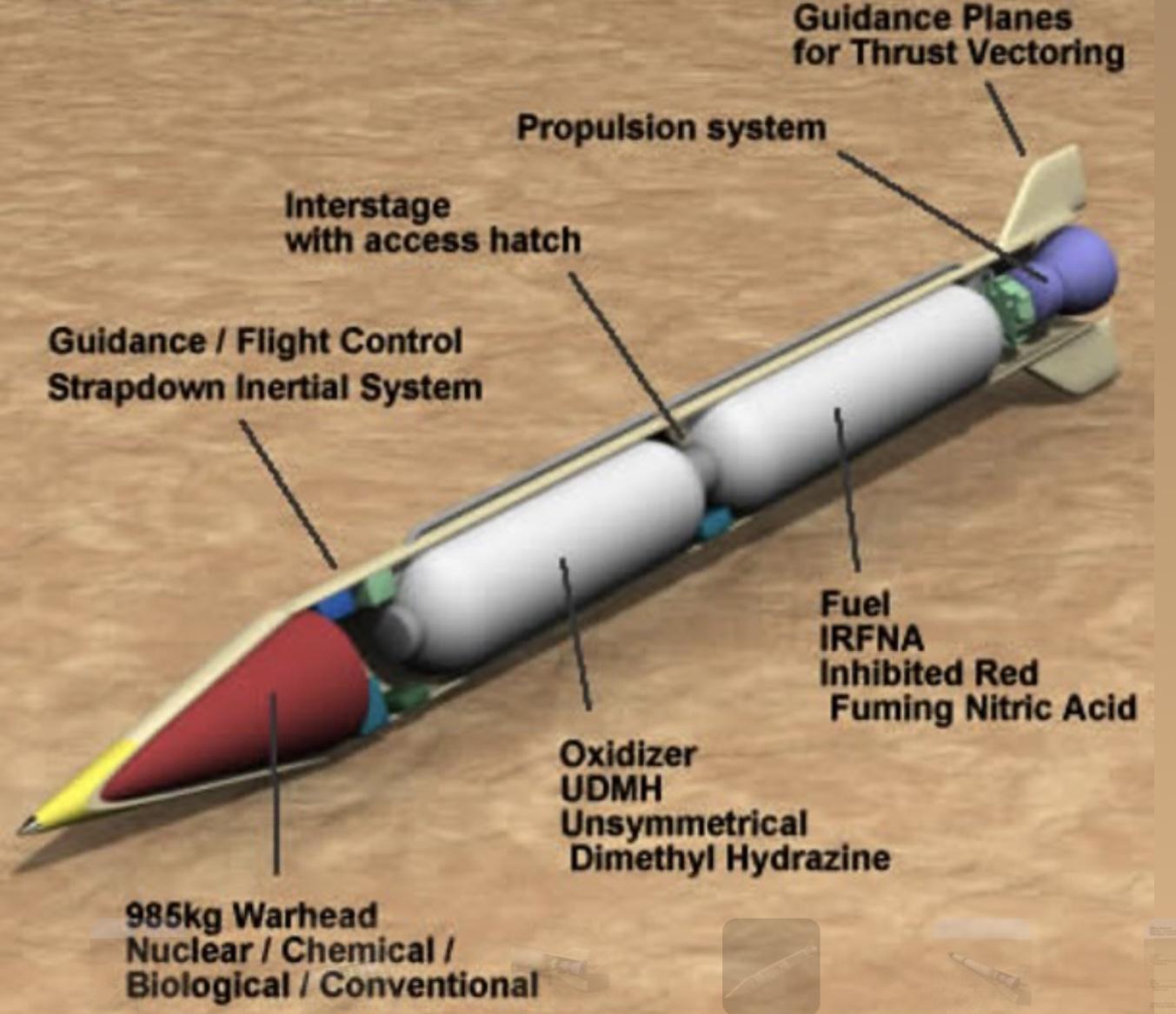
Early versions had a maximum range of around 150 kilometers. The most widely used model, introduced in the early 1960s, extended this range to roughly 300 kilometers. Later variants increased reach even further, with some versions capable of flying between 500 and 700 kilometers, although these longer ranges usually came at the cost of reduced accuracy. Flight speed during the terminal phase typically exceeded Mach 5, meaning the missile traveled at more than five times the speed of sound as it descended toward its target.
After launch, the missile followed a high ballistic arc rather than flying like an aircraft or cruise missile. At the peak of its trajectory, it could reach altitudes of approximately 80 to 90 kilometers, placing it briefly at the edge of space before falling back toward the Earth under gravity. This steep descent angle made interception difficult with early missile defense systems and added to its psychological impact.
The missile used liquid fuel, which had both advantages and disadvantages. Liquid propulsion was relatively simple to manufacture and provided sufficient power for long-range flight, but it required fueling shortly before launch. This process could take up to an hour, making the system vulnerable to detection and attack if observed during preparation.
One of the key strengths of the design was its flexibility in launch methods. It could be fired from fixed, prepared launch sites using static launch pads, which were often reinforced concrete structures intended for repeated use. More importantly, it could also be launched from mobile transporter-erector-launcher vehicles. These large trucks carried the missile horizontally, raised it to a vertical position for launch, and allowed crews to relocate quickly after firing. This mobility made the weapon far harder to destroy preemptively and allowed it to be hidden, dispersed, and launched with little warning.
Precise production figures remain uncertain due to secrecy and incomplete records, but several thousand missiles were built in the Soviet Union between the late 1950s and the 1980s. When licensed production, copied designs, and modified local versions are included, total global production is believed to exceed 7,000 units. Many were assembled outside the Soviet Union using imported parts or reverse-engineered technology.
Originally manufactured in the Soviet Union, the missile spread widely through exports and military aid during the Cold War. It became common in the Middle East, North Africa, and parts of Asia, where it was often seen as a symbol of strategic power. Several countries later established their own production programs based on the original design, adapting it to local industrial capabilities.
The missile gained worldwide attention during the 1991 Gulf War, when modified versions were launched against Israel and Saudi Arabia. Although physical damage was limited due to poor accuracy, the high speed, steep descent, and difficulty of interception created widespread alarm. The attacks demonstrated how even relatively crude ballistic weapons could have a major psychological and political impact.
Technically, the design is simple by modern standards. Accuracy is low, often missing targets by hundreds of meters, and the liquid fuel system limits readiness. Despite these flaws, low cost, mobility, and ease of production made it attractive to states with limited access to advanced weapons technology.
Its greatest legacy lies in proliferation. Many modern short- and medium-range ballistic missiles trace their design heritage directly or indirectly to this system. More than half a century after its introduction, its influence remains visible across the world, not because of precision or sophistication, but because of how widely it reshaped military planning and missile development.