F-105 Thunderbolt
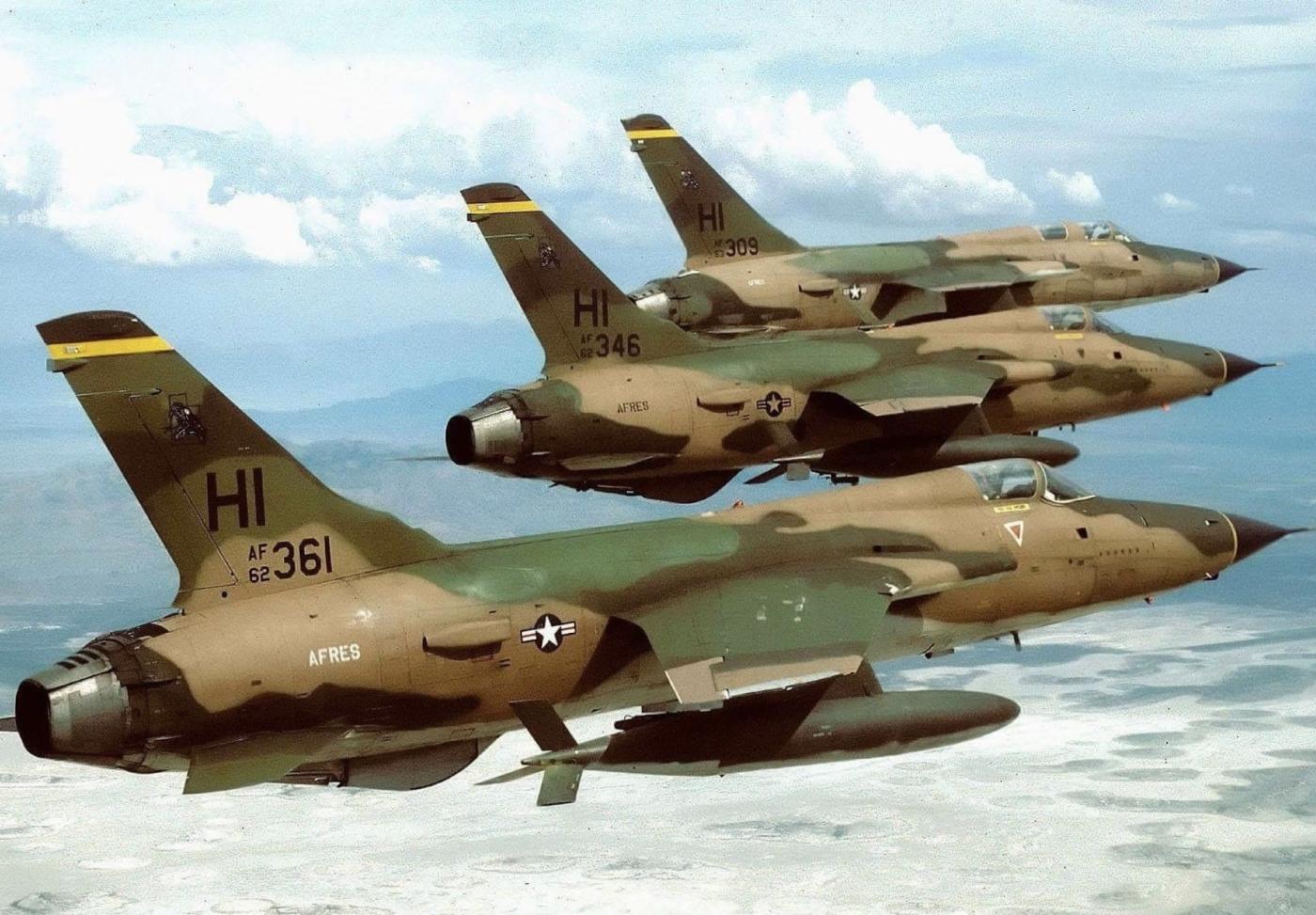
The Republic F-105 Thunderchief was one of the most powerful single-engine combat aircraft ever built and became a defining aircraft of the early jet age and the Vietnam War. Designed during the Cold War as a high-speed nuclear strike fighter, it evolved into the U.S. Air Force’s primary conventional strike aircraft over North Vietnam and later into a specialized hunter of enemy missile sites.
The aircraft was designed by Republic Aviation under the leadership of Alexander Kartveli, the same designer responsible for the famous P-47 Thunderbolt of World War II. Republic, based in Farmingdale, New York, developed the Thunderchief in the early 1950s in response to a U.S. Air Force requirement for a supersonic fighter-bomber capable of carrying a nuclear weapon internally and delivering it at high speed and low altitude. The first prototype flew in October 1955, and full production followed soon after. A total of 833 Thunderchiefs were built between 1955 and 1964, all manufactured by Republic Aviation.
The F-105 was a large aircraft for a single-seat fighter. In fact, at the time it entered service it was the largest single-engine, single-seat combat jet in the world. It was powered by one Pratt & Whitney J75 afterburning turbojet engine producing up to roughly 26,500 pounds of thrust with afterburner. This gave the Thunderchief impressive performance. It could exceed Mach 2 at altitude, reaching top speeds around 1,390 miles per hour. Even at low level it could fly supersonic. Its service ceiling was about 50,000 feet, and with internal fuel and external tanks its ferry range exceeded 1,900 miles. In-flight refueling capability extended its operational reach even further.
Originally, the Thunderchief’s primary mission was nuclear strike. It was designed to carry a nuclear weapon in an internal bomb bay, allowing it to penetrate enemy airspace at high speed and low altitude while minimizing drag. As U.S. strategy shifted during the Vietnam War, however, the F-105 became a conventional bomber. It proved capable of carrying up to 14,000 pounds of ordnance on external hardpoints, a bomb load comparable to some World War II medium bombers. Its internal armament consisted of a single M61A1 20 mm rotary cannon. It could also carry a wide variety of weapons including general purpose bombs, cluster munitions, rockets, AIM-9 Sidewinder air-to-air missiles, and later anti-radiation missiles such as the AGM-45 Shrike for attacking enemy radar systems.
Crew size depended on the variant. The F-105B and F-105D were single-seat aircraft flown by one pilot. Later two-seat versions, the F-105F and the F-105G, added a second crew member who served as an electronic warfare officer. These two-seat models became the famous “Wild Weasel” variants, tasked with suppressing enemy air defenses by locating and destroying surface-to-air missile sites. The Wild Weasel mission was extremely dangerous, often requiring crews to deliberately expose themselves to enemy radar in order to draw missile fire and then attack the source.
The Thunderchief saw its most intense combat during the Vietnam War, particularly during Operation Rolling Thunder. For several years it carried out the majority of U.S. Air Force strike missions against North Vietnam. Flying low and fast into heavily defended airspace, F-105 crews faced dense anti-aircraft artillery, radar-guided surface-to-air missiles, and MiG fighter interceptors. Losses were heavy. Of the 833 built, 382 were lost in combat in Southeast Asia. Despite these losses, the aircraft and its crews achieved notable successes. F-105 pilots were credited with more than two dozen MiG kills in air-to-air combat. Two Wild Weasel crew members received the Medal of Honor for extraordinary bravery under fire.
Pilots nicknamed the aircraft the “Thud,” a name that stuck despite its unofficial origins. Although it suffered from maintenance challenges and high attrition, many pilots respected it for its speed, stability at low altitude, and heavy payload. It could absorb significant battle damage and still bring its pilot home, though not always.
As newer aircraft such as the F-4 Phantom II and the swing-wing F-111 took over strike roles, the Thunderchief was gradually phased out of front-line service. The Wild Weasel variants remained in service longer because of their specialized mission, but by the early 1980s the type was retired from the Air Force.
Today, the F-105 Thunderchief is remembered as a powerful but demanding aircraft that carried a disproportionate share of the air war over North Vietnam. Built for nuclear war but tested in conventional conflict