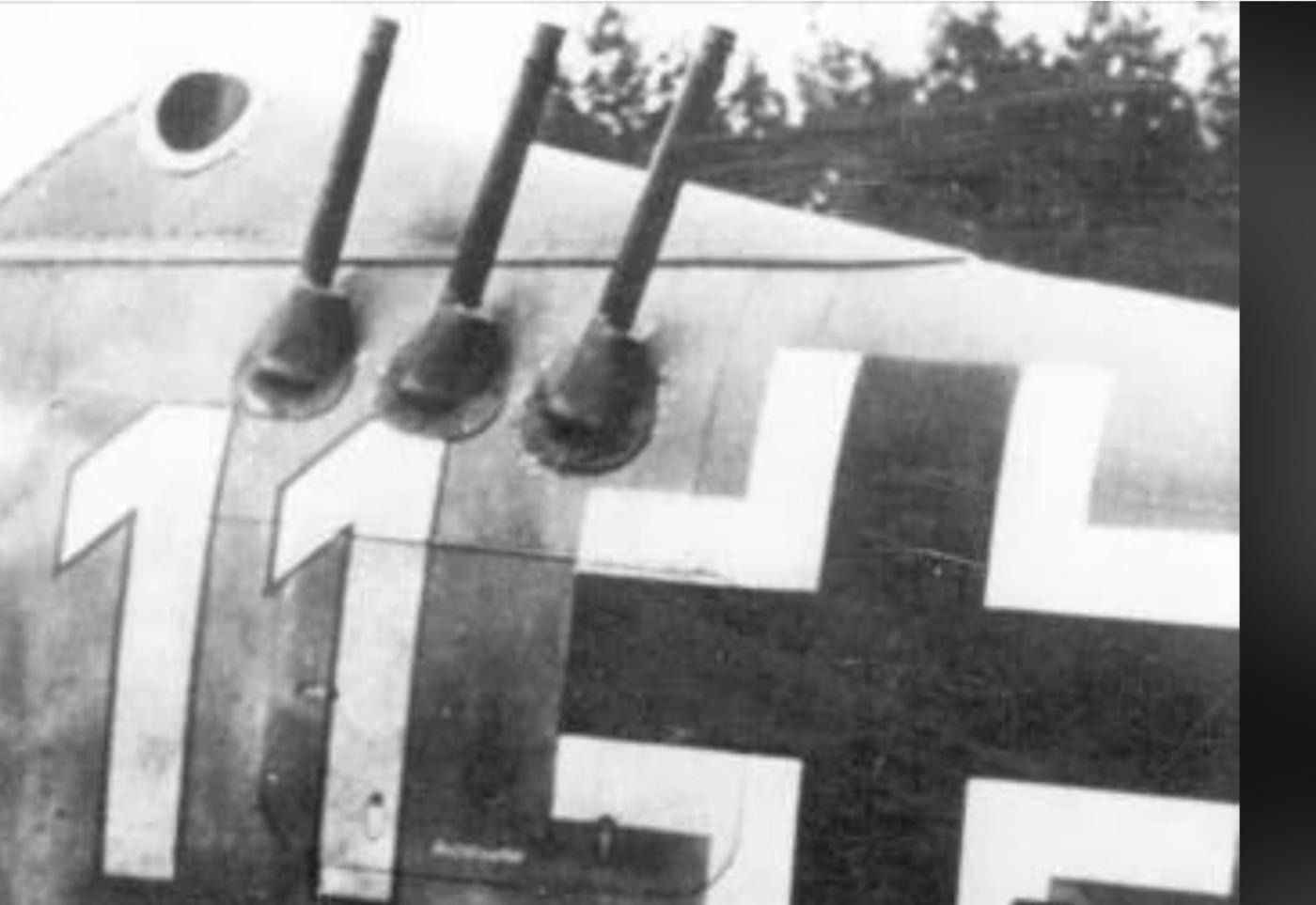
Schrage Musik upward firing guns
The upward-firing gun system known as Schräge Musik was one of the most deadly and innovative air combat developments of the Second World War. Introduced by the German Luftwaffe during the night bombing campaign over Europe, it allowed German night fighters to destroy British and Allied heavy bombers with frightening efficiency while remaining almost invisible to the bomber crews they were attacking. The tactic exploited a major defensive weakness in RAF bomber formations and for many months it caused a mysterious and devastating rise in aircraft losses.
The term Schräge Musik literally translates from German as “slanted music” or “crooked music.” It was originally a slang term used in Germany for jazz music, which the Nazi regime officially disliked. The name referred to the unusual mounting angle of the weapons inside German night fighters. Instead of firing forward like normal aircraft guns, these cannons were installed inside the fuselage and angled upward, usually between about twenty and thirty degrees. From below a bomber the fighter could fire directly into its most vulnerable areas without ever being seen.
The concept of upward-firing guns is generally credited to the German night fighter pilot Rudolf Schönert. In 1941 he began experimenting with the idea while serving in the Luftwaffe night fighter force. Schönert realised that British bombers were extremely vulnerable from below because their defensive gun turrets were designed mainly to protect them from attacks coming from the rear or above. The underside of most bombers was poorly defended and in some cases completely unprotected.
At first the idea was dismissed by senior commanders in the Luftwaffe night fighter organisation. However Schönert continued experimenting and eventually proved the effectiveness of the system during operational trials. Once the results became clear the Luftwaffe quickly adopted the idea and installations of Schräge Musik began appearing in operational night fighters during 1943.
The reason the system worked so well was because of the design of RAF heavy bombers such as the Avro Lancaster, the Handley Page Halifax and the Short Stirling. These aircraft carried several defensive gun turrets, usually in the nose, dorsal position and tail. Earlier British bombers sometimes carried ventral turrets underneath the aircraft but these were largely abandoned on later designs because they created drag and were difficult to operate. This left a large blind spot beneath the aircraft.
German night fighter pilots soon learned that by approaching from slightly below and behind a bomber they could remain completely unseen. The bomber’s silhouette was clearly visible against the faint glow of the night sky above, while the fighter below was hidden in darkness. Once in position the German pilot would carefully match the bomber’s speed and fly directly underneath it.
At that point the upward-firing guns could be used. A short burst of cannon fire directed into the bomber’s wing roots or fuel tanks often caused catastrophic damage. Fuel tanks ignited instantly and the bomber could explode or burst into flames within seconds. Many bomber crews never even realised they were under attack.
The cannons used in Schräge Musik installations were usually 20 millimetre MG FF/M weapons or the much more powerful 30 millimetre MK 108 autocannon. The MK 108 fired a large high explosive shell specifically designed to destroy heavy bombers. Only a few hits were required to cause fatal damage. The ammunition often included high explosive and incendiary rounds which were particularly effective against fuel tanks.
These guns were mounted inside the fuselage behind the cockpit and angled upward. The installation allowed the night fighter to fire into the bomber while maintaining a steady position beneath it. Some installations even used ammunition with reduced tracer so the attack would remain almost invisible to the bomber crew.
Several Luftwaffe night fighter aircraft were fitted with Schräge Musik. Among the most important were the Messerschmitt Bf 110 night fighter, the Junkers Ju 88 night fighter versions such as the Ju 88G, the Dornier Do 217 night fighter and the advanced Heinkel He 219 Uhu. By 1944 a large proportion of German night fighters carried upward-firing guns.
The effectiveness of the system was increased even further by the sophisticated German night defence system operating over occupied Europe. Known as the Kammhuber Line, this network consisted of radar stations, searchlights and ground control centres which tracked incoming RAF bomber streams. Controllers would guide night fighters toward the bomber formations using radar information.
Once close to the bomber stream the night fighter’s onboard radar would take over. German night fighters carried radar sets such as the Lichtenstein radar which allowed them to detect individual bombers in darkness or cloud. The radar operator sitting behind the pilot would guide the aircraft toward the target until the bomber became visible as a dark silhouette above them.
The attack could then be made with devastating effect. In many cases the bomber simply exploded or caught fire without any warning. To other aircraft flying in formation it often looked as though a bomber had suddenly been struck by flak or had suffered a mysterious internal explosion.
For many months RAF Bomber Command did not fully understand what was happening. Losses during night raids were rising dramatically but crews rarely saw the fighters responsible. Because the attacks came from beneath, where no gunner was normally watching, many crews believed they were being hit by anti-aircraft fire from the ground.
Reports from gunners who suspected attacks from below were sometimes dismissed or misunderstood. Some airmen believed the Germans had developed a new form of anti-aircraft shell known as “scarecrow shells” which exploded near bombers to frighten crews. In reality many of these sudden explosions were bombers being destroyed by German night fighters using Schräge Musik.
This mystery surrounding the losses created serious concern within RAF Bomber Command. Aircraft were disappearing at alarming rates and many crews had no idea what had destroyed them. High ranking RAF officers were careful about revealing too much information until they fully understood the new threat. The idea that German fighters could approach unseen beneath bombers was extremely worrying and could have had a damaging effect on crew morale.
Eventually investigators began examining the wreckage of returning aircraft and analysing damage patterns. It became clear that shells were striking from below rather than from behind or above. Once the truth was finally understood, Bomber Command began introducing countermeasures.
These included additional lookout duties for gunners, experiments with downward facing guns, and improved radar equipment designed to detect aircraft below the bomber. Fast de Havilland Mosquito night fighters were also sent into bomber streams to hunt German night fighters before they could attack.
Despite these measures the system remained effective until late in the war. Because the attack usually came from a hidden position beneath the bomber, many crews never saw the fighter that destroyed them. Schräge Musik allowed relatively small numbers of German night fighters to inflict heavy losses on RAF bomber forces and it remains one of the most ingenious and lethal air combat innovations of the entire war.