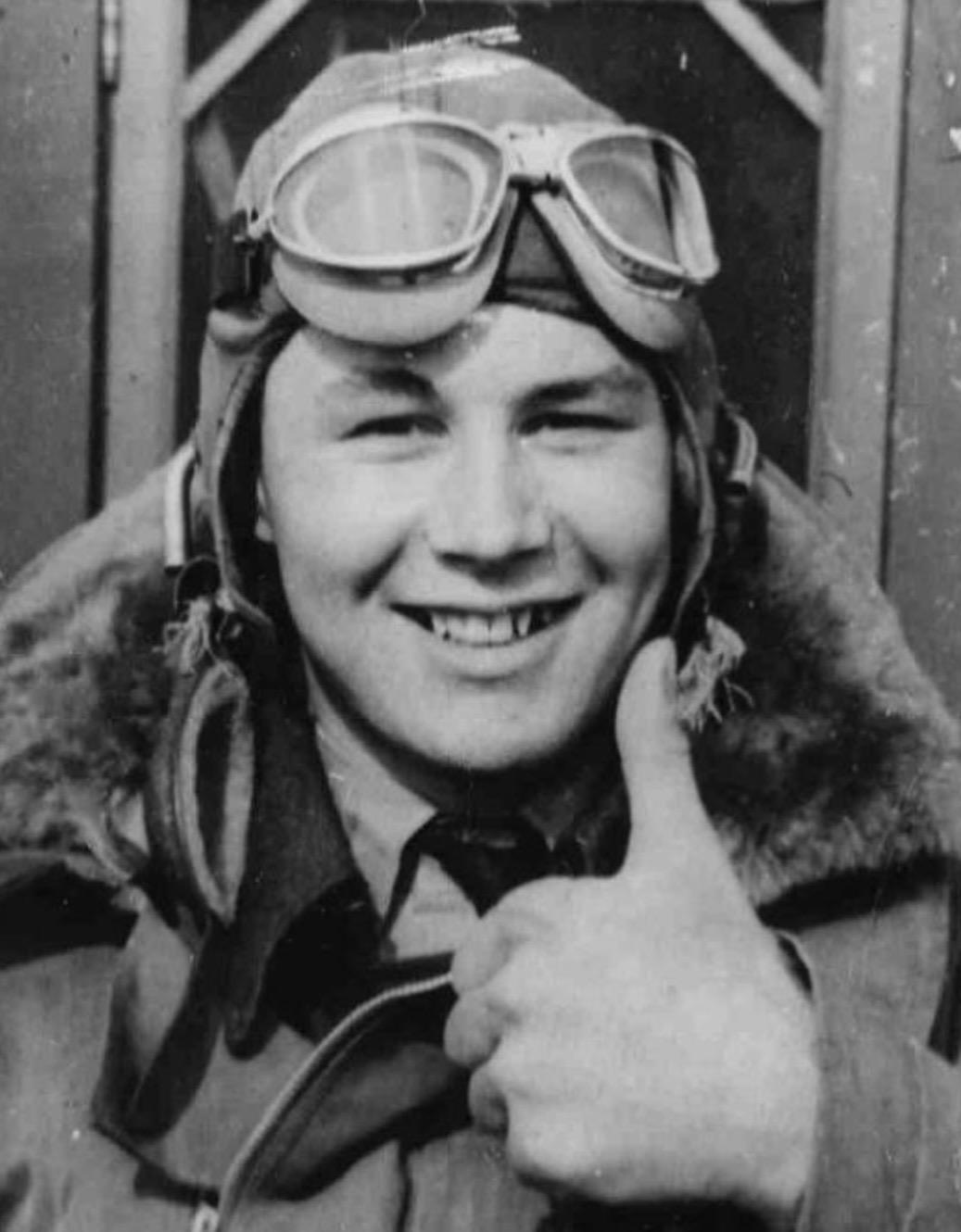
Cyril Barton
Cyril Joe Barton was one of the most remarkable bomber pilots of the Second World War. His courage during a catastrophic bombing mission in March 1944 earned him the Victoria Cross, the highest decoration for bravery in the British and Commonwealth armed forces. His story reflects the determination and sacrifice of the young men who flew with RAF Bomber Command.
Cyril Joe Barton was born on 5 June 1921 in Elmdon, near Birmingham in England. His father worked in a steel rolling mill, and like many families in industrial areas of the Midlands during the interwar period, the Bartons lived a modest working-class life. Cyril grew up in a time when aviation was still a relatively new and exciting field, and stories of daring pilots from the First World War were still fresh in public memory.
As a boy Barton was known for being quiet, determined and hardworking. He attended the local grammar school where he proved capable academically, though he was not known as a particularly outstanding student. What set him apart was his determination and reliability. Teachers and friends later remembered him as calm, thoughtful and serious for his age.
During his teenage years aviation fascinated him. The rapid expansion of air power in the late 1930s captured the imagination of many young men, and Barton was among those drawn to the idea of flying. When the Second World War began in 1939, he was still too young to serve, but he closely followed the news of the war in Europe.
In 1940, as Britain fought for survival during the Battle of Britain, Barton decided to join the Royal Air Force. Like many recruits at the time, he entered through the wartime training system designed to produce thousands of aircrew as quickly as possible.
His training was long and demanding. The RAF training system required prospective pilots to pass through several stages including initial ground training, elementary flying training and then advanced training on larger aircraft. Barton proved to be a steady and dependable trainee pilot. While he was not considered a flamboyant flyer, instructors valued his calmness and ability to remain composed under pressure.
After completing his pilot training he was posted to operational bomber units within Bomber Command. By 1943 he was flying the four-engined Handley Page Halifax, one of the main heavy bombers used by the RAF during the war. The Halifax carried large bomb loads and had a crew of seven men: pilot, flight engineer, navigator, bomb aimer, wireless operator and two gunners.
Barton was eventually assigned to No. 578 Squadron RAF, which operated from RAF Burn in Yorkshire. The squadron had been formed in early 1944 and flew night bombing missions over Germany and occupied Europe. These missions were extremely dangerous. Bomber crews faced anti-aircraft guns, German night fighters, bad weather and mechanical problems. Loss rates were high, and completing a full tour of operations was considered a remarkable achievement.
Barton was promoted to pilot officer and became captain of his own bomber crew. As captain, he carried enormous responsibility. The pilot was responsible not only for flying the aircraft but also for the safety and leadership of the six other men on board.
His most famous mission took place on the night of 30–31 March 1944 during a large bombing raid on the German city of Nuremberg. This mission would become one of the most costly operations for Bomber Command during the entire war.
Barton took off from RAF Burn in Halifax bomber LV907 with his crew. As the bomber stream approached Germany, the aircraft came under heavy attack from German night fighters and anti-aircraft fire. During the mission Barton’s aircraft was badly damaged. The Halifax lost two of its four engines and suffered extensive structural damage.
The aircraft was now extremely difficult to control and was losing altitude. Under normal circumstances a pilot in such a situation might have ordered the crew to bail out over enemy territory. Instead, Barton chose to try to bring the crippled bomber back to England.
For several hours he struggled to keep the damaged aircraft airborne. Flying a heavy bomber with half its engines gone required extraordinary skill and concentration. The aircraft was barely controllable, yet Barton managed to guide it across the North Sea back toward Britain.
When the Halifax finally reached the English coast the situation had become even worse. The remaining engines were failing and the aircraft was rapidly losing height. Barton realized that the bomber would not reach the safety of its airfield.
At this moment he made a crucial decision. Rather than abandoning the aircraft immediately, he ordered his crew to bail out first while he held the bomber steady. This allowed several crew members to parachute safely.
Keeping a badly damaged bomber level while crew members exit is extremely dangerous for the pilot, especially at low altitude. Barton maintained control long enough for most of the crew to escape.
After the others had jumped, Barton attempted to land the crippled aircraft himself. Unfortunately the bomber crashed near the village of Ryton in Northumberland. Barton was killed in the crash, but four of his crew survived because of the time he had given them to escape.
For his extraordinary courage and self-sacrifice he was posthumously awarded the Victoria Cross. The citation praised his “magnificent courage and determination” in remaining at the controls of a crippled aircraft and ensuring the survival of his crew.
The award placed Barton among the very small number of Bomber Command airmen who received the Victoria Cross during the war. Bomber Command crews faced some of the highest casualty rates of any Allied service, and acts of heroism were tragically common.
Barton was only twenty-two years old when he died. His body was buried in Ryton Cemetery in Northumberland near the site of the crash. His Victoria Cross was later preserved and displayed in museums dedicated to RAF history.
His story became symbolic of the bravery shown by bomber crews who flew dangerous night missions over occupied Europe and Germany. These men operated in darkness, often facing overwhelming odds, yet continued to carry out their missions.