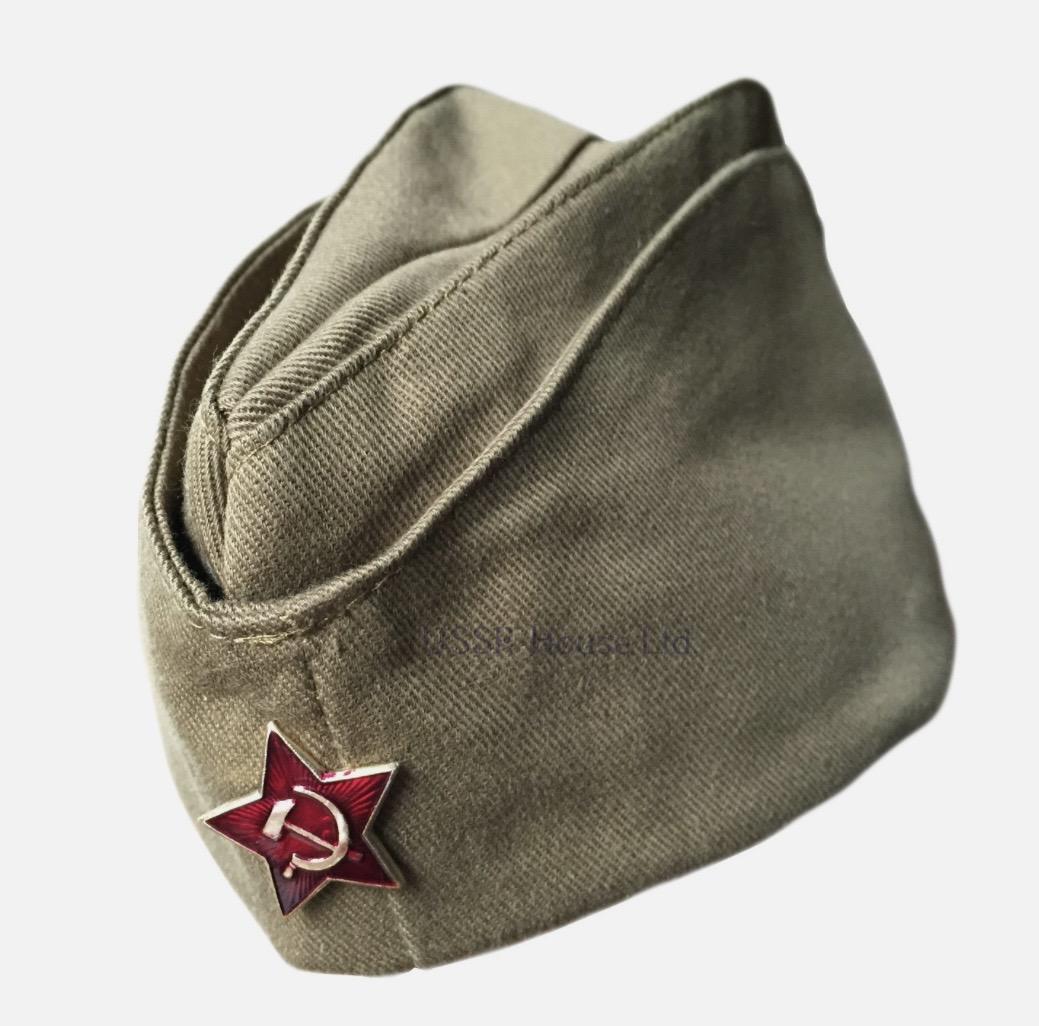
Russian Pilolka hat/cap
The Soviet military side cap commonly associated with the Red Army during the Second World War became one of the most recognisable items of Soviet uniform. Its name comes from the Russian word for pilot because the earliest examples were first worn by aviators of the Imperial Russian military toward the end of the First World War. Pilots required a lightweight cap that could be worn comfortably beneath flying helmets and other equipment, and this led to the development of a soft foldable design that could be easily stored when not in use.
Versions of this cap began appearing in Russia around 1916. At the time Russian forces were receiving French Adrian steel helmets, and soldiers needed a soft cap that could be worn underneath them. The simple side cap proved ideal for this purpose. It was light, practical, and far easier to produce than traditional military hats with rigid brims or large crowns.
Following the Russian Revolution in 1917 and the creation of the Red Army, the Soviet military experimented with several forms of headgear. One of the most famous early Soviet hats was the budenovka, a pointed cloth helmet inspired by medieval Russian designs. Although visually striking, it was complicated to manufacture and uncomfortable when worn under modern helmets. As the Soviet Union began reorganising and modernising its armed forces in the 1930s, military planners looked for simpler and more practical uniform equipment.
In December 1935 a new uniform system was introduced and the foldable side cap was officially adopted as a standard item for warm weather use. It gradually replaced the budenovka for most duties and quickly became popular with soldiers. The cap could be folded flat and tucked into a pocket or belt when not being worn, and it fit comfortably beneath steel helmets during combat.
The construction was deliberately simple so that factories could produce large numbers quickly and cheaply. The cap was formed from two long panels of cloth sewn together along the top seam to create a narrow ridge running from front to back. When worn, the sides angled downward toward the ears while the front and rear formed small triangular points. This distinctive profile made it easy to recognise in photographs of Soviet troops.
Most wartime examples were made from khaki or olive-green wool cloth. Wool was chosen because it was durable, warm in cooler weather, and flexible enough to allow the cap to fold without losing its shape. Inside there was often a basic cotton lining to improve comfort and absorb sweat. As the war progressed and material shortages increased, some versions were made with mixed fabrics that combined wool and cotton.
Two general forms were issued within the Red Army. The standard version worn by ordinary soldiers was usually plain khaki with little decoration. Officers wore a similar cap but often had coloured piping around the upper edges or seams to indicate their branch of service. Different colours were associated with infantry, artillery, cavalry, armoured units, and the air force. Despite these small distinctions, the overall shape and method of construction remained the same for all ranks.
During the Second World War this cap became the most common summer head covering used by Soviet troops. It appeared on every front of the Great Patriotic War from the early defensive battles in 1941 to the final advance into Germany in 1945. Because the Red Army mobilised more than thirty million personnel during the war, production numbers were extremely high. Exact statistics are not available, but historians believe that many tens of millions were manufactured between the late 1930s and the end of the conflict. Clothing factories throughout the Soviet Union produced them in huge quantities, and smaller regional workshops sometimes assisted with uniform production.
The badge worn on the front of the cap was one of the most recognisable symbols of the Soviet armed forces. This emblem was the red star of the Red Army, a five-pointed star that had become the official symbol of Soviet military power during the early years of the revolutionary state. The star was widely interpreted as representing the global struggle of workers and the spread of socialist revolution.
At the centre of the star was the hammer and sickle, the well-known symbol of the Soviet Union. The hammer represented industrial workers while the sickle represented peasants and agricultural labourers. Together they symbolised the alliance between the working class and the rural population that formed the ideological foundation of the Soviet state.
Most wartime badges were made from stamped metal. Brass and steel were the most common materials, although aluminium was sometimes used during periods of material shortage. After the metal star was pressed into shape using a die, bright red enamel was applied to the surface and fired to create a smooth glossy finish. The hammer and sickle in the centre were usually left in a gold or brass colour so that the symbol stood out clearly against the red background.
The size of the emblem was generally small, usually between two and three centimetres wide. Despite its small size, it was highly visible against the khaki cloth of the cap. The badge was normally attached using two metal prongs on the back that passed through the fabric and were bent to secure it in place. Some versions used a threaded screw post that passed through the cloth and was tightened with a small nut on the inside.
These emblems were produced in extremely large numbers during the war. Factories across the Soviet Union stamped them using simple industrial presses that allowed rapid mass production. The design remained largely unchanged throughout the conflict, which made it instantly recognisable across all branches of the armed forces.
The combination of the soft foldable cap and the red star badge became closely associated with the image of the Soviet soldier during the war. Photographs from the Eastern Front frequently show Red Army infantry wearing this cap as they marched through liberated towns, rode on tanks, or rested between battles. It is also visible in many famous images taken during the final stages of the war in Europe.
Even after the end of the conflict the cap remained part of Soviet military uniform for many years. Later uniform reforms introduced new styles of field headgear, but this simple foldable design continued to be issued well into the late twentieth century. Its practicality, low cost, and strong connection with the Red Army during the Second World War ensured that it remained one of the most recognisable pieces of Soviet military clothing in history.