Northover Projector
The Northover Projector was designed in 1940 by Major Robert Harry Northover, an officer serving with the British Army. Northover was not a professional weapons designer; his idea reflected the emergency mindset of the time rather than any long-term development plan. His proposal was accepted largely because it could be manufactured extremely quickly, required minimal skilled labor, and used materials that were not in short supply. At a moment when Britain could not equip its forces with enough anti-tank guns, even a crude stopgap solution was considered better than nothing.
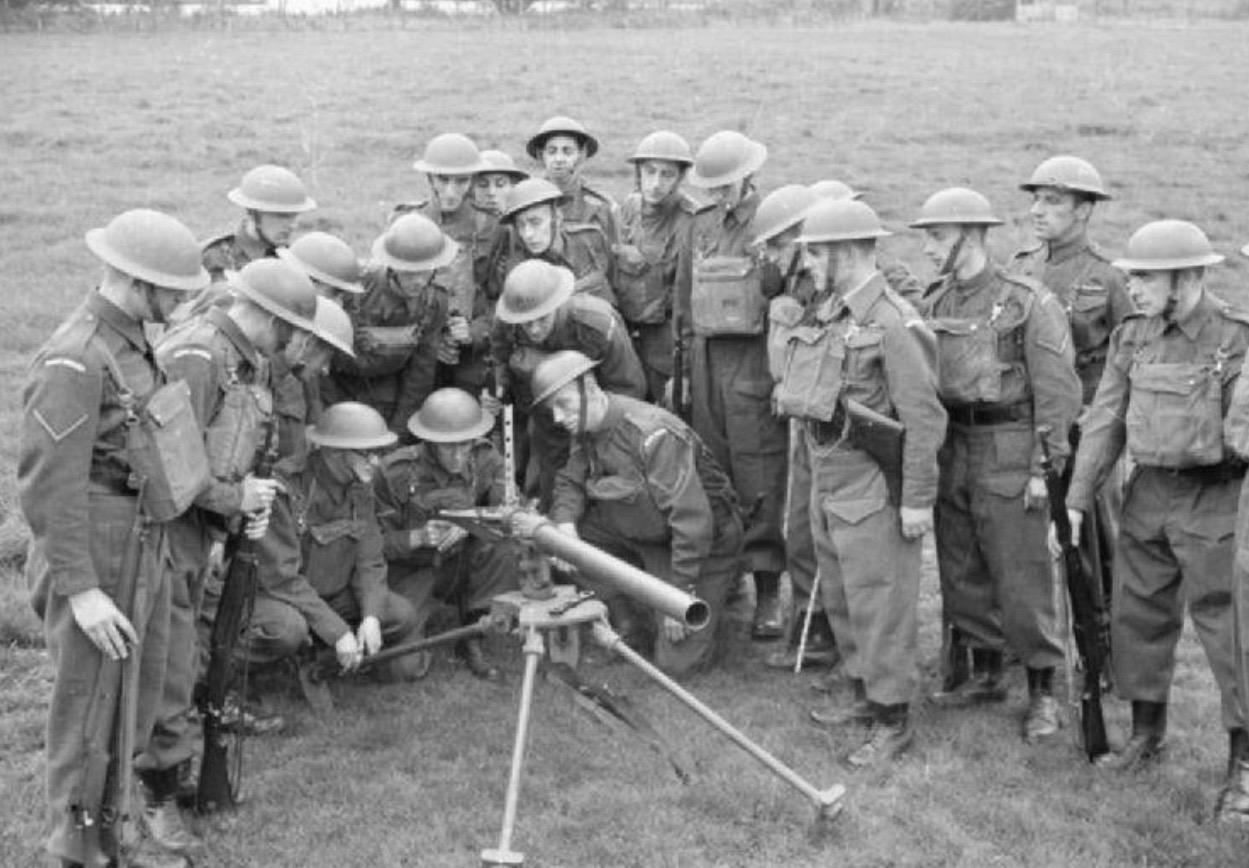
Construction of the projector was astonishingly simple. It consisted of a short length of steel pipe, usually around two and a half inches in diameter, mounted on a basic metal frame or tripod. The pipe was closed at one end and fitted with a simple firing mechanism. There was no rifling, no recoil system, and no attempt at sophistication. The weapon was smooth-bored, inaccurate, and heavy for its size, but it could be produced in large numbers with minimal tooling. Most were manufactured by small engineering firms and workshops across Britain that had little or no prior experience producing weapons.
The projector fired a special incendiary grenade known as the No. 76 Special Incendiary Grenade, often referred to as the self-igniting phosphorus grenade. This projectile contained white phosphorus, which ignited on contact with air. When launched, the grenade relied on a black-powder propellant charge rather than a modern cartridge. The operator dropped the grenade into the open muzzle, added the propellant, and fired it using a percussion cap. The process was slow, awkward, and potentially dangerous, particularly under combat conditions.
In terms of performance, the Northover Projector was extremely limited. Its effective range was typically around 100 yards, with a maximum range of roughly 300 yards under ideal conditions, though accuracy beyond short distances was very poor. It was intended to be used against lightly armored vehicles or to set fire to tanks by splashing burning phosphorus over engine decks, vision slits, or air intakes. Against modern German tanks, it had little chance of causing serious damage unless used at very close range and with considerable luck.
One of the most serious drawbacks of the weapon was its danger to the crew. The white phosphorus grenade could ignite prematurely, and misfires were not uncommon. The blast and burning fragments posed a real risk to the operator, especially since the weapon offered no shielding or protection. Additionally, firing the projector produced a conspicuous flash and cloud of smoke, instantly revealing the crew’s position.
Despite its flaws, the Northover Projector was produced in large numbers. Approximately 18,000 units were manufactured between 1940 and 1941. The majority were issued not to front-line army units but to the Home Guard, Britain’s hastily raised citizen militia composed largely of men too young, too old, or in reserved occupations. For many Home Guard units, the Northover Projector was one of the few anti-tank weapons available, alongside Molotov cocktails and improvised roadblocks.
The weapon’s reputation among those who used it was poor. Many Home Guard members disliked it, viewing it as unreliable and dangerous, and some reportedly preferred not to fire it at all during training. Nonetheless, it served an important psychological role. At a time when invasion seemed possible, it gave lightly equipped units at least the feeling that they had something capable of resisting enemy armor, however inadequate that capability might have been in reality.
By 1942, as Britain’s industrial output improved and more effective anti-tank weapons such as the PIAT became available, the Northover Projector was rapidly withdrawn from service. It never saw significant combat use, and no confirmed tank kills can be reliably attributed to it. Today, it stands as a striking example of wartime improvisation, illustrating how fear, urgency, and scarcity can drive the adoption of weapons that would never be considered acceptable under normal circumstances. More than anything, the Northover Projector symbolizes the desperate defensive mindset of Britain in 1940, when even a crude pipe capable of throwing burning phosphorus was pressed into service in the hope of stopping an invasion.