Rolls Armoured Car
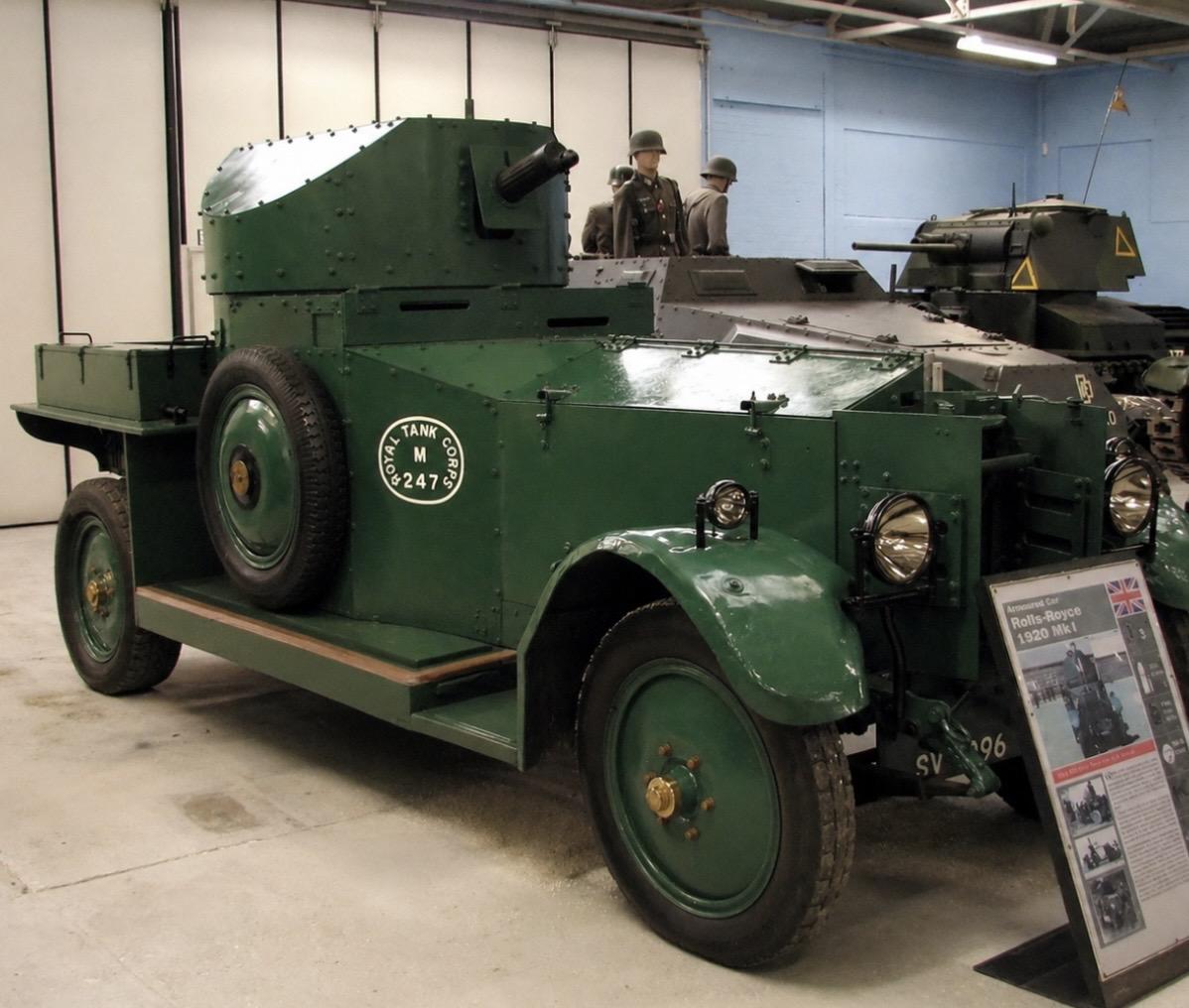
The vehicle shown is a Rolls-Royce armoured car, one of the most iconic and effective armoured fighting vehicles of the First World War. Built on the reliable chassis of the Rolls-Royce Silver Ghost, it combined civilian engineering excellence with military improvisation at a time when mechanised warfare was still in its infancy. What began as an ad hoc response to the demands of modern war quickly became one of the most respected armoured cars of the conflict.
The origins of the Rolls-Royce armoured car can be traced to 1914, when Royal Naval Air Service (RNAS) personnel needed a way to protect their aircraft and recover downed pilots behind enemy lines. Using privately owned Rolls-Royce cars, they improvised armour plating and mounted machine guns, creating some of the earliest armoured cars used in combat. The performance of these early conversions was so impressive that the British Admiralty ordered a more standardised design, leading to the development of the 1914 pattern armoured car.
The vehicle retained the Silver Ghost’s 40/50 horsepower engine, a six-cylinder unit renowned for its smoothness and reliability. This engine gave the armoured car a respectable top speed for its time, often around 45 to 50 miles per hour on roads, which was remarkable considering the added weight of armour plating. The chassis was robust and capable of handling harsh conditions, making it particularly suited for long-range operations in open terrain.
Armour thickness varied but was generally around 8 mm, enough to protect against small arms fire and shrapnel. The body was constructed with riveted steel plates, giving it the distinctive angular and somewhat boxy appearance seen in the image. The turret, typically mounted centrally, housed a Vickers machine gun, providing 360-degree fire capability. This allowed the vehicle to engage targets in any direction without needing to reposition, a significant tactical advantage.
One of the defining characteristics of the Rolls-Royce armoured car was its adaptability. Over the course of the war and into the interwar period, several variants were produced, including the 1920 and 1924 patterns, which featured improvements such as better armour layout and modified turrets. These later versions are often what survive in museums today, as they continued to serve long after the First World War ended.
Operationally, the Rolls-Royce armoured car proved especially effective in the Middle Eastern theatres, such as in Egypt, Palestine, and Mesopotamia. The wide open deserts allowed it to exploit its speed and range, performing reconnaissance, raiding, and patrol duties with great success. Figures such as T. E. Lawrence, better known as Lawrence of Arabia, famously praised these vehicles, reportedly calling them “more valuable than rubies” for their reliability and mobility in desert warfare.
In contrast, the muddy and trench-dominated conditions of the Western Front limited the effectiveness of wheeled vehicles like this one. Tanks, with their tracked systems, were better suited to crossing trenches and rough ground. As a result, Rolls-Royce armoured cars were gradually withdrawn from that theatre and redeployed where terrain allowed them to excel.
The crew typically consisted of three to four men: a driver, a commander, and one or two gunners. Communication was basic, often relying on hand signals or shouted commands within the confined interior. Despite the cramped and sometimes uncomfortable conditions, crews valued the vehicle for its protection and mobility compared to unarmoured transport.
Another notable feature visible on many examples is the spare wheel mounted on the side, which was essential given the risk of punctures during operations. Early military vehicles often suffered from tyre failures, especially in rough terrain, so carrying a spare was a practical necessity. The flatbed rear section seen on some versions could be used for carrying supplies or additional equipment.
After the First World War, the Rolls-Royce armoured car continued to serve in various conflicts and colonial policing roles throughout the British Empire. It saw action in Ireland during the War of Independence, in the Middle East during various uprisings, and even into the early years of the Second World War. Its longevity is a testament to the quality of its design and construction.
Today, surviving examples are preserved in museums and collections, where they stand as a reminder of a transitional period in military history. The Rolls-Royce armoured car represents the moment when warfare began shifting from traditional cavalry and infantry to mechanised forces. It also highlights the ingenuity of early war engineers, who adapted existing technology to meet entirely new challenges on the battlefield.
The example in the image, finished in a deep green and bearing Royal Tank Corps markings, reflects the later standardised appearance of these vehicles. Its riveted armour, prominent turret, and solid stance capture both the elegance of its civilian origins and the functional toughness required for war. Even today, it retains an aura of prestige and durability, qualities long associated with the Rolls-Royce name.