On this day in military history…
On 20 July 1944, a group of German Army officers and civilian opponents of the Nazi regime launched the most serious attempt to assassinate Adolf Hitler and overthrow his government. The operation centred on Colonel Claus Schenk Graf von Stauffenberg, who carried a bomb into Hitler’s military headquarters and placed it only a few feet from him during a conference. The explosion tore through the room, killing four men and injuring many others, but Hitler survived. Within hours, the planned uprising had collapsed and its leading members were being arrested and executed.
The attempt was not an isolated act carried out by a single officer. It was the culmination of years of secret opposition involving senior military commanders, diplomats, civil servants, politicians, lawyers and religious figures. They differed greatly in their political beliefs and their reasons for opposing Hitler, but by 1944 they shared the belief that Germany was being led towards complete destruction.
Opposition within the German military had existed since before the outbreak of the Second World War. Some officers had considered removing Hitler during the crisis over Czechoslovakia in 1938, fearing that his aggressive policies would provoke a war Germany could not win. These early plans collapsed after Britain and France accepted the German occupation of the Sudetenland under the Munich Agreement, which greatly increased Hitler’s popularity.
As the war progressed, reports of mass shootings, atrocities in occupied territories and the systematic murder of Europe’s Jewish population persuaded some officers that resistance had become a moral duty. Others were principally concerned with Germany’s military situation, the destruction of the legal system or the growing power of the Nazi Party and SS. The defeat at Stalingrad, the Allied bombing campaign and the steady advance of Soviet forces made it increasingly clear that Germany was losing the war.
One of the most important early organisers was Major General Henning von Tresckow, an officer serving on the Eastern Front. Tresckow became convinced that Hitler had to be killed, regardless of whether the assassination succeeded in saving Germany from defeat. He believed that the German resistance had to demonstrate to the world that not every German had supported the crimes of the Nazi regime.
Tresckow and his associates made several attempts to kill Hitler. On 13 March 1943, conspirators placed explosives disguised as bottles of Cointreau aboard Hitler’s aircraft after a visit to Army Group Centre headquarters near Smolensk. The bomb failed to explode, probably because the freezing conditions in the aircraft’s baggage compartment prevented the detonator from working properly. The package was recovered before it could be discovered.
A few days later, Colonel Rudolf-Christoph von Gersdorff planned to kill Hitler by detonating explosives concealed beneath his uniform during an exhibition of captured Soviet equipment in Berlin. Gersdorff expected Hitler to spend enough time viewing the display for the timed detonators to operate. Instead, Hitler hurried through the exhibition and left after only a few minutes, forcing Gersdorff to rush to a lavatory and disarm the explosives.
Several other attempts were abandoned because Hitler unexpectedly changed his plans, left meetings early or was surrounded by circumstances that made an attack impossible. His irregular movements, intense personal security and reluctance to announce his schedule in advance made him an exceptionally difficult target.
Claus von Stauffenberg gradually became a central figure in the resistance. Born into an aristocratic Catholic family in Bavaria in 1907, he had joined the German Army in the 1920s and initially welcomed some aspects of the Nazi rise to power. His attitude changed as he witnessed the brutality of the regime and the consequences of Hitler’s military leadership.
Stauffenberg served in Poland, France, the Soviet Union and North Africa. On 7 April 1943, while serving with the 10th Panzer Division in Tunisia, his vehicle was attacked by Allied aircraft. He suffered terrible injuries, losing his left eye, his right hand and two fingers from his left hand. Despite these wounds, he recovered with remarkable speed and returned to duty.
His disability created enormous difficulties when handling weapons and explosives, but his new appointment gave him something the conspirators desperately needed: access to Hitler. In 1944, Stauffenberg became chief of staff to General Friedrich Fromm, commander of the Replacement Army. His position required him to attend military conferences at Hitler’s headquarters.
The conspirators intended to combine the assassination with a revised version of Operation Valkyrie. Valkyrie was an existing emergency plan designed to mobilise the Replacement Army if civil unrest, forced labour uprisings or other disturbances threatened the German state. The plotters secretly altered its orders so that, after Hitler’s death, troops would occupy government buildings, communications centres, radio stations and SS headquarters.
The coup leaders planned to claim that Hitler had been murdered by a criminal group within the SS and that the Army was acting to restore order. SS and Nazi Party officials would be arrested, while military commanders across Germany and occupied Europe would receive instructions from the conspirators in Berlin.
General Ludwig Beck, a former chief of the Army General Staff, was expected to become head of state. Conservative politician Carl Friedrich Goerdeler was proposed as the new chancellor, while Field Marshal Erwin von Witzleben would become commander-in-chief of the armed forces. Other figures, including diplomats and trade union representatives, were intended to take positions in a post-Nazi government.
The plotters hoped that a new administration could negotiate an end to the war with Britain and the United States, although their political plans were far from united. Some wanted to restore a conservative authoritarian state, while others supported parliamentary government, constitutional reform or a broader democratic system. There was also disagreement about Germany’s future borders and whether the Western Allies would be willing to negotiate separately from the Soviet Union.
By the summer of 1944, time was running out. Allied forces had landed in Normandy on 6 June, Rome had fallen and Soviet armies were destroying German forces in the east. Hitler’s commanders were losing control of events, while German cities were being devastated from the air.
Stauffenberg attended a briefing at Hitler’s Berghof residence near Berchtesgaden on 11 July with explosives in his briefcase, but he did not act because Heinrich Himmler was absent. The conspirators hoped to kill both Hitler and Himmler, fearing that the SS leader might seize power if he survived. Another opportunity on 15 July was abandoned at the last moment when it became uncertain whether Hitler was still present.
On the morning of 20 July 1944, Stauffenberg and his assistant, Lieutenant Werner von Haeften, flew from Berlin to Hitler’s headquarters near Rastenburg in East Prussia, now Kętrzyn in Poland. The heavily guarded complex was known as the Wolfsschanze, or Wolf’s Lair. It was surrounded by forests, minefields, barbed wire, checkpoints and camouflaged bunkers.
Stauffenberg carried two packets of British-made plastic explosive in his briefcase. Each bomb was fitted with a chemical pencil detonator. To arm the device, a small glass capsule had to be crushed, releasing acid that gradually ate through a wire holding back a spring-loaded firing pin.
Shortly before the conference, Stauffenberg asked to use a room where he could change his shirt. With the assistance of Haeften, he began preparing the explosives using specially adapted pliers. Because he had only three fingers on his left hand and no right hand, the task was extremely difficult.
The two men were interrupted by an officer informing them that the conference was about to begin. Under pressure, Stauffenberg managed to arm only one of the two explosive charges. The second packet was carried away by Haeften and never placed in the briefcase. Had both bombs been present, the greater force of the explosion might have killed everyone in the room.
The meeting had originally been expected to take place in a reinforced underground bunker. Because of the hot weather and the need to discuss maps, it was instead held in a lightly constructed conference hut with open windows. This change allowed much of the force of the explosion to escape and greatly improved Hitler’s chances of survival.
Around 24 people gathered around a large oak map table. Stauffenberg placed his briefcase beneath the table close to Hitler and then left the room, claiming that he needed to make a telephone call. The detonator was set to give him only a short time to escape.
After Stauffenberg departed, Colonel Heinz Brandt apparently moved the briefcase because it was obstructing his view or interfering with his position at the table. He placed it on the opposite side of one of the table’s heavy wooden supports. This thick support shielded Hitler from much of the blast.
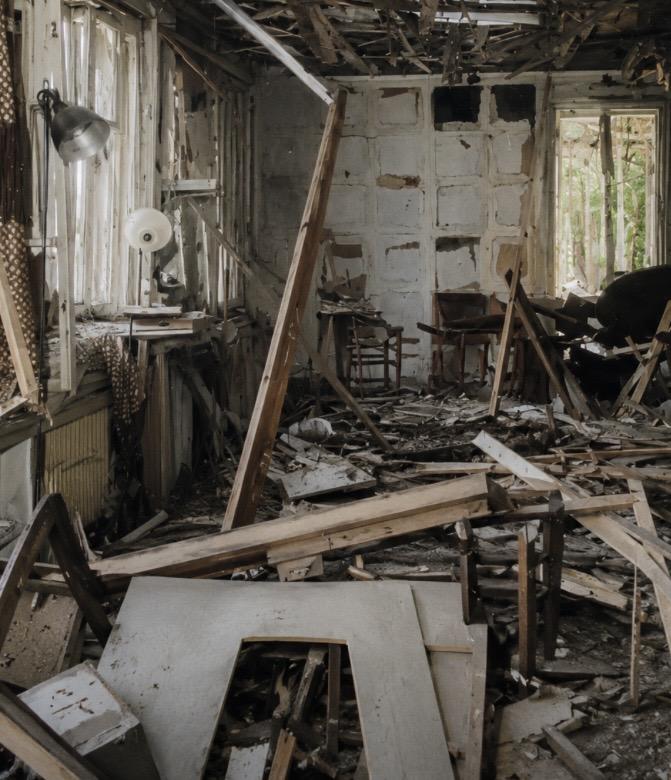
At approximately 12.42 p.m., the bomb exploded. The conference hut was ripped apart, windows shattered and the roof was lifted by the blast. Smoke, splintered wood, broken glass, documents and fragments of furniture filled the air. Stauffenberg saw the explosion from a distance and believed that nobody could possibly have survived.
Four men eventually died from their wounds: General Rudolf Schmundt, Colonel Heinz Brandt, General Günther Korten and stenographer Heinrich Berger. Many others were injured. Hitler suffered burns, cuts, bruising, damaged eardrums and temporary weakness in one arm, but the heavy table support and the open construction of the building had protected him from the full force of the explosion.
Stauffenberg and Haeften bluffed their way through the Wolf’s Lair security checkpoints. After reaching their waiting aircraft, they flew back to Berlin, convinced that Hitler was dead. During the journey, Haeften threw the unused packet of explosives from the aircraft.
The conspirators in Berlin, however, had received conflicting reports. General Friedrich Olbricht and other leaders at the Bendlerblock, the Replacement Army headquarters, hesitated to activate Valkyrie without confirmation of Hitler’s death. This delay proved disastrous.
Only at around 4 p.m., after Stauffenberg returned and insisted that Hitler could not have survived, did Olbricht and Colonel Albrecht Mertz von Quirnheim begin issuing the Valkyrie orders. Army units were told that Hitler was dead and that the SS had attempted to seize control of the government.
In some places, the coup initially appeared to be succeeding. Troops occupied important buildings in Berlin, and units in Paris began arresting SS and Nazi officials. Major Otto Ernst Remer, commander of the Grossdeutschland Guard Battalion, was ordered to seal off government buildings and arrest senior Nazi leaders, including Propaganda Minister Joseph Goebbels.
Goebbels persuaded Remer to telephone Hitler’s headquarters. Hitler personally spoke to the major, proving that he was alive, and ordered him to crush the coup. Remer was promoted immediately and turned his troops against the conspirators.
Communication from the Wolf’s Lair, radio broadcasts and messages from loyal commanders quickly exposed the false claim that Hitler had been killed. Field Marshal Wilhelm Keitel informed military headquarters across Europe that the Führer was alive. Many officers who had been prepared to follow official orders refused to support an uprising once they realised the assassination had failed.
At the Bendlerblock, confusion became panic. General Fromm, whose precise knowledge of the conspiracy remains debated, attempted to distance himself from the plotters. He was briefly arrested by Stauffenberg and the others but was freed by loyal officers later that evening.
By midnight, the coup had collapsed. Fromm convened an improvised court martial and sentenced Stauffenberg, Olbricht, Mertz von Quirnheim and Haeften to death. His haste may have been intended to silence them before they could reveal his own possible involvement.
During the early hours of 21 July, the four men were taken into the courtyard of the Bendlerblock and shot by firing squad in the light of vehicle headlamps. As the soldiers prepared to fire at Stauffenberg, he reportedly cried out words honouring what he called “sacred Germany”. Haeften stepped in front of Stauffenberg during one volley and was killed before him.
General Ludwig Beck was permitted to attempt suicide. After failing to kill himself with two pistol shots, he was finished off by a soldier. Fromm’s effort to conceal his connections did not save him. He was later arrested, tried and executed in March 1945.
When Hitler appeared on German radio during the night, he described his survival as proof that fate had preserved him to continue his mission. He used the failed assassination to justify a vast purge of suspected opponents.
The Gestapo launched an enormous investigation and uncovered documents, diaries, correspondence and lists of names. Thousands of people were arrested, including relatives of the conspirators. Estimates vary, but around 200 people connected directly or indirectly with the plot were executed, while several thousand were detained during the wider repression that followed.
Many defendants were tried before the People’s Court under its notorious president, Roland Freisler. The hearings were deliberately humiliating spectacles. Prisoners were brought into court without belts or properly fitting clothes, shouted at and prevented from defending themselves. Film cameras recorded parts of the proceedings for Nazi propaganda purposes.
Among those executed were Carl Goerdeler, Ulrich von Hassell, Helmuth James von Moltke, Peter Yorck von Wartenburg, Erwin von Witzleben and numerous military officers, civil servants and civilians. Several condemned men were hanged at Plötzensee Prison in Berlin, sometimes using thin cord or piano wire.
Henning von Tresckow, serving on the Eastern Front, realised that the plot had failed and that his arrest was inevitable. On 21 July, he walked into an area between the German and Soviet lines and killed himself with a grenade. He hoped that his death in apparent combat would protect his family and prevent the Gestapo from discovering the full extent of his activities.
Field Marshal Erwin Rommel was not directly involved in planting the bomb, and historians continue to debate how much he knew about the assassination plan. He had contact with several conspirators and supported removing Hitler from power, although he appears to have preferred arrest and trial rather than assassination.
After the Gestapo uncovered evidence implicating him, Hitler offered Rommel a terrible choice. He could face a public trial, almost certain execution and possible punishment of his family, or take poison in return for guarantees concerning his wife and son. On 14 October 1944, Rommel took cyanide. The regime falsely announced that he had died from wounds suffered in an Allied air attack and gave him a state funeral.
The failure of the plot strengthened Hitler’s distrust of the Army. He increasingly relied upon loyal Nazi officers, the SS and political fanatics. Traditional military courtesies were altered, and the Nazi salute became compulsory throughout the armed forces. Hitler also became even more isolated and suspicious, while his interference in military decisions intensified.
Even had the bomb killed him, the outcome of the coup would have been uncertain. The SS remained heavily armed, many senior commanders were loyal to the regime and the conspirators had no guarantee that ordinary soldiers would obey their orders. The Allies were committed to Germany’s unconditional surrender and were unlikely to accept a peace settlement that allowed Germany to retain conquered territory.
By July 1944, much of Europe had already suffered under Nazi occupation and millions of Jews and other victims had been murdered. The assassination therefore came too late to prevent most of the regime’s crimes. Nevertheless, a successful coup might have shortened the war, reduced further destruction and saved many of the lives lost during its final ten months.
The motivations of the conspirators remain complex. Some had opposed Hitler for years on religious, moral or legal grounds. Others had served the regime loyally before turning against it after military defeat appeared inevitable. A number held conservative, nationalist or authoritarian views that would not be considered democratic today. They were not a single movement with one ideology, and they did not all oppose every aspect of Nazi policy from the beginning.
Their actions nevertheless required extraordinary courage. They understood that failure would almost certainly mean torture, execution and danger to their families. Stauffenberg, Tresckow and their associates chose to act in the knowledge that their chances of success were rapidly disappearing.
The Bendlerblock courtyard where Stauffenberg and his companions were shot is now part of the German Resistance Memorial Centre in Berlin. A memorial stands at the site, honouring those who attempted to overthrow the Nazi dictatorship. Germany’s armed forces also commemorate 20 July as a symbol of the principle that a soldier’s duty cannot be based upon blind obedience when orders violate law and conscience.
The assassination attempt of 20 July 1944 failed because of a combination of chance, delay, confusion and hesitation. Only one bomb was armed, the meeting was moved to a less enclosed building, the briefcase was shifted behind a heavy table support and the conspirators waited too long before beginning the coup. Hitler’s survival allowed loyal officers to regain control before the resistance could secure Berlin.
For a few dramatic hours, however, the Nazi leadership stood on the edge of collapse. The explosion at the Wolf’s Lair was more than an attempt to kill one man. It was the signal for an ambitious military and political uprising intended to destroy the dictatorship from within. Although it failed and brought death to many of those involved, the events of 20 July remain one of the most significant acts of German resistance during the Second World War.