Kilted Killer
Colonel Sir Ronald Thomas Stewart Macpherson, better known throughout his life as Tommy Macpherson, became one of the most extraordinary British soldiers of the Second World War. A Commando, prisoner of war, serial escapee, intelligence officer and leader of resistance fighters, he conducted daring operations across North Africa, occupied Europe and northern Italy. Frequently operating far behind enemy lines and often wearing Highland battledress complete with kilt, he acquired the legendary nickname “The Kilted Killer”. By the end of the conflict he had received three awards of the Military Cross, three French Croix de Guerre and the Légion d’honneur, placing him among the most highly decorated British servicemen of the war.
Macpherson was born in Edinburgh on 4 October 1920, the youngest of seven children. His father, Sir Thomas Stewart Macpherson, had served in India, while his mother, Helen, was the daughter of a Church of Scotland minister. Although born in Edinburgh, the family had strong Highland connections with Newtonmore and Badenoch, an ancestry of which the young Tommy remained intensely proud throughout his life. The kilt that later made him instantly recognisable in occupied Europe was therefore not theatrical costume but a powerful expression of his Scottish identity.
He was educated at Fettes College in Edinburgh, where he became an outstanding athlete. He excelled particularly in running and represented Scotland at schoolboy level. He was intelligent, physically fit, self-confident and fiercely competitive, qualities that would later prove invaluable when he was required to survive alone in hostile territory. Before the outbreak of war, he intended to study at Oxford University, but the rapidly worsening situation in Europe changed the direction of his life.
When Britain declared war on Germany in September 1939, Macpherson was still only eighteen. He joined the Territorial Army and was commissioned into the Queen’s Own Cameron Highlanders. His natural confidence, fitness and appetite for adventure soon brought him to the attention of those forming Britain’s new Commando units. These formations were intended to strike quickly against enemy positions, destroy important targets and withdraw before superior forces could respond.
Macpherson volunteered for Commando service and became a member of No. 11 Scottish Commando. The unit trained in mountain warfare, demolitions, navigation, unarmed combat and amphibious operations. Its members were expected to operate independently, make decisions without waiting for orders and continue fighting even when isolated from the main force. This demanding environment suited Macpherson perfectly.
In June 1941, No. 11 Commando took part in Operation Exporter, the Allied invasion of Vichy French-controlled Syria and Lebanon. The Commandos landed near the mouth of the Litani River with the task of capturing bridges and preventing their destruction. The operation involved fierce fighting and heavy casualties. Macpherson distinguished himself during the action, demonstrating both courage and leadership under fire.
Later that year he was selected for an even more dangerous mission in North Africa. A small group was ordered to penetrate deep behind Axis lines and attack what was believed to be the headquarters of General Erwin Rommel near Beda Littoria in Libya. The raid, which took place in November 1941, became known as Operation Flipper.
The raiders were landed from submarines and crossed difficult terrain in poor weather. Their objective was to kill or capture Rommel and disrupt the command of the Afrika Korps shortly before a major British offensive. Unknown to the attackers, Rommel was not present at the target. The operation went badly wrong, and Lieutenant Colonel Geoffrey Keyes, who led the assault, was killed.
Macpherson and two companions attempted to escape through the desert. For days they avoided enemy patrols, travelling through harsh country with little food or water. Their situation eventually became hopeless and they were captured by Italian troops. At only twenty-one years of age, Macpherson began a long period as a prisoner of war, but captivity did not reduce his determination to continue fighting.
He made repeated escape attempts from camps in Italy and elsewhere. Some accounts credit him with as many as seven separate attempts during his period as a prisoner. On one occasion he escaped and travelled hundreds of miles before being recaptured. He was transferred between increasingly secure camps as the authorities realised that he could not be trusted to remain behind barbed wire.
During one escape he and his companions used their limited knowledge of languages, stolen clothing and forged documents to pass through enemy-controlled areas. Macpherson displayed a remarkable ability to remain calm while being questioned, often relying on confidence and bluff rather than elaborate planning. Even when captured again, he treated imprisonment as a temporary inconvenience rather than the end of his war.
After Italy began moving towards an armistice in 1943, Macpherson escaped once more. He travelled through northern Italy and crossed into neutral Switzerland. From there he eventually made his way through Europe, reaching Britain by way of Sweden. After almost two years in enemy hands, he returned home determined to rejoin active operations rather than accept a safer posting.
His experience of escape, survival and clandestine movement made him ideal for service with the Special Operations Executive. The organisation had been created to conduct sabotage, gather intelligence and support resistance movements throughout occupied Europe. Macpherson was trained in parachuting, wireless communications, explosives and guerrilla warfare before being selected for Operation Jedburgh.
The Jedburgh teams were small groups, usually consisting of British, American or French officers and a radio operator, who were parachuted into occupied France after D-Day. Their mission was to organise local resistance groups, arrange the delivery of weapons and supplies, gather intelligence and coordinate attacks against German communications.
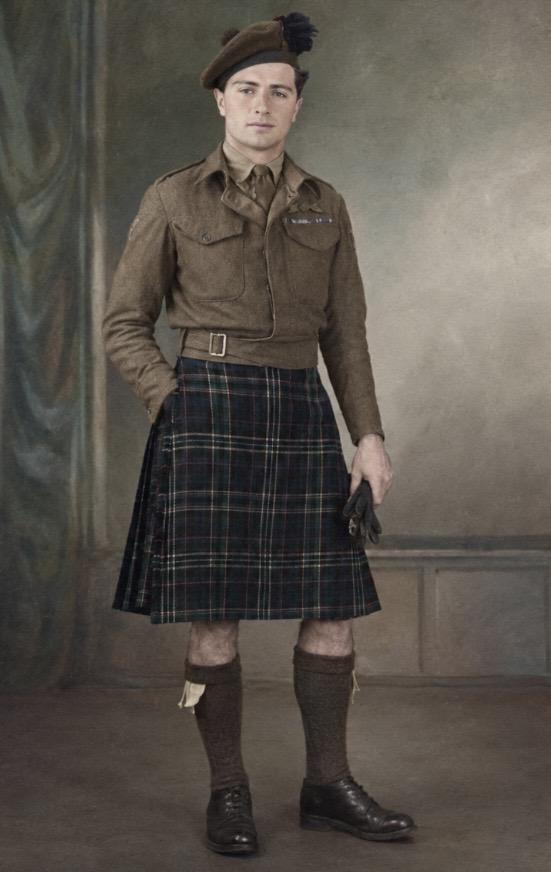
On 8 June 1944, only two days after the Allied landings in Normandy, Macpherson parachuted into south-western France as part of a Jedburgh team. He landed wearing his Cameron Highlanders battledress and tartan kilt. The decision was partly practical because he wanted the French Resistance to recognise immediately that he was a British officer rather than an enemy agent. It was also an act of extraordinary confidence, demonstrating that he had no intention of hiding his identity from either friend or enemy.
He soon gathered local resistance fighters and began organising attacks against German forces. Roads were blocked, railway lines destroyed, bridges damaged and telephone cables cut. Fuel convoys were ambushed, vehicles disabled and isolated garrisons harassed. These operations forced the Germans to divert men and equipment away from the Normandy battlefront and made every movement through the region increasingly dangerous.
Macpherson understood that the resistance could not defeat heavily armed German units in conventional battle. Instead, he concentrated on delay, confusion and psychological pressure. Trees were felled across roads, explosives were placed beneath railway tracks, signposts were altered and false information was spread. Small groups attacked quickly before disappearing into forests and remote villages.
The German 2nd SS Panzer Division Das Reich was stationed in southern France when the Allies landed in Normandy. It was ordered north to reinforce the German armies opposing the invasion, but resistance attacks caused serious delays. Railways were repeatedly sabotaged and roads obstructed, forcing much of the division to travel by road while continually dealing with ambushes and damaged equipment.
Macpherson and the French resistance fighters operating under his influence contributed to this wider campaign of disruption. Although later popular accounts sometimes exaggerated the claim that he personally stopped the entire division, his operations formed part of the resistance effort that considerably delayed its movement towards Normandy. Every day lost gave the Allied forces more time to strengthen their beachhead.
His appearance helped create the legend that surrounded him. A tall British officer wearing a tartan kilt and carrying weapons was difficult to overlook. German notices reportedly described him as a dangerous terrorist, and a substantial reward was said to have been offered for his capture. The figure most commonly associated with the bounty was 300,000 francs. Yet Macpherson continued travelling openly through the region, sometimes using a black Citroën displaying a Union flag and a pennant of the Cameron Highlanders.
His boldness had a psychological purpose. The visible presence of a uniformed British officer reassured the French that the Allies had not forgotten them. It also allowed captured Germans to understand that they were dealing with an official representative of the Allied forces rather than an irregular bandit. To many resistance fighters, the kilted officer became a living symbol that liberation was approaching.
One of the most remarkable stories associated with Macpherson occurred as German resistance in south-western France began collapsing. Using confidence, deception and carefully selected information, he persuaded senior German officers that their position was hopeless and that overwhelming Allied forces were closing in. In reality, the number of resistance fighters available to him was much smaller than he suggested.
Macpherson reportedly warned that the Royal Air Force could destroy German columns on the roads and that large resistance forces surrounded them. His bluff contributed to the surrender of thousands of enemy troops. Some later accounts described him as persuading as many as 23,000 men to lay down their weapons, although this simplified a much larger series of negotiations and German surrenders across the region. What cannot be doubted is that Macpherson used courage and psychological warfare to obtain results far beyond the strength of the forces directly under his command.
He was promoted rapidly during the war because his responsibilities were far greater than those normally given to someone of his age. Having begun the conflict as a junior officer, he was already operating as a major while still in his early twenties. He commanded groups containing hundreds and sometimes thousands of resistance fighters, negotiated with senior enemy officers and coordinated operations with Allied headquarters.
His work in France earned him further recognition, but his war was not over. Late in 1944 he was sent into northern Italy as part of another mission to support Italian partisans and disrupt German forces. The political situation there was extremely complicated. German troops, Italian Fascists, monarchists, communists and Yugoslav partisans were all competing for control as the Axis position weakened.
Macpherson parachuted into enemy-held territory and once again began organising resistance operations. He worked with Italian partisans, arranged supply drops and directed attacks against German communications. His ability to deal with people of different political beliefs was as important as his skill with weapons and explosives. Resistance groups were often divided by bitter rivalries, and keeping them focused on the common enemy required considerable patience and authority.
As the war approached its end, Yugoslav forces under Marshal Josip Broz Tito advanced towards Trieste and parts of north-eastern Italy. There was a serious danger that the region would be occupied permanently before British and American troops could arrive. Macpherson played an important role in establishing an Allied presence and communicating firm warnings that helped prevent Yugoslav forces from extending their control farther into Italian territory.
He moved through dangerous areas in uniform, using a combination of diplomacy and bluff to represent Allied authority before substantial Allied forces had reached the area. His actions contributed to the effort to secure key territory and reduce the possibility of a confrontation between the Western Allies and Tito’s forces. This final stage of his war required political judgement as well as personal courage.
Macpherson received the Military Cross and two Bars, meaning that he was awarded the decoration on three separate occasions. The Military Cross was given to officers for exemplary gallantry during active operations against the enemy. Receiving it once was a considerable distinction; receiving it three times placed him among a very small group of exceptional soldiers.
France awarded him the Croix de Guerre on three occasions and appointed him to the Légion d’honneur. His collection of British and foreign decorations led to him being widely described as one of the most decorated British soldiers of the Second World War. During his later life, publishers and newspapers sometimes referred to him as Britain’s most decorated living soldier. Such claims are difficult to define precisely because decorations from different countries and services cannot easily be compared, but he was unquestionably among the most highly decorated British Army officers to survive the conflict.
The nickname “Kilted Killer” was created by the extraordinary contrast between his appearance and his method of warfare. He looked like a figure from Scotland’s military past, yet he was conducting thoroughly modern clandestine operations involving radios, explosives, coded messages, air supply drops and organised resistance networks. His kilt became part of the psychological campaign he waged against the enemy.
However, Macpherson’s achievements were not based simply upon daring clothing or reckless bravery. He possessed an unusual combination of physical endurance, intelligence, confidence and imagination. He understood when to fight, when to withdraw and when an audacious lie could achieve more than a direct attack. He was able to convince nervous resistance fighters to continue operating and persuade enemy officers that surrender was their only reasonable option.
After the war, he finally attended Oxford University, studying philosophy, politics and economics and gaining a first-class degree. He also continued his athletic career and became a prominent figure in Scottish rugby. He played at fly-half for London Scottish and remained closely connected with the club for many years.
His military service also continued. He remained in the Territorial Army, eventually reaching the rank of colonel. In civilian life he pursued a successful business career and held a number of senior positions. He became involved with major companies and public organisations, including the National Coal Board, and later served as High Sheriff of Greater London.
Macpherson was appointed a Commander of the Order of the British Empire and received a Territorial Decoration for his continued military service. He was also appointed a Deputy Lieutenant. In 1992 he succeeded his brother as the 3rd Baronet of Biallid, becoming Sir Thomas Macpherson, although to friends, former soldiers and admirers he remained simply Tommy.
For many years he spoke relatively little about his wartime adventures. Like many members of the wartime special forces and intelligence services, he returned to civilian life without seeking celebrity. Only much later did the full scale of his experiences become widely known. His autobiography, Behind Enemy Lines, introduced a new generation to the remarkable story of the young Highland officer who escaped from captivity and returned to fight behind enemy lines.
Some of the stories surrounding him grew in the telling, and certain popular accounts have confused dates, numbers or the exact circumstances of German surrenders. The truth, even without embellishment, remains extraordinary. He took part in a hazardous Commando raid, survived years as a prisoner, made repeated escape attempts, crossed occupied Europe and then volunteered to parachute back behind enemy lines.
He organised sabotage throughout France, helped delay German reinforcements moving towards Normandy, led resistance fighters and used psychological warfare to secure large-scale enemy surrenders. He then repeated the experience in Italy, where he operated among competing resistance groups and helped assert Allied authority during the dangerous final weeks of the war.
Colonel Sir Tommy Macpherson died peacefully on 6 November 2014 at the age of ninety-four. By then he had become recognised as one of the last great representatives of the wartime Commando and Special Operations generation. His medals provide evidence of his courage, but they tell only part of his story.
His greatest weapon was often not a rifle or an explosive charge but his ability to convince those around him that he possessed greater strength than he actually did. Whether facing prison guards, German patrols, senior enemy officers or politically divided resistance groups, he survived through nerve, intelligence and an almost unbelievable degree of self-confidence.
The image of the young Scottish major moving through occupied France in his Cameron Highlanders kilt, carrying a Sten gun and openly displaying the Union flag, has become one of the most memorable legends of Britain’s secret war. Behind that image stood a highly capable officer whose operations disrupted enemy movements, strengthened resistance forces and contributed directly to the liberation of occupied Europe.
Tommy Macpherson may not be proved conclusively to have been the single most decorated soldier of the Second World War, as there is no universally accepted method of comparing every British and foreign award. He can, however, accurately be described as one of Britain’s most decorated and remarkable wartime officers. Few soldiers of any nation experienced such a varied war, and fewer still returned from captivity only to volunteer immediately for another mission behind enemy lines.
His courage, resourcefulness and refusal to accept defeat ensured that the name of the “Kilted Killer” would pass into military history. He represented the finest traditions of the Highland soldier while mastering the unconventional methods of modern warfare, becoming a symbol of resistance to the enemy and an enduring example of what one determined officer could achieve against overwhelming odds.