Piper L-4
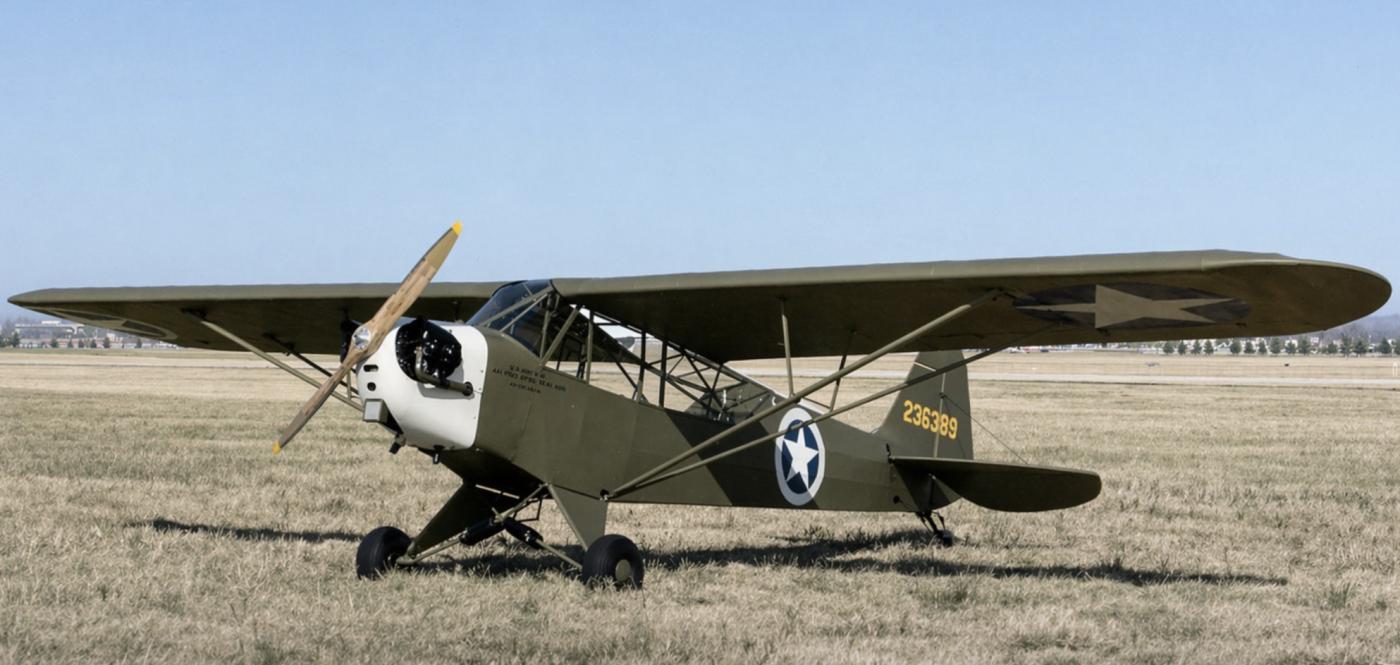
The Piper Grasshopper was one of the simplest yet most effective aircraft used during the Second World War, a light observation and liaison plane derived directly from the civilian Piper J-3 Cub. It was designed and manufactured by Piper Aircraft at its factory in Lock Haven, Pennsylvania, and became one of the most widely used light aircraft of the war.
The origins of the design go back to the late 1930s when the J-3 Cub was developed as a small, inexpensive training and private aircraft. When the United States Army began looking for a light aircraft for battlefield observation and liaison duties, the Cub was quickly adapted for military use. Initially designated the O-59 in 1941, it was later redesignated as the L-4, with “L” standing for liaison. The nickname “Grasshopper” came from its ability to operate from very short, rough fields.
Production was extensive for such a small aircraft. During World War II, roughly 5,400 examples were built for U.S. forces, with total numbers often cited between about 5,000 and nearly 6,000 depending on the source. These aircraft formed part of a much larger family of Cub-based designs, with total production of Cub variants reaching nearly 20,000 units. At peak output, factories were producing one aircraft roughly every 20 minutes.
Power came from a simple and reliable air-cooled, four-cylinder engine, most commonly the Continental A-65 engine, producing about 65 horsepower. This gave a top speed of around 85 miles per hour and a cruising speed of roughly 75 miles per hour. Its range was typically between 190 and 225 miles, and it could remain airborne for several hours. The service ceiling generally ranged from about 9,300 to 11,500 feet.
The structure was extremely lightweight, built from a framework of steel tubing with wood and fabric covering. It usually carried two people, a pilot and an observer seated in tandem. Additional windows and a skylight provided excellent visibility, which was essential for spotting enemy positions.
Despite its small size and lack of armour, this aircraft played a critical role in the war. It was used primarily for artillery spotting, with observers flying low over the battlefield and radioing corrections to ground units. It also served as a liaison aircraft, carrying messages, officers, and small cargo between units, often landing close to the front lines. Other duties included reconnaissance, training, casualty evacuation, and directing air strikes. It operated in every major theatre, including North Africa, Italy, Western Europe, and the Pacific.
In terms of armament, it was not designed as a combat aircraft and normally carried no weapons. Its effectiveness came from low speed, manoeuvrability, and the ability to operate from improvised strips. There were rare experimental cases where examples were fitted with light weapons such as bazookas, but these were highly unusual.
What made the Grasshopper particularly valuable was its ability to take off and land in very confined spaces, often from fields or roads. It required minimal maintenance, was easy to fly, and could stay close to advancing troops. This allowed it to provide real-time battlefield awareness in a way that larger aircraft could not.
Overall, the Piper L-4 Grasshopper was not fast or heavily armed, but it proved to be one of the most useful aircraft of the war, making a major contribution through communication, observation, and coordination of ground forces.