
Paris Peace Accords
The Paris Peace Accords, formally titled the Agreement on Ending the War and Restoring Peace in Vietnam, were signed on 27 January 1973 and represented the most significant diplomatic effort to end the Vietnam War and secure the withdrawal of United States forces. The accords were the result of nearly five years of intermittent and often stalled negotiations held in Paris between representatives of the United States, the Democratic Republic of Vietnam (North Vietnam), the Republic of Vietnam (South Vietnam), and the Provisional Revolutionary Government, which represented the Viet Cong.
The background to the accords lay in the prolonged and costly nature of the Vietnam War, which had begun as a conflict between North and South Vietnam after the 1954 Geneva Accords and escalated dramatically with large-scale U.S. military involvement from the mid-1960s. By the late 1960s, the war had become deeply unpopular in the United States, provoking mass protests, political division, and growing pressure on the government to find a negotiated settlement. The Tet Offensive of 1968, although a military setback for North Vietnam, demonstrated that the war was far from being won and undermined public confidence in official claims of progress.
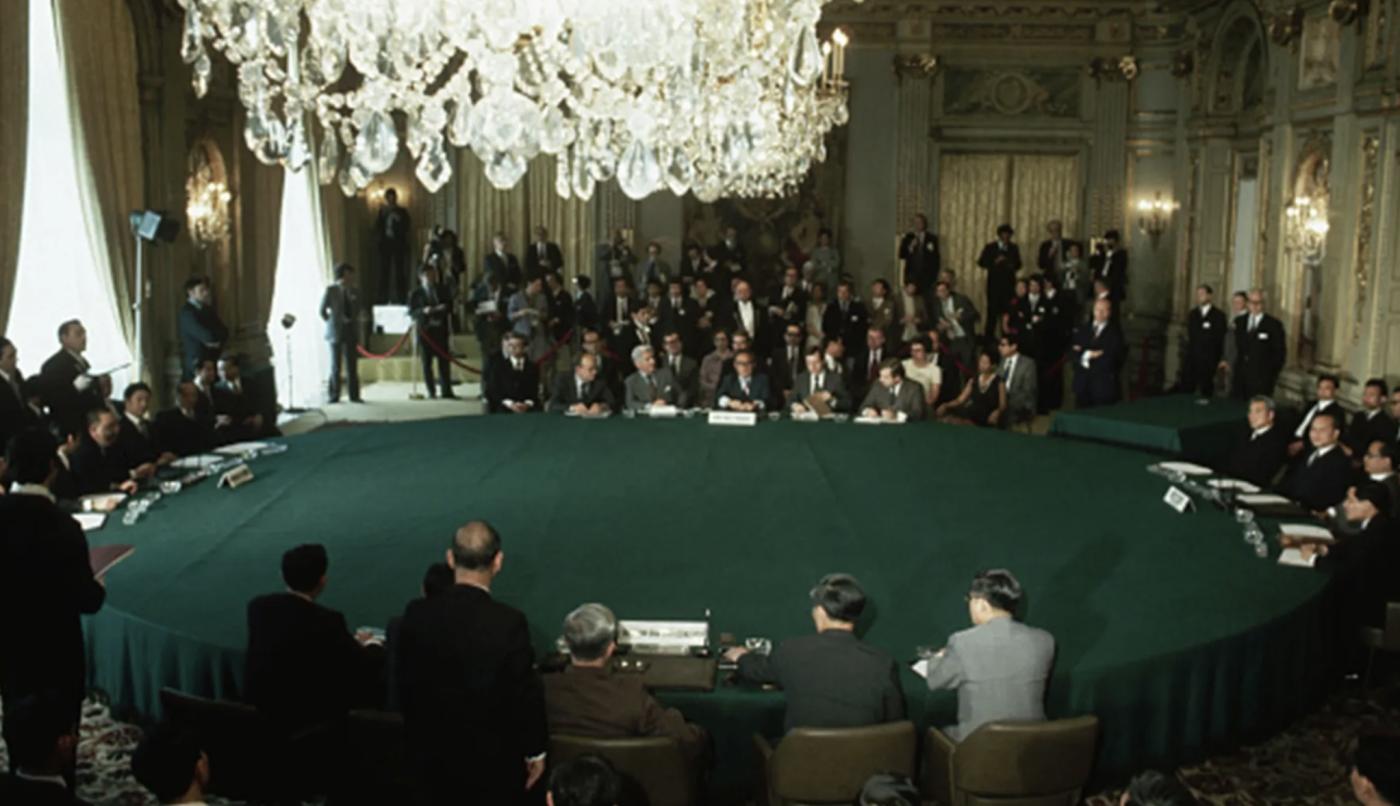
Formal peace talks began in May 1968 in Paris, initially between the United States and North Vietnam, later expanding to include South Vietnam and the Provisional Revolutionary Government. The negotiations were marked by long periods of deadlock, symbolic disputes such as the shape of the negotiating table, and fundamental disagreements over the future political structure of South Vietnam. Key figures in the talks included U.S. National Security Adviser Henry Kissinger and North Vietnamese negotiator Le Duc Tho, whose secret bilateral negotiations eventually proved decisive.
The accords consisted of several interrelated documents. Their core provisions called for a ceasefire throughout Vietnam, Laos, and Cambodia; the complete withdrawal of all U.S. and allied foreign troops from South Vietnam within 60 days; the dismantling of U.S. military bases; and the return of prisoners of war. In exchange, North Vietnam agreed to release American POWs and declared its respect for the territorial integrity of South Vietnam. Crucially, however, North Vietnamese troops already present in South Vietnam were allowed to remain in place, a provision that would later prove decisive.
The agreement also addressed Vietnam’s internal political future. It recognized the existence of two opposing administrations in South Vietnam and called for the creation of a National Council of National Reconciliation and Concord, intended to organize free and democratic elections and determine the country’s political future peacefully. This ambiguous political framework reflected the inability of the negotiators to resolve the core issue of power in South Vietnam and allowed each side to interpret the agreement in ways favorable to its own position.
For the United States, the Paris Peace Accords fulfilled President Richard Nixon’s promise of “peace with honor.” They enabled the withdrawal of U.S. combat forces, which was completed by March 1973, and secured the return of American prisoners of war, an emotionally powerful outcome that helped restore a sense of closure for the U.S. public. However, the accords did not require North Vietnam to withdraw its forces from the South, nor did they provide effective enforcement mechanisms to prevent renewed fighting.
In South Vietnam, President Nguyen Van Thieu reluctantly accepted the agreement under strong U.S. pressure, fearing that it undermined his government’s survival. His concerns were well founded. Almost immediately after the accords were signed, ceasefire violations occurred on all sides. Although the United States pledged to respond forcefully to major violations, domestic opposition and the U.S. Congress’s passage of legislation restricting military involvement in Southeast Asia severely limited American willingness and ability to intervene again.
Internationally, the accords were guaranteed by an International Commission of Control and Supervision, made up of representatives from Canada, Poland, Hungary, and Indonesia. In practice, the commission lacked both the authority and the resources to enforce compliance, and its effectiveness was minimal. The broader Cold War context also shaped the outcome, as the United States was simultaneously pursuing détente with the Soviet Union and opening diplomatic relations with China, reducing its appetite for renewed escalation in Vietnam.
In the years following the accords, fighting steadily intensified between North and South Vietnamese forces. Without direct U.S. military support and facing declining American financial aid, South Vietnam grew increasingly vulnerable. In the spring of 1975, North Vietnamese forces launched a full-scale offensive that rapidly overwhelmed the South. Saigon fell on 30 April 1975, leading to the reunification of Vietnam under communist rule and marking the definitive end of the Vietnam War.
The Paris Peace Accords remain a subject of historical debate. They are often seen less as a true peace settlement than as a negotiated exit for the United States from an unwinnable war. While they succeeded in ending direct U.S. military involvement and returning American prisoners of war, they failed to secure a lasting peace for Vietnam itself. Nevertheless, the accords stand as a landmark in diplomatic history, illustrating both the possibilities and the limitations of negotiated settlements in deeply entrenched ideological and civil conflicts.