Para Dogs
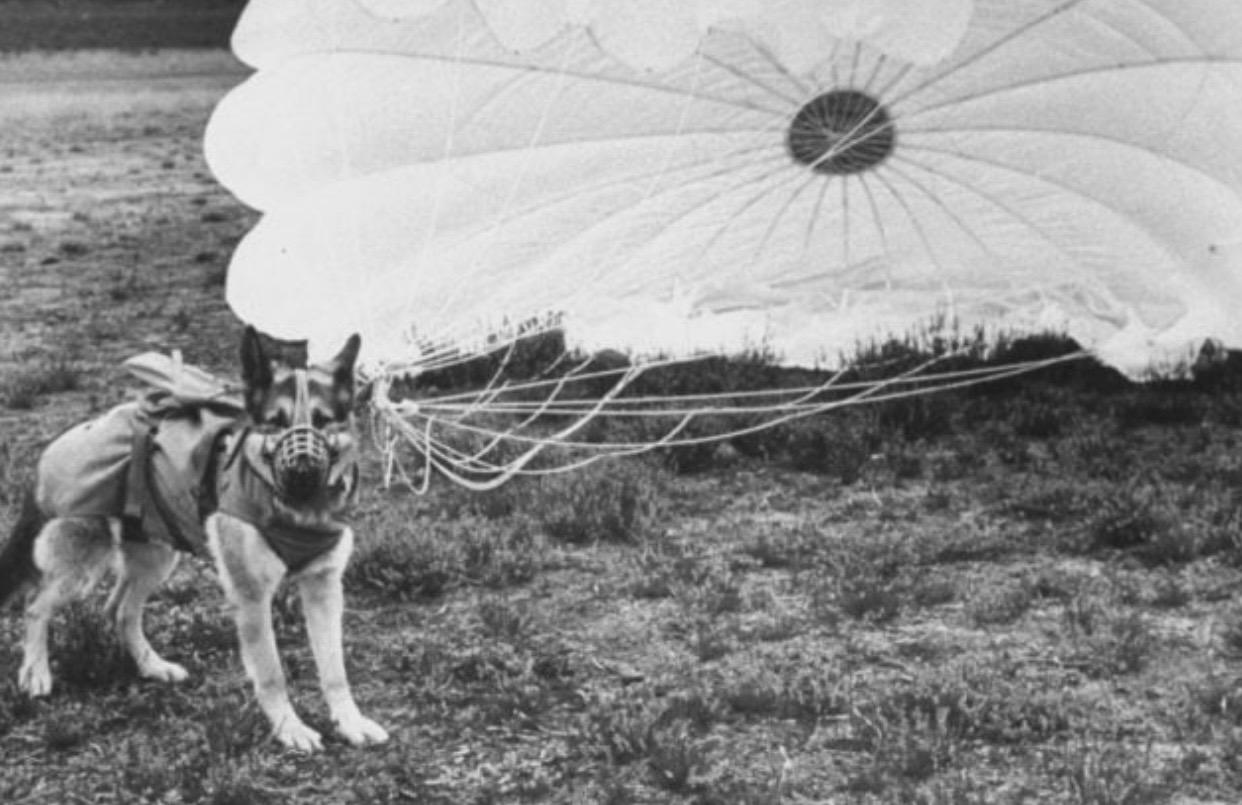
During the Second World War, dogs were used by the British Army and other Allied forces not merely as mascots but as active, working members of units, providing invaluable services that helped save countless human lives. These animals were trained for a variety of roles including sentry and guard duties, mine and booby‑trap detection, patrol work, message carrying, search and rescue, and in rare instances even parachuting into combat alongside airborne troops. The British Army’s airborne forces developed a distinctive group of what were colloquially known as “Para Dogs,” canines trained to jump from aircraft with their handlers and serve on the front lines.
Para Dogs of the 13th (Lancashire) Parachute Battalion were part of an adventurous experiment undertaken by their unit as preparations were made for the Normandy invasion. These dogs were trained to cope with warlike conditions, including the noise of aircraft and explosives, and were taught tasks that took advantage of their acute senses. Their roles included acting as an early warning system for approaching enemy forces or hidden dangers, detecting mines and booby traps by sniffing them out, standing guard at night or on patrol to alert soldiers to danger, and otherwise supporting their human comrades when the stakes were highest. The presence of such dogs was a comfort to the men; their senses and instincts often saved lives in chaotic and hostile environments.
One of the most celebrated of these paradogs was an Alsatian‑Collie mix known as Bing during his military service and as Brian to his original family. Brian came into Army service in 1944 when wartime shortages made it hard for his owners in Loughborough to feed him, so they offered him to the War Office with the understanding they could have him back after the conflict. He was sent to the Army War Dog Training School at Potters Bar and, after qualifying as a patrol dog, was posted to the Reconnaissance Platoon of the 13th Parachute Battalion. There he underwent the parachute course and became one of the few dogs to complete it successfully, earning the right to jump into combat alongside his human unit.
Brian made multiple jumps, including his first operational descent on 6 June 1944, as part of the D‑Day invasion of Normandy. On that occasion his drop into the vicinity of Ranville did not go smoothly; his parachute lines snagged him in a tree under enemy fire, leaving him suspended for hours until he was rescued by his handler Sergeant Ken Bailey. Despite being hit by enemy mortar fire and suffering superficial wounds to the chest and eye, Brian carried out his duties, standing guard for his battalion and continuing patrol work with distinction. He went on to participate in later operations, including the crossing of the Rhine in March 1945, the largest airborne operation of the war, where thousands of Allied paratroopers and their support troops landed in Germany.
The bravery, devotion, and utility of dogs such as Brian were formally recognised after the war. The People’s Dispensary for Sick Animals (PDSA) Dickin Medal, established in 1943 by Maria Dickin, founder of the British veterinary charity PDSA, is widely considered the animal equivalent of the Victoria Cross. The award honours animals that have displayed conspicuous gallantry and devotion to duty in service with the armed forces or civil defence units. Over the years since its inception, it has been awarded to pigeons famed for delivering critical messages, horses for service and transport tasks, cats for their work aboard naval vessels, and a range of dogs in a variety of theatres and roles.
Brian’s citation for the Dickin Medal, presented to him on 29 March 1947, succinctly captures his wartime contributions. It notes that “This patrol dog was attached to a Parachute Battalion of the 13th Battalion Airborne Division. He landed in Normandy with them and, having done the requisite number of jumps, became a fully‑qualified Paratrooper.” This recognition on behalf of animals who served was not just ceremonial; it acknowledged the very real risks these dogs faced, the discomforts and dangers of airborne operations, and the lifesaving work they carried out under fire.
Across the Allied forces thousands of dogs served in World War II in diverse capacities. They helped detect mines and ambushes, warned troops of incoming danger, worked as messengers between isolated units, and conducted search and rescue operations in bombed cities. Their acute senses enabled them to find hidden threats or buried survivors, saving innumerable human lives even if their contributions were not always widely recognised in official military records. The stories of para dogs like Brian, those who survived their missions and were honoured for their service, stand as powerful reminders of the crucial role that animals played in one of history’s largest and most complex conflicts.