Palmer Tyres
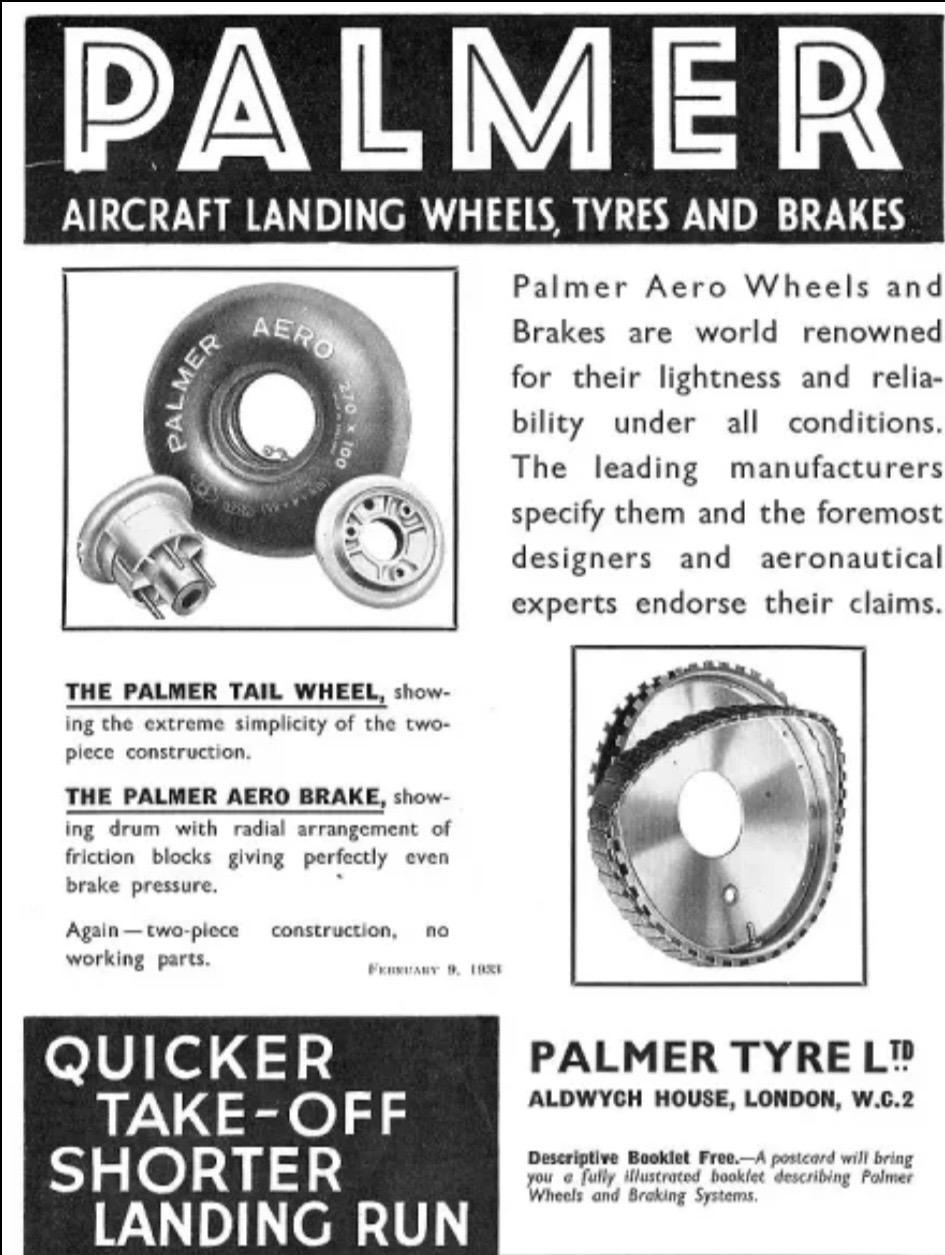
In the closing years of the nineteenth century, as cycling and motoring transformed British roads, a small but ambitious company in London began shaping a technology that would quietly revolutionize both transport and warfare. Palmer Tyre Company emerged as one of the early pioneers of corded tyre construction, and from its base at Cordwallis Works, Manor Road, Wallington, London, it built a reputation for technical innovation that would eventually extend far beyond the streets of Britain and into the skies over Europe.
The company traced its roots to the inventive energy of William Henry Palmer, who recognized that the future of tyres lay not simply in thicker rubber, but in reinforcing that rubber with strong textile cords. Early pneumatic tyres relied heavily on layers of canvas or fabric laid in criss-cross patterns. While adequate for bicycles and early motorcars, these designs struggled under increasing loads and speeds. Palmer’s approach introduced parallel cord reinforcement embedded within the rubber, distributing stresses more evenly and dramatically improving strength without proportionally increasing weight.
This was a pivotal breakthrough. Corded tyres were lighter for the same strength, more resistant to deformation, and capable of supporting greater loads. They also dissipated stress more effectively when subjected to repeated impacts. For early motorists navigating rough roads, the improvement was noticeable. But it was in aviation that the innovation proved transformative.
When the First World War erupted in 1914, aviation technology was still in its infancy. Aircraft were fragile machines made of wood and fabric, yet their operational demands were escalating rapidly. As engines grew more powerful and airframes more robust, aircraft weight increased. Landing gear, in particular, became a critical point of vulnerability. A hard landing could destroy a wheel and cripple an aircraft. Tyres had to absorb shock, bear weight, and maintain reliability in rough field conditions.
Here, Palmer’s corded tyre construction found a new and urgent purpose. War planes required tyres that were both lightweight and capable of carrying heavier loads than ever before. Every additional pound saved in tyre weight could be allocated to fuel, armament, or structural reinforcement. At the same time, tyres needed to withstand repeated take-offs and landings on improvised airstrips. The corded structure offered higher load-carrying capacity and improved resistance to blowouts compared to earlier fabric-based designs.
As the war intensified, aircraft grew larger and more complex. Bombers carried heavier payloads; reconnaissance planes flew longer distances. The aviation industry demanded tyres that could match this evolution. Palmer’s technology enabled incremental increases in load capacity without excessive bulk, supporting the rapid scaling of aircraft performance. The company became a key supplier in a wartime supply chain where reliability could mean the difference between mission success and disaster.
Between the wars, aviation continued to mature. Civil aviation expanded, and military planners prepared for the possibility of future conflicts. Tyre design kept pace with these demands. Advances in cord materials, improved rubber compounds, and refined manufacturing techniques all contributed to even greater strength-to-weight ratios. The lessons learned during wartime production fed directly into peacetime innovation, and vice versa.
When the Second World War broke out in 1939, the requirements intensified dramatically. Aircraft were now heavier, faster, and capable of carrying unprecedented payloads. Heavy bombers in particular placed extraordinary stress on landing gear systems. Tyres had to endure not only increased static loads but also the high-speed impacts of wartime operations. Again, the corded tyre principle proved indispensable. The ability to reinforce tyres internally with strong, carefully aligned cords allowed for the production of units capable of bearing substantial loads without catastrophic failure.
The evolution of warfare drove continuous refinement. As bomb loads increased and aircraft frames were strengthened, tyres had to evolve accordingly. The demand for greater load-bearing capacity was not theoretical; it was dictated by strategic necessity. Stronger tyres meant heavier aircraft could operate safely, extending range and carrying more equipment. In this way, tyre technology quietly underpinned advances in military aviation capability.
Eventually, as consolidation swept through British industry, Palmer’s independence came to an end. The company was taken over by Dunlop Rubber Company, itself a dominant force in tyre manufacturing. Yet the technological legacy of Palmer’s corded construction did not disappear. Instead, it was absorbed and further developed within a larger industrial framework, influencing broader tyre production standards in Britain and beyond.
The story of Palmer Tyres is a reminder that transformative change often occurs in components seldom celebrated. Aircraft engines, airframes, and weaponry capture the imagination, but none could function without reliable landing systems. The humble tyre, strengthened by cords devised in a London works at Wallington, played a vital role in enabling heavier loads, safer landings, and more ambitious flight operations. As wars demanded ever greater performance, corded tyre technology answered the call,