Oldest continuous military unit
The Pontifical Swiss Guard is widely regarded as the oldest continuously active military unit in the world. It has served as the personal army and protective force of the pope for more than five centuries, combining military tradition, ceremonial splendor, and fierce loyalty to the Roman Catholic Church. Officially established on January 22, 1506, it remains one of the most recognizable institutions within the Vatican and continues to protect the pope and the Apostolic Palace today.
The origins of the Guard can be traced back to the late Middle Ages when Swiss mercenaries gained an extraordinary reputation throughout Europe for their discipline, courage, and battlefield effectiveness. During the fifteenth century, the cantons of Switzerland produced some of the finest soldiers on the continent. European monarchs and rulers competed to hire Swiss troops because they were known for their loyalty, strict military organization, and fearlessness in combat.
Pope Julius II, one of the most powerful and ambitious popes of the Renaissance, decided to create a permanent corps of Swiss soldiers to defend the papacy. Julius II was known as the “Warrior Pope” because he personally led military campaigns and sought to strengthen the political and territorial power of the Papal States. Recognizing the value of Swiss mercenaries, he negotiated with the Swiss cantons to recruit a special unit for papal protection.
On January 22, 1506, a force of 150 Swiss soldiers entered Rome through the Porta del Popolo under the command of Captain Kaspar von Silenen of Lucerne. This date is officially considered the founding of the corps. The soldiers marched to the Vatican and received the blessing of Pope Julius II. From that moment onward, it became the official military bodyguard of the pope.
The most famous and defining moment in its history occurred during the Sack of Rome on May 6, 1527. At that time, troops loyal to Holy Roman Emperor Charles V invaded Rome in one of the most violent attacks in Renaissance history. Thousands of imperial soldiers stormed the city, looting churches, murdering civilians, and destroying buildings. During the chaos, 189 guards defended Pope Clement VII at Saint Peter’s Basilica.
The guards fought desperately against overwhelming odds. Of the 189 guardsmen, 147 were killed while protecting the pope. Their sacrifice allowed Clement VII to escape through the secret Passetto di Borgo, a fortified passageway connecting the Vatican to Castel Sant’Angelo. The surviving guards escorted the pope to safety while holding off enemy forces. This heroic defense became legendary and remains central to the identity of the corps. Every year on May 6, new recruits are sworn in during a ceremony commemorating the fallen guards of 1527.
Today the unit is much smaller than historical armies but remains an elite military organization. The modern corps usually consists of around 135 members. Their duties include protecting the pope, guarding entrances to Vatican City, accompanying the pope on international trips, and providing security during papal ceremonies and public appearances.
To join, candidates must meet strict requirements. A recruit must be a male Swiss citizen, Catholic, unmarried at the time of entry, between specific age limits, physically fit, and of excellent moral character. He must also have completed basic military training in the Swiss Army. These requirements reflect the Guard’s traditional role as both a military and religious institution.
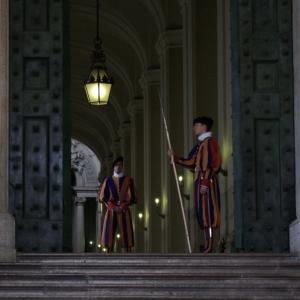
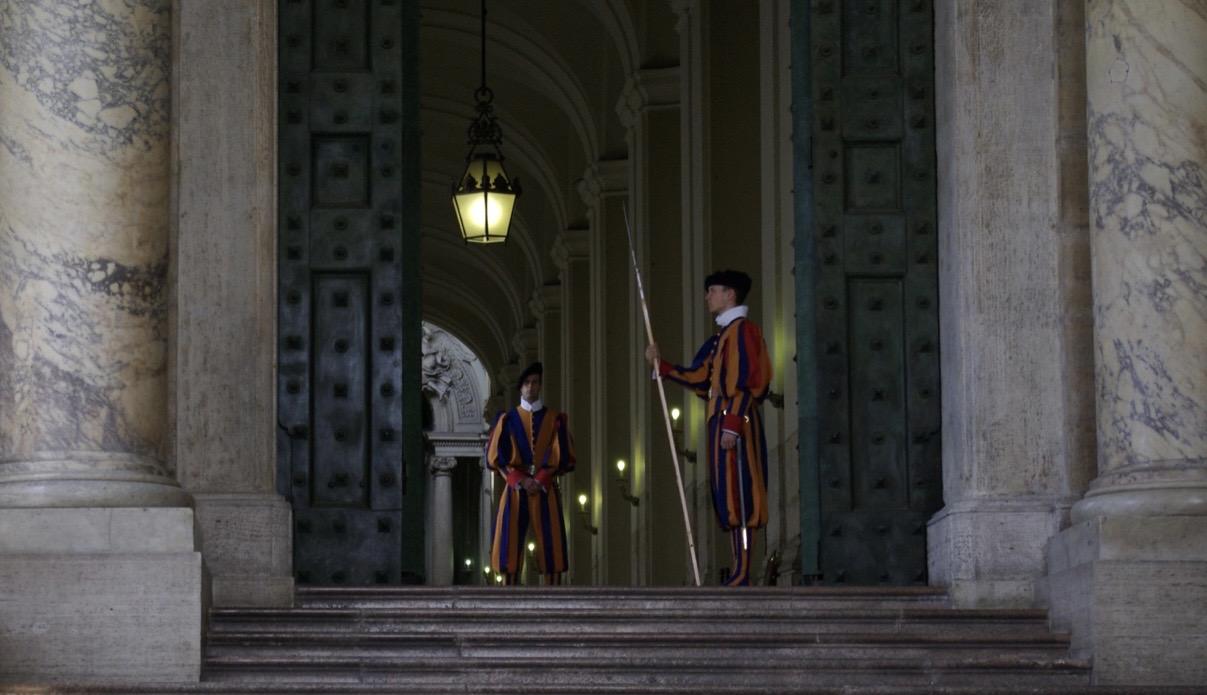
One of the most famous aspects of the corps is its striking uniform. The brightly colored blue, red, orange, and yellow Renaissance-style uniform is often mistakenly attributed to the artist Michelangelo, but historians generally believe it was designed centuries later and inspired by Renaissance artistic styles. The current design is largely credited to Commandant Jules Repond, who modernized the appearance in the early twentieth century while preserving historical elements.
The guards carry traditional weapons such as halberds and ceremonial swords during official events, giving them their distinctive medieval appearance. However, they are also professionally trained in modern security techniques and use contemporary firearms when necessary. Behind the ceremonial image lies a highly trained protective force responsible for the safety of the pope and Vatican officials.
The organization is not merely ceremonial. In 1981, members played a critical role during the assassination attempt against Pope John Paul II in Saint Peter’s Square. After Mehmet Ali Ağca shot the pope, guards quickly responded, secured the area, and assisted in protecting the wounded pontiff. This event demonstrated that despite its historical traditions, the corps still functions as an active security service.
Another fascinating feature is the oath ceremony. Each new recruit places his left hand on the banner while raising three fingers of his right hand, symbolizing the Holy Trinity. The recruit swears to faithfully, loyally, and honorably serve the reigning pope, even sacrificing his life if necessary. The ceremony is conducted in several languages, reflecting Switzerland’s multilingual culture.
The Vatican itself is the smallest independent state in the world, and the corps serves as its de facto military force. Although Vatican City no longer fights wars, it continues to represent the sovereignty and security of the Holy See. Technically, the Guard is not part of the Italian military or Swiss military, but an independent armed corps serving the pope directly.
The commander holds the rank of colonel and oversees all operations, training, discipline, and ceremonial functions. Over the centuries, the organization has adapted to changing political and security realities while preserving many ancient customs and traditions.
The barracks are located within Vatican City near Saint Peter’s Basilica. Guards live inside the Vatican during their service, creating a close-knit military community with strong traditions and discipline. Historically, guards were forbidden from marrying during their early years of service, though senior guards who meet certain conditions may now marry after a number of years.
Throughout history, the corps has witnessed many major events involving the papacy, including papal coronations, conclaves, funerals, and world wars. During World War II, the Vatican maintained neutrality, but the guards remained active in protecting Pope Pius XII and securing Vatican territory amid fears of Nazi occupation.
Its endurance for more than 500 years is remarkable because many other famous military units disappeared through war, revolution, or political change. Despite the fall of kingdoms, empires, and states across Europe, the corps survived the Renaissance, the Reformation, Napoleonic invasions, Italian unification, and the modern era.
Today, tourists visiting Vatican City often photograph the guards because of their historic uniforms and ceremonial duties. Yet behind the colorful appearance lies a professional military tradition built upon sacrifice, discipline, loyalty, and religious devotion.